|

Carney speech: Monetary policy can be more nimble than fiscal policy
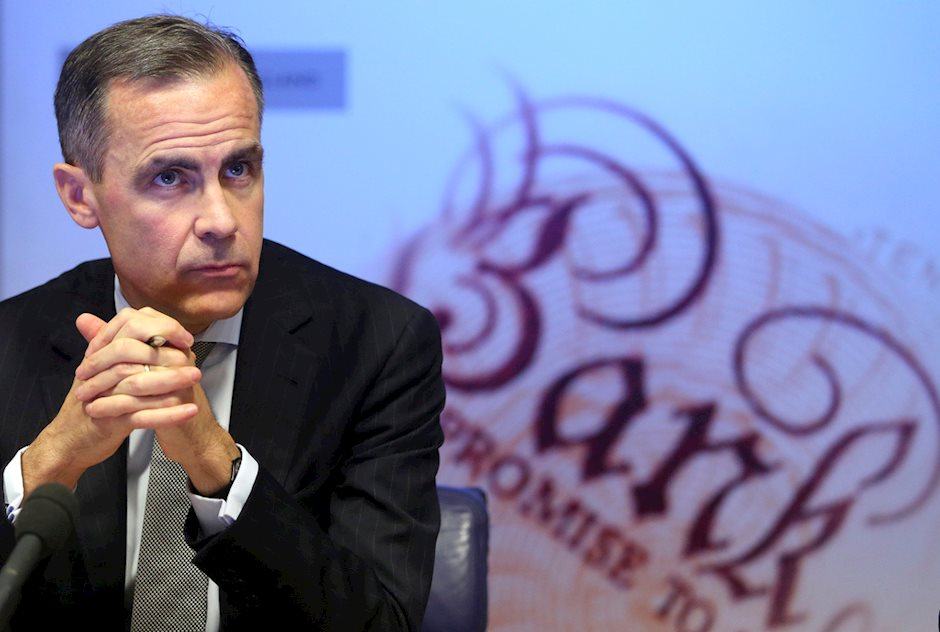
Following the Bank of England's decision to keep its policy rate unchanged at 0.75%, Governor Mark Carney is responding to questions from the press with key quotes, via Reuters, found below.

"Monetary policy can be more nimble than fiscal policy."

"Fiscal policy is an upside risk to UK growth outlook."

"Temporary factors are the biggest driver of expected short-term fall in UK inflation."

"We would look through temporary factors lowering inflation."

"If downside risks emerge to UK economy, there may be a need to provide reinforcement but this is not pre-committing."

Related articles

Bank of England leaves policy rate unchanged at 0.75% in November as expected

In a widely expected decision, the Bank of England's Monetary Policy Committee held the policy rate unchanged at 0.75%. The asset purchase facility remained steady at €435 billion as well. On a dovish note, 2 members of the Monetary Policy Committee voted to cut the policy rate. 

Bank of England QIR: GDP growth in 2019 +1.4% (Aug. forecast +1.3%), 2020 +1.2% (Aug. +1.3%)

In its latest Quarterly Inflation Report (QIR), the Bank of England (BoE) announced that the Gross Domestic Product (GDP) in 2019 is now expected to grow 1.4%, slightly higher than the 1.3% announced in August's QIR. On the other hand, the BoE lowered 2020 GDP growth forecast to 1.2% from 1.3%.

About Mark Carney 

Mark Carney is Governor of the Bank of England and Chairman of the Monetary Policy Committee, Financial Policy Committee and the Board of the Prudential Regulation Authority. His appointment as Governor was approved by Her Majesty the Queen on 26 November 2012. The Governor joined the Bank on 1 July 2013.

Author

Eren Sengezer

As an economist at heart, Eren Sengezer specializes in the assessment of the short-term and long-term impacts of macroeconomic data, central bank policies and political developments on financial assets.


More from Eren Sengezer
Share:

Editor's Picks

EUR/USD keeps the bid bias just over 1.1800

EUR/USD has started the week on a positive foot, hovering around the 1.1800 region in the latter part of Monday’s session. The pair’s recovery comes on the back of a decent decline in the US Dollar, as investors keep their attention on the evolving US–EU trade relationship after President Trump’s announcement of sweeping global tariff hikes.

GBP/USD looks stuck around 1.3500 amid firm gains

GBP/USD is pushing further north on Monday, revisiting the 1.3500 hurdle and beyond. Cable’s uptick is largely being fuelled by the broader softness in the Greenback, amid lingering uncertainty around tariffs.

Gold pops above $5,200, four-week highs

Gold is holding onto its bullish tone on Monday, reaching new multi-week highs just past the $5,200 mark per troy ounce. Fresh trade-war concerns, coupled with rising geopolitical tensions in the Middle East, are keeping demand for the yellow metal well on the rise.

Crypto Today: Bitcoin, Ethereum, XRP intensify sell-off as tariff uncertainty weighs

Bitcoin, Ethereum and Ripple are trading amid increasing selling pressure at the time of writing on Monday, as investors react to fresh trade uncertainty over US President Donald Trump’s push for more tariffs.

Supreme Court nixes tariffs, Trump teases 15% global tariff

On February 20th, the Supreme Court ruled that Trump’s global tariffs under IEEPA authority were unconstitutional, effectively nullifying the framework. However, the relief was short-lived. Within hours, Trump floated a 15% blanket tariff under an alternative legal authority.

XRP recovers slightly as bearish sentiment dominates crypto market

Ripple is rising above $1.40 at the time of writing on Monday amid fresh tariff-triggered headwinds in the broader cryptocurrency market. The sell-off to $1.33, the token’s intraday low, can be attributed to macroeconomic uncertainty, geopolitical tensions and risk-averse sentiment among other factors.














