Canadian Dollar whipsaws as tariff concerns prompt BoC policy planning shift
- The Canadian Dollar fell and then rose 0.6% on Thursday.
- The BoC has announced changes to how it approaches policy guidance.
- Ongoing concerns about the US’s lopsided trade approach has policymakers on edge.


The Canadian Dollar (CAD) whipsawed on Thursday, rising and then falling six-tenths of a percent as Loonie traders digest new policy guidance plans from the Bank of Canada (BoC). The shift in approach was announced by BoC Governor Tiff Macklem, who was speaking at the Calgary Economic Development meeting in Calgary, noted that the US’s hamhanded dealings in on-again, off-again trade tariffs has prompted the Canadian central bank to take a looser, faster approach to dealing in rates with less forecasting to avoid inaccuracies in its track record.
The BoC recently trimmed interest rates for a seventh consecutive call, slashing rates even as the Canadian economy heads into another inflation upturn. The string of inflationary data continued on Thursday, with Canadian Industrial Product Prices and the Raw Material Price Index both accelerating more than expected in February.
Daily digest market movers: CAD plunges and rallies as BoC announces policy changes
- BoC Governor Tiff Macklem announced the Bank of Canada would be shifting its rate-call approach, reducing its forecasts in order to maintain accuracy.
- The stance shift from the BoC is meant to enable the Canadian central bank to react immediately to shocks in Canadian data as fallout from US tariffs weigh on the economy.
- Despite clear and obvious concerns warranting an immediate structural shift from the BoC, Governor Macklem insisted there’s no obvious signs of problems in Canadian data.
- Canadian Industrial Product Prices rose 0.4% MoM in February, slightly above the expected 0.3%. January’s hot print was revised slightly lower to 1.4%.
- The Canadian Raw Material Price Index also accelerated in February, rising another 0.3% MoM compared to the expected -0.3% contraction. January’s raw index was also revised slightly lower, to a still eye-watering 3.5%.
Canadian Dollar price forecast
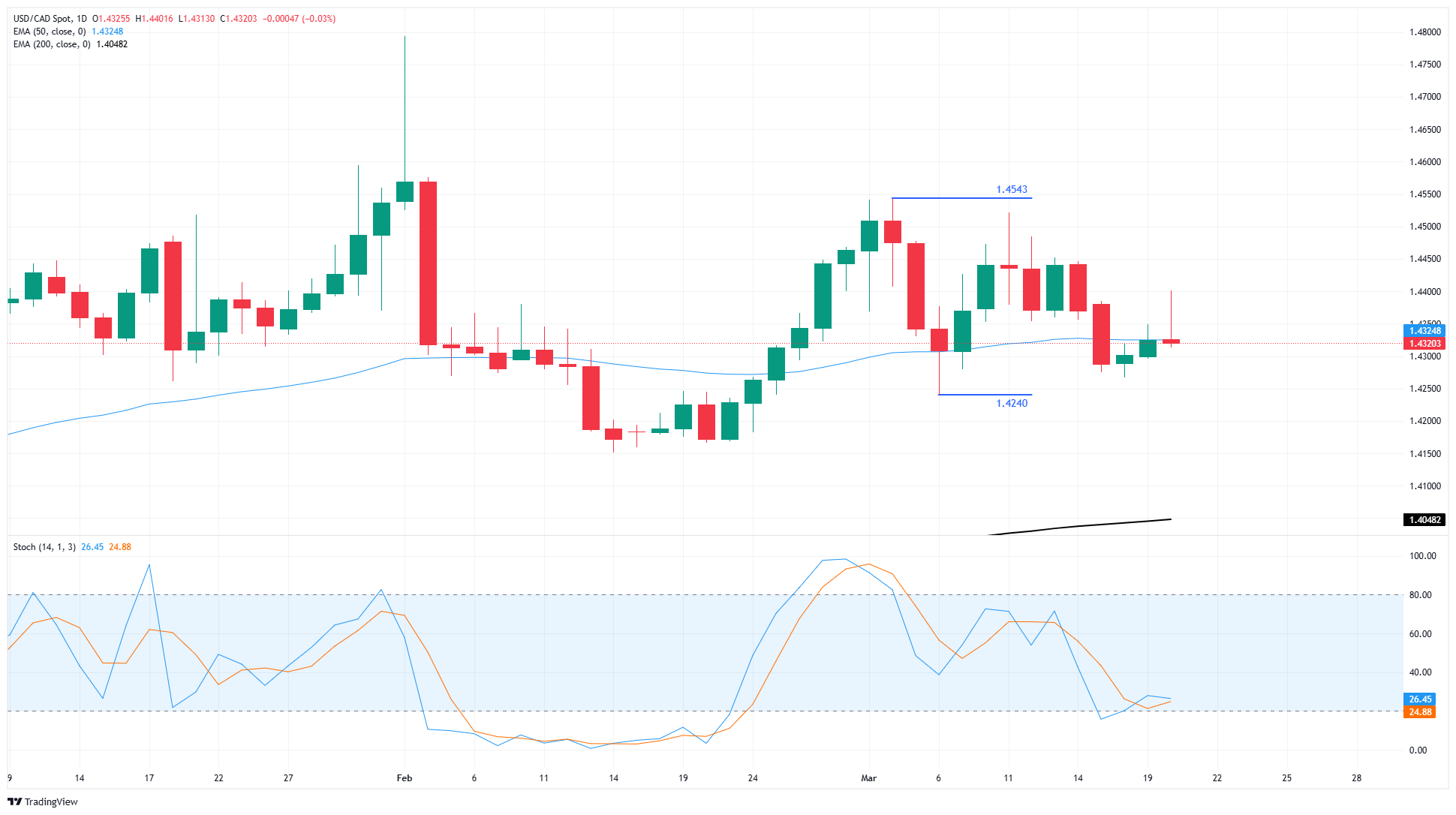
Thursday’s whipsaw leaves the Canadian Dollar still stuck in familiar territory as the USD/CAD pair continues to churn near the 1.4300 handle. The pair briefly tapped the 1.4400 level in the early hours, before facing a downside rejection amid renewed Loonie bidding.
USD/CAD is still trading well within its ongoing sideways channel as price action grinds laterally. However, Loonie bulls will be looking to drag the pair into fresh lows at March’s bottom bids near 1.4240.
USD/CAD daily chart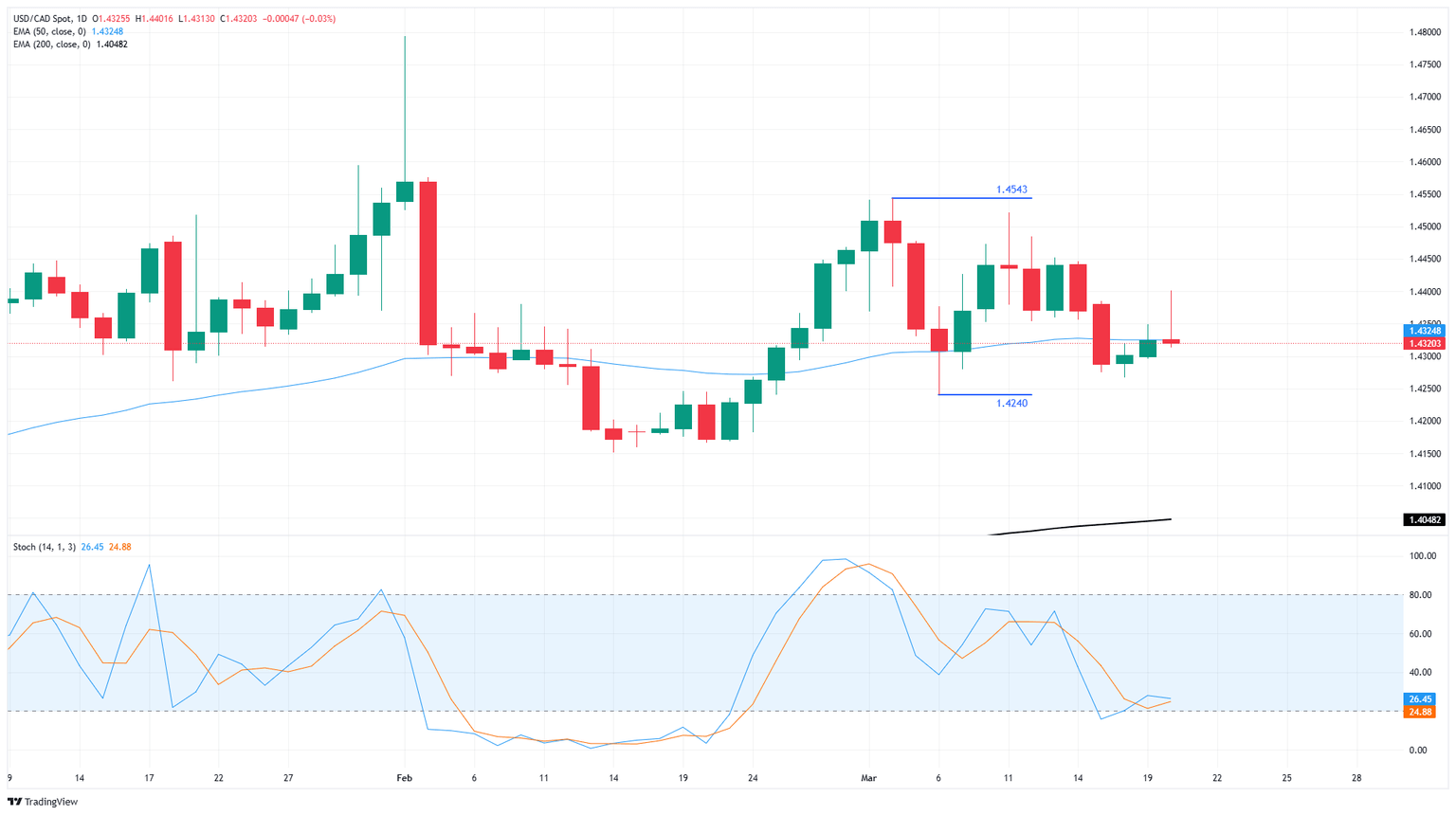
Canadian Dollar FAQs
The key factors driving the Canadian Dollar (CAD) are the level of interest rates set by the Bank of Canada (BoC), the price of Oil, Canada’s largest export, the health of its economy, inflation and the Trade Balance, which is the difference between the value of Canada’s exports versus its imports. Other factors include market sentiment – whether investors are taking on more risky assets (risk-on) or seeking safe-havens (risk-off) – with risk-on being CAD-positive. As its largest trading partner, the health of the US economy is also a key factor influencing the Canadian Dollar.
The Bank of Canada (BoC) has a significant influence on the Canadian Dollar by setting the level of interest rates that banks can lend to one another. This influences the level of interest rates for everyone. The main goal of the BoC is to maintain inflation at 1-3% by adjusting interest rates up or down. Relatively higher interest rates tend to be positive for the CAD. The Bank of Canada can also use quantitative easing and tightening to influence credit conditions, with the former CAD-negative and the latter CAD-positive.
The price of Oil is a key factor impacting the value of the Canadian Dollar. Petroleum is Canada’s biggest export, so Oil price tends to have an immediate impact on the CAD value. Generally, if Oil price rises CAD also goes up, as aggregate demand for the currency increases. The opposite is the case if the price of Oil falls. Higher Oil prices also tend to result in a greater likelihood of a positive Trade Balance, which is also supportive of the CAD.
While inflation had always traditionally been thought of as a negative factor for a currency since it lowers the value of money, the opposite has actually been the case in modern times with the relaxation of cross-border capital controls. Higher inflation tends to lead central banks to put up interest rates which attracts more capital inflows from global investors seeking a lucrative place to keep their money. This increases demand for the local currency, which in Canada’s case is the Canadian Dollar.
Macroeconomic data releases gauge the health of the economy and can have an impact on the Canadian Dollar. Indicators such as GDP, Manufacturing and Services PMIs, employment, and consumer sentiment surveys can all influence the direction of the CAD. A strong economy is good for the Canadian Dollar. Not only does it attract more foreign investment but it may encourage the Bank of Canada to put up interest rates, leading to a stronger currency. If economic data is weak, however, the CAD is likely to fall.
Author
Joshua Gibson
FXStreet
Joshua joins the FXStreet team as an Economics and Finance double major from Vancouver Island University with twelve years' experience as an independent trader focusing on technical analysis.