Canadian Dollar rises as PPI strengthens
- USD/CAD dips as traders digest Fed minutes, signaling cautious stance on rate cuts.
- Trump’s new tariffs on Canadian lumber add fresh trade uncertainty.
- Markets eye Canadian Retail Sales, BoC Governor Macklem’s speech for further cues.


The Canadian Dollar appreciated against the Greenback on Thursday. The USD/CAD dropped below the 1.4200 figure, and the Greenback got battered due to investors digesting the latest Federal Open Market Committee (FOMC) minutes.
Canada’s economic docket revealed that Producer Prices exceeded market estimates and December’s figures in January. Other data showed that housing prices were mixed monthly and yearly.
Regarding tariffs, US President Donald Trump announced plans to enact tariffs on lumber and forest products next month. This is significant for Canada, one of the world's leading producers and exporters.
In the meantime, the Fed’s latest minutes showed that officials are concerned about Trump’s administration's trade and immigration policies. Policymakers noted that some inflation expectations had risen recently, adding that maintaining policy firm is appropriate.
Traders would be eyeing the release of Canadian Retail Sales on Friday and Bank of Canada (BoC) Governor Tiff Macklem's speech. At the same time, S&P Global Flash PMIs will update the status of business activity in the US.
Daily digest market movers: Canadian Dollar rallie amid mixed US data
- Canada’s Producer Price Index (PPI) rose 1.6% MoM in January, above forecasts of 0.8%. In the twelve months to January, the PPI increased 5.8%, up from 4.1%.
- US Initial Jobless Claims for the week ending February 15 increased by 219K, exceeding forecasts of 215K.
- Interest rate differentials between Canada and the United States are putting a lid on the Loonie’s gains.
- Elevated inflation reports in Canada could prevent the BoC from lowering rates in check following the release of January’s CPI data. In that outcome, the USD/CAD could aim lower as the Canadian Dollar appreciates versus the Greenback.
USD/CAD price forecast: Canadian Dollar gathers traction and appreciates on soft US Dollar
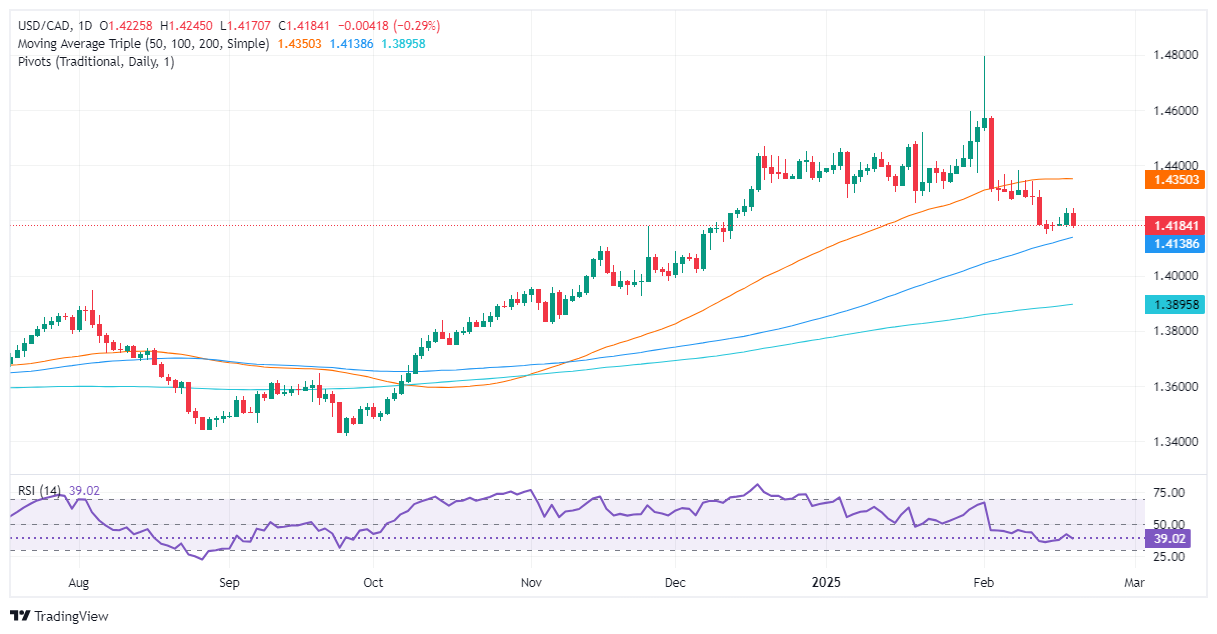
The USD/CAD uptrend has lost steam after the pair peaked near 1.4800. Since then, sellers have taken over, pushing prices below the 50-day Simple Moving Average (SMA) at 1.4338 and clearing the January 20 daily low of 1.4260, a crucial level for buyers. Further downside lies ahead if bears push spot prices below the 100-day SMA at 1.4111.
Otherwise, if buyers lift USD/CAD past 1.4300, they must reclaim the 50-day SMA to remain hopeful of higher prices.
Bank of Canada FAQs
The Bank of Canada (BoC), based in Ottawa, is the institution that sets interest rates and manages monetary policy for Canada. It does so at eight scheduled meetings a year and ad hoc emergency meetings that are held as required. The BoC primary mandate is to maintain price stability, which means keeping inflation at between 1-3%. Its main tool for achieving this is by raising or lowering interest rates. Relatively high interest rates will usually result in a stronger Canadian Dollar (CAD) and vice versa. Other tools used include quantitative easing and tightening.
In extreme situations, the Bank of Canada can enact a policy tool called Quantitative Easing. QE is the process by which the BoC prints Canadian Dollars for the purpose of buying assets – usually government or corporate bonds – from financial institutions. QE usually results in a weaker CAD. QE is a last resort when simply lowering interest rates is unlikely to achieve the objective of price stability. The Bank of Canada used the measure during the Great Financial Crisis of 2009-11 when credit froze after banks lost faith in each other’s ability to repay debts.
Quantitative tightening (QT) is the reverse of QE. It is undertaken after QE when an economic recovery is underway and inflation starts rising. Whilst in QE the Bank of Canada purchases government and corporate bonds from financial institutions to provide them with liquidity, in QT the BoC stops buying more assets, and stops reinvesting the principal maturing on the bonds it already holds. It is usually positive (or bullish) for the Canadian Dollar.
Author
Christian Borjon Valencia
FXStreet
Christian Borjon began his career as a retail trader in 2010, mainly focused on technical analysis and strategies around it. He started as a swing trader, as he used to work in another industry unrelated to the financial markets.