Breaking: RBNZ unchanged and sticks to guidance of March 16
- The Reserve Bank of New Zealand holds OCR steady at 0.25%, introducing FLP.
- RBNZ sees average OCR In 1Q 2021 at 0.25%.
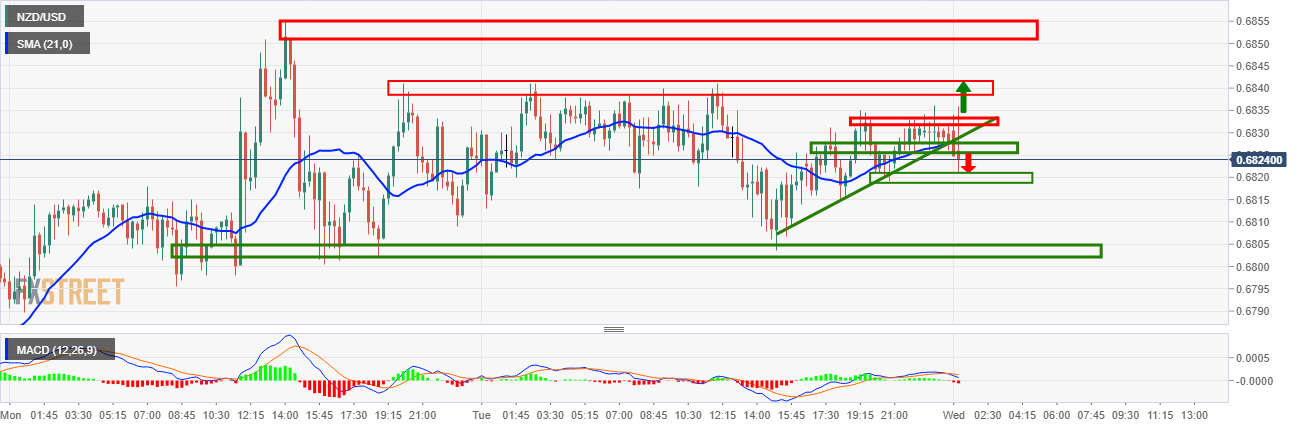
- NZD/USD little changed in a muted reaction between support and resistance 0.6800/40.


The Reserve Bank of New Zealand has presented its Monetary Policy Statement (MPS) today which was expected to be all about the RBNZ unveiling a Funding for Lending Programme (FLP).
The FLP is a scheme that will be offering funds directly to the banks at a rate near OCR.
Markets are especially looking for comments about the likelihood of a negative OCR.
RBNZ MPS
Says prepared to reduce the OCR if required.
Says agreed to provide additional monetary stimulus to the economy in order to meet its consumer price inflation and employment remit.
Says we expect an ongoing increase in unemployment as the economy adjusts
Says consumer price inflation is also projected to remain at the lower-end of the remit target range for a period
Says agreed that monetary policy will need to remain stimulatory for a long time
Says committee agreed it must remain prepared to provide additional support if necessary
The RBNZ minutes
The committee reached a consensus to hold cash rate;
Committee reached a consensus to maintain existing LSAP programme of maximum nz$100 bln by June 2022;
Committee reached a consensus to direct the bank to implement an flp in early december 2020;
The banking system is on track to be operationally ready for negative interest rates by year-end;
Committee agreed that it was prepared to lower the OCR to provide additional stimulus if required;
Committee reaffirmed that an FLP, a lower or negative OCR, purchases of foreign assets, and interest rate swaps remain under consideration;
Members agreed with the staff assessment that an flp would be an effective way to provide additional monetary stimulus;
Members agreed that flp was the best tool to deploy at this time given the committee’s principles for alternative monetary policy instruments;
Committee noted that other prudential policy settings could be adjusted to reduce risks to the financial system if required;
Members noted that the reserve bank will consult on the possible reintroduction of limits on high loan-to-value ratio lending, in order to slow the build-up of riskier lending on bank balance sheets;
There was less regret associated with the risk of temporarily overshooting their policy remit given economic situation;
Recent news on vaccine developments is positive;
There were still challenges to overcome before widespread vaccine availability could be achieved.
NZD/USD reaction
The price is steady at around 0.6830 on the as expected outcome.
April rate cuts are already baked into the price which had been consolidating in the low 0.68s ahead of today’s MPS.
The kiwi has been tracking performances in global stocks.
''If we see more strength, that speaks to more NZD strength on the general bounce in risk appetite and offshore equity hedging flows,'' analysts at ANZ argued.
''The Fed’s new average inflation targeting framework means that policy will be easy for some time even with an effective vaccine, and that should be a long term positive for risk too.''
From here, the analysts at ANZ said that ''much will depend on how the data and virus news pans out into the New Year and the effectiveness of the FLP at lowering retail interest rates (the programme’s measure of success).''
''One thing is clear'', they added, ''aggressive stimulus doesn’t make sense forever and policy will become more nuanced in time.''
About the RBNZ's MPS
The New Zealand Reserve Bank publishes its Monetary Policy Statement (MPS) quarterly.
Each Monetary Policy Statement must set out: how the Reserve Bank proposes to achieve its targets; how it proposes to formulate and implement monetary policy during the next five years; and how monetary policy has been implemented since the last Monetary Policy Statement.
Author
FXStreet Team
FXStreet

















