Beyond EVs: Tesla's AI pivot and the future of TSLA

Tesla has unveiled its groundbreaking Cybercab robotaxi, a fully autonomous vehicle that marks a significant shift in the company’s strategy. At the “We, Robot” event held at Warner Bros. Studios, Elon Musk introduced this driverless innovation, signaling Tesla’s ambition to lead in robotics and artificial intelligence (AI). This move comes at a critical juncture for Tesla, as its electric vehicle (EV) business faces increasing competition and a softening market. The Cybercab represents a bold step towards a future where Tesla’s revenue streams extend far beyond EVs. But will this ambitious gamble pay off? And how will it impact Tesla’s share price and its position in the tech landscape? Let's explore the implications of this game-changing development.
The end of driving? Tesla’s bold vision for the future of transportation
Elon Musk has outlined a visionary future for transportation, one where autonomous vehicles drastically reduce traffic accidents and create a more relaxed, efficient commuting experience. In this futuristic world, cars will become "comfortable little lounges" where passengers can work or unwind while traveling to their destinations. Musk even envisions parking lots being transformed into parks, and personal vehicle ownership greatly diminishing.
The Tesla Cybercab—a two-door autonomous vehicle—is central to this vision and is considered Tesla’s most significant milestone since the Model 3’s debut in 2017. Expected to be priced below $30,000, the Cybercab will feature no steering wheel or pedals, and it will utilize inductive charging. Alongside the Cybercab, Tesla has also introduced the Robovan, a larger autonomous shuttle capable of carrying up to 20 passengers.
Musk is known for his ambitious timelines and has predicted that Cybercab production could begin before 2027, though there’s no specific timeline for the Robovan. If Tesla can bring these vehicles to market at a competitive price, it could dramatically accelerate the adoption of autonomous technology and reshape the transportation landscape.
Tesla's autonomous ride-hailing vision: A new era of mobility
Autonomous ride-hailing has been a cornerstone of Elon Musk’s vision for Tesla since he first introduced the concept in 2019. Musk foresees a future where driverless vehicles redefine transportation, aiming to transform both the roads and the way we move. His goal is to create a world where passengers are seamlessly shuttled around by fully autonomous vehicles, which will serve as the backbone of Tesla’s new business model.
Musk has emphasized that the success of Tesla’s autonomous vehicle technology is vital to the company’s long-term growth and market valuation. He has even projected that the widespread deployment of self-driving cars, coupled with advances in robotics, could boost Tesla’s market value to $30 trillion—nearly 40 times its current level.
The Cybercab is part of Musk’s larger strategy to position Tesla as a leader in AI, robotics, and full transportation autonomy. This strategy is becoming increasingly central to Tesla’s identity, especially as its EV lineup ages, and the company faces challenges, including a 10% workforce reduction and significant cuts to its charging team.
A two-part autonomous ride-hailing business model
Tesla’s autonomous ride-hailing business could operate on two fronts. The first involves Tesla running its own fleet of robotaxis through a dedicated Tesla ride-hailing app. This would allow the automaker to compete directly with services like Uber and Lyft, but with the significant advantage of fully autonomous vehicles.
The second part of Musk’s strategy resembles the models of companies like Uber or Airbnb, with a unique twist. Tesla owners whose vehicles are equipped with full self-driving (FSD) technology will be able to add their cars to Tesla’s ride-hailing network, earning extra income when their vehicles are not in use. Tesla will take a 25% to 30% commission on these earnings, similar to the fee structure of other app-based marketplaces like Apple's App Store.
Bottom line: Autonomous driving – Tesla’s future
For Musk, autonomous driving is not just an innovation—it’s the future of Tesla. Investors have long viewed Tesla not merely as a car manufacturer but as a technology company with enormous potential in AI and automation.
Successfully bringing autonomous vehicles to market could have profound effects on the transportation industry. Tesla could democratize access to personal transportation and reduce traffic congestion by offering affordable and reliable autonomous vehicles. However, the company must overcome significant hurdles, including navigating complex regulatory environments, resolving technological challenges, and competing with rivals such as Alphabet’s Waymo and General Motors’ Cruise.
Tesla’s future may depend more on its success in the autonomous vehicle space than on its EV sales. The company’s performance in advancing self-driving technology could significantly impact its stock price in the coming years. Any delays or setbacks in achieving its ambitious goals could dampen investor confidence and lead to a decline in share value.
This shift in focus comes as Tesla faces headwinds in the EV market, with increased competition and slowing demand. As of Friday, October 11, before the U.S. market opened, despite a remarkable 5-year growth of 1,344%, Tesla’s stock had dipped 3.88% since the start of 2024 and 9.21% over the past year.
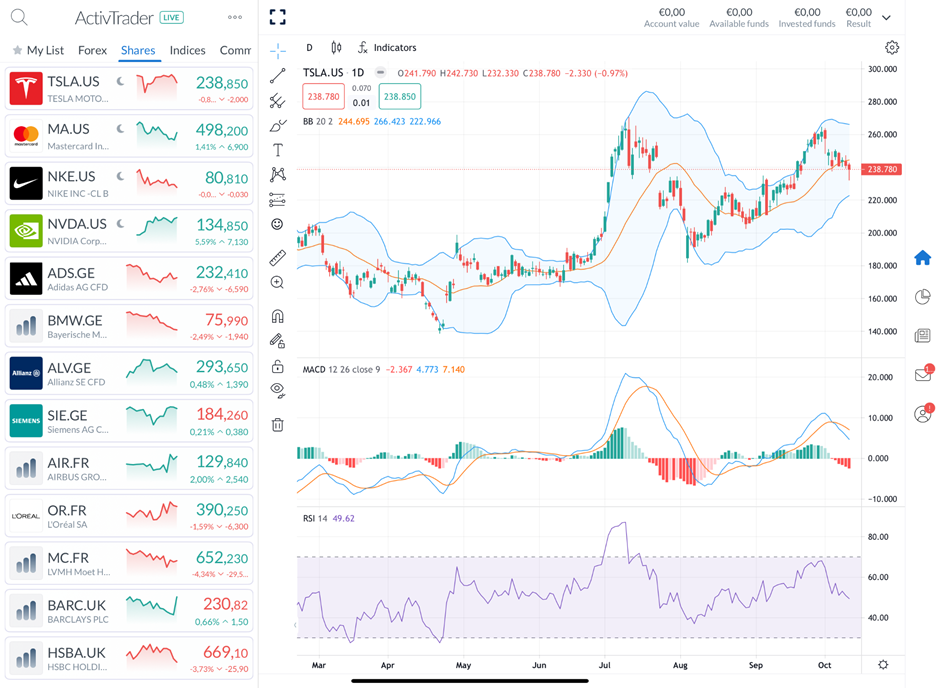
Daily Tesla Chart with 3 Technical Indicators (Bollinger Bands, MACD, and RSI) - Source: ActivTrades’ Online Trading Platform
The information provided does not constitute investment research. The material has not been prepared in accordance with the legal requirements designed to promote the independence of investment research and as such is to be considered to be a marketing communication.
All information has been prepared by ActivTrades (“AT”). The information does not contain a record of AT’s prices, or an offer of or solicitation for a transaction in any financial instrument. No representation or warranty is given as to the accuracy or completeness of this information.
Any material provided does not have regard to the specific investment objective and financial situation of any person who may receive it. Past performance is not a reliable indicator of future performance. AT provides an execution-only service. Consequently, any person acting on the information provided does so at their own risk.
Stay up to date with what's moving and shaking on the world's markets and never miss another important headline again! Check ActivTrades daily news and analyses here.
Author
Carolane de Palmas
ActivTrades
Carolane graduated with a Masters in Corporate Finance & Financial Markets and got the AMF Certification (Financial Markets Regulator in France). Afterward, she became an independent trader, investing mostly in European and American stocks/indices.