Australian Dollar gathers strength on softer US Dollar, investors await US PMI data
- The Australian Dollar holds positive ground on Thursday.
- The Aussie edges higher as Australian PMI reading has maintained expansion in June.
- Investors await the advanced US S&P Global PMI data, which is due on Friday.


The Australian Dollar (AUD) trades with mild gains in Thursday’s early European session. The Aussie edges higher after the recent Australian Judo Bank PMI report suggested that business activity is still growing despite a slower pace than in March and April. Furthermore, the Reserve Bank of Australia’s (RBA) hawkish hold on Tuesday is likely to underpin the AUD in the near term.
However, the escalating geopolitical tensions in the Middle East after Israeli officials reiterated that the country is ready for an all-out war against Hezbollah, might boost safe-haven currencies like the US Dollar (USD). The advanced US S&P Global Manufacturing and Services PMI will take center stage on Friday. If the US business activity showed an improvement in June, this could further support the Greenback and act as a headwind for the pair.
Daily Digest Market Movers: Australian Dollar remains strong after the country’s PMI data
- Advanced Australia's Judo Bank Composite PMI declined in June to 50.6 from 52.1 in May. The Manufacturing PMI dropped to 47.5 in June from 49.7 in the previous reading, weaker than the 50.6 expected. The Services PMI fell to a five-month low of 51.0 in June compared to 51.2 prior, according to the Judo Bank and S&P Global.
- US Initial Jobless Claims for the week ending June 15 rose by 238K, compared to the previous reading of 243K, above the market consensus of 235K.
- US Building Permits dropped by 3.6% MoM in May from 1.44 million to 1.386 million, while Housing Starts for the same period fell by 5.5% from 1.352 million to 1.277 million.
- Richmond Fed President Tom Barkin said on Thursday that the central bank is well-positioned with necessary firepower for job, but will have to maintain a strict data-dependent approach before considering cutting rates.
- Minneapolis Fed President Neel Kashkari noted that it could take one to two years for inflation to return to the Fed’s 2% target, per Reuters.
Technical Analysis: AUD/USD’s constructive bias remains in place
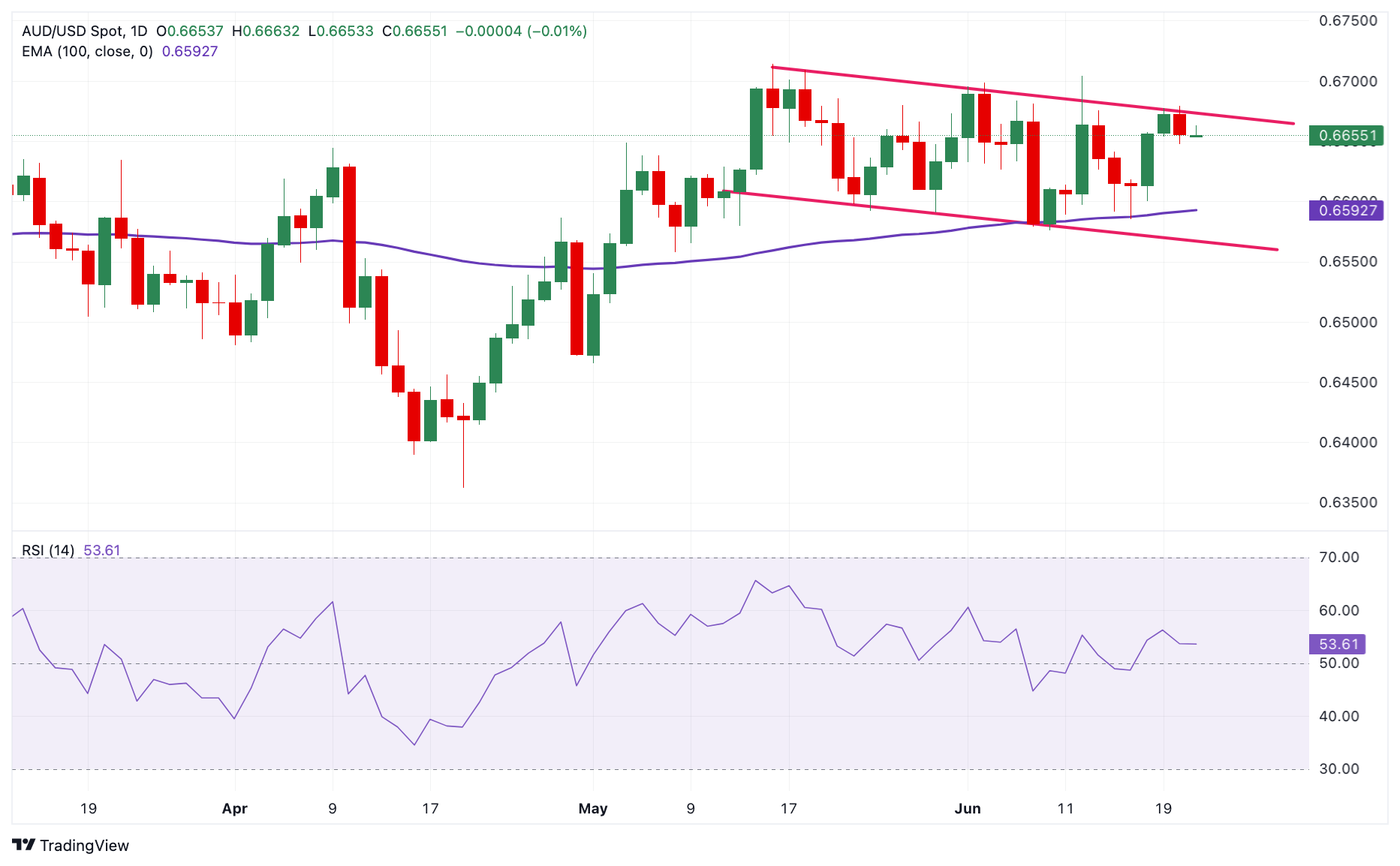
The Australian Dollar trades on a stronger note on the day. The AUD/USD pair has remained stuck within a descending trend channel since May 14. The pair maintains a positive outlook beyond the 100-day Exponential Moving Average (EMA) on the daily chart. The 14-day Relative Strength Index (RSI) continues to show bullish momentum, suggesting resistance is more likely to hold than to break.
A decisive break above 0.6675 (the upper boundary of the descending trend channel) could send the pair up to the 0.6700 round mark en route to 0.6760 (high of January 4).
In the bearish case, the key contention level for AUD/USD is seen at 0.6592 (100-day EMA) A breach of the mentioned level will see more loss to 0.6565 (the lower limit of the channel). The additional downside filter to watch is 0.6510, a low of March 22, followed by 0.6465, a low of May 1.
Australian Dollar price today
The table below shows the percentage change of Australian Dollar (AUD) against listed major currencies today. Australian Dollar was the weakest against the Euro.
| USD | EUR | GBP | CAD | AUD | JPY | NZD | CHF | |
| USD | -0.11% | -0.02% | -0.05% | -0.08% | -0.03% | -0.03% | -0.03% | |
| EUR | 0.11% | 0.09% | 0.06% | 0.03% | 0.09% | 0.08% | 0.06% | |
| GBP | 0.01% | -0.09% | -0.04% | -0.06% | 0.00% | -0.01% | -0.02% | |
| CAD | 0.05% | -0.04% | 0.04% | -0.02% | 0.03% | 0.03% | -0.01% | |
| AUD | 0.08% | -0.02% | 0.06% | 0.03% | 0.06% | 0.05% | 0.04% | |
| JPY | 0.03% | -0.10% | 0.00% | -0.03% | -0.04% | 0.01% | -0.01% | |
| NZD | 0.03% | -0.08% | 0.01% | -0.03% | -0.05% | 0.01% | -0.01% | |
| CHF | 0.03% | -0.07% | 0.02% | -0.02% | -0.04% | 0.02% | 0.01% |
The heat map shows percentage changes of major currencies against each other. The base currency is picked from the left column, while the quote currency is picked from the top row. For example, if you pick the Euro from the left column and move along the horizontal line to the Japanese Yen, the percentage change displayed in the box will represent EUR (base)/JPY (quote).
RBI FAQs
The role of the Reserve Bank of India (RBI), in its own words, is '..to maintain price stability while keeping in mind the objective of growth.” This involves maintaining the inflation rate at a stable 4% level primarily using the tool of interest rates. The RBI also maintains the exchange rate at a level that will not cause excess volatility and problems for exporters and importers, since India’s economy is heavily reliant on foreign trade, especially Oil.
The RBI formally meets at six bi-monthly meetings a year to discuss its monetary policy and, if necessary, adjust interest rates. When inflation is too high (above its 4% target), the RBI will normally raise interest rates to deter borrowing and spending, which can support the Rupee (INR). If inflation falls too far below target, the RBI might cut rates to encourage more lending, which can be negative for INR.
Due to the importance of trade to the economy, the Reserve Bank of India (RBI) actively intervenes in FX markets to maintain the exchange rate within a limited range. It does this to ensure Indian importers and exporters are not exposed to unnecessary currency risk during periods of FX volatility. The RBI buys and sells Rupees in the spot market at key levels, and uses derivatives to hedge its positions.
Author
Lallalit Srijandorn
FXStreet
Lallalit Srijandorn is a Parisian at heart. She has lived in France since 2019 and now becomes a digital entrepreneur based in Paris and Bangkok.