Australian Dollar extends downside as China disappoints traders without more major stimulus
- The Australian Dollar extends downside in Tuesday’s early European session.
- Chinese officials disappoint traders without more major stimulus, dragging the Aussie; hawkish remarks of the RBA might cap its downside.
- Investors will keep an eye on the Fedspeak later on Tuesday.


The Australian Dollar (AUD) loses traction on Tuesday, pressured by the comments from the National Development and Reform Commission press conference. China’s state planner stated that China's economy is facing a more complex internal and external environments. Chinese officials disappoint traders without more major stimulus. Additionally, the risk-off sentiment amid the escalating geopolitical tensions in the Middle East might exert some selling pressure on riskier assets like the AUD for the time being.
However, the downside of the pair might be limited due to the hawkish tone of the Reserve Bank of Australia (RBA) after the September Meeting Minutes. Looking ahead, investors await the Fedspeak later on Tuesday for fresh impetus ahead of the Federal Open Market Committee (FOMC) Minutes. The attention will shift to the US Consumer Price Index (CPI) for September on Thursday.
Daily Digest Market Movers: Australian Dollar loses momentum after China's NDRC press conference
- According to the RBA September Meeting Minutes released on Tuesday, the board members discussed scenarios for lowering and raising interest rates in the future.
- "Policy will need to remain restrictive until Board members are confident inflation is moving sustainably towards the target range,” noted the RBA Minutes.
- RBI Deputy Governor Andrew Hauser said the Australian central bank will act when inflation stops being high and sticky, adding that lowering inflation is a significant task and we are not completed yet.
- St. Louis Fed President Alberto Musalem noted on Monday that he supports additional interest rate cuts as the economy moves forward. Musalem further stated that the performance will determine the path of monetary policy, per Reuters.
- Minneapolis Fed President Neel Kashkari said on Monday that he supported the Fed's decision to cut rates by 50 bps, adding that the balance of risks shifted from "high inflation towards maybe higher unemployment.”
- According to the CME FedWatch Tool, the markets have priced in nearly an 85% chance of 25 bps Fed rate cuts in November, up from 31.1% last week.
Technical Analysis: Australian Dollar keeps the bullish vibe in the longer term
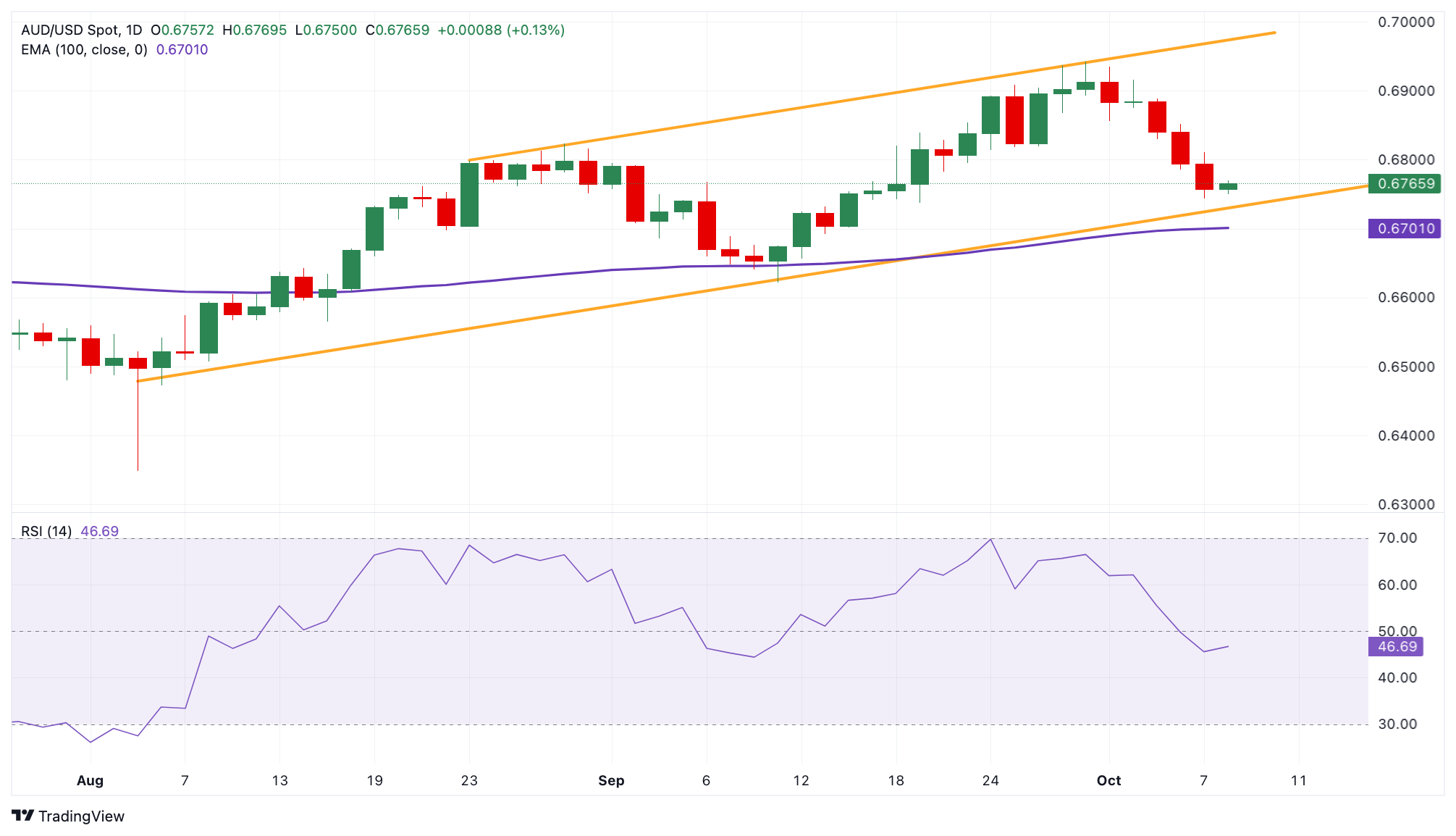
The Australian Dollar pair rebounds on the day. According to the daily chart, the AUD/USD pair remains stuck within the lower limit of the ascending trend channel. The pair maintains the bullish bias as it is well-supported above the key 100-day Exponential Moving Average (EMA). Nonetheless, further consolidation or downside cannot be ruled out as the 14-day Relative Strength Index (RSI) is located below the midline near 47.0.
The lower limit of the trend channel near 0.6735 acts as an initial support level for AUD/USD. A breach of the mentioned level could create a bearish momentum that drags the pair down to the 0.6700 psychological level. The additional downside filter to watch is 0.6622, the low of September 11.
On the upside, the first upside barrier emerges at 0.6823, the high of August 29. Extended gains could pave the way to 0.6942, the high of September 30. A decisive break above this level could draw in enough buyers to push AUD/USD to the upper boundary of the trend channel at 0.6980.
Interest rates FAQs
Interest rates are charged by financial institutions on loans to borrowers and are paid as interest to savers and depositors. They are influenced by base lending rates, which are set by central banks in response to changes in the economy. Central banks normally have a mandate to ensure price stability, which in most cases means targeting a core inflation rate of around 2%. If inflation falls below target the central bank may cut base lending rates, with a view to stimulating lending and boosting the economy. If inflation rises substantially above 2% it normally results in the central bank raising base lending rates in an attempt to lower inflation.
Higher interest rates generally help strengthen a country’s currency as they make it a more attractive place for global investors to park their money.
Higher interest rates overall weigh on the price of Gold because they increase the opportunity cost of holding Gold instead of investing in an interest-bearing asset or placing cash in the bank. If interest rates are high that usually pushes up the price of the US Dollar (USD), and since Gold is priced in Dollars, this has the effect of lowering the price of Gold.
The Fed funds rate is the overnight rate at which US banks lend to each other. It is the oft-quoted headline rate set by the Federal Reserve at its FOMC meetings. It is set as a range, for example 4.75%-5.00%, though the upper limit (in that case 5.00%) is the quoted figure. Market expectations for future Fed funds rate are tracked by the CME FedWatch tool, which shapes how many financial markets behave in anticipation of future Federal Reserve monetary policy decisions.
Author
Lallalit Srijandorn
FXStreet
Lallalit Srijandorn is a Parisian at heart. She has lived in France since 2019 and now becomes a digital entrepreneur based in Paris and Bangkok.