Australian Dollar extends losses ahead of Australia PMI data
- Australian Dollar continues the losing streak as the US Dollar recovers.
- Australia’s central bank is expected to implement more interest rate hikes.
- China to hold a financial policy conference to address potential risks within the $61 trillion financial industry.
- Upbeat US Treasury yields contribute support for the Greenback.


The Australian Dollar (AUD) continues the losing streak for the fourth successive session on Monday. The AUD/USD pair faces challenges due to a rebound in US Dollar (USD) amid upbeat US Treasury yields.
Australia’s central bank is anticipated to implement more stringent monetary policies. Reserve Bank of Australia (RBA) Governor Michele Bullock has stated that should inflation persist above the projected levels, the RBA is prepared to enact suitable policy measures.
Australia's employment scenario is experiencing interesting shifts. In September, the Employment Change took an unexpectedly sharp decline, adding a surprising twist to the equation. On a positive note, the Unemployment Rate made a favorable move by dropping more than anticipated, deviating from the expected trend.
Westpac's new Chief Economist, Luci Ellis, a Former Assistant Governor (Economic) at the RBA, has provided insights into the future path of RBA cash rate policy. Ellis mentioned in a note that the outlook is finely balanced, with further rate increases not completely ruled out, but contingent on a significant change in the inflation outlook.
China is preparing to hold a significant financial policy conference next week, a meeting that occurs once every five years. The purpose of this gathering is to discuss risk prevention strategies, including a focus on Local Government Financing Vehicles (LGFVs). The conference aims to address potential risks within the $61 trillion financial industry and establish medium-term priorities.
The US Dollar Index (DXY) bounces back to recover recent losses, potentially supported by strong economic data from the United States (US). However, the US Dollar (USD) encountered hurdles as US Treasury yields experienced a pullback on Friday.
Federal Reserve (Fed) Chairman Jerome Powell indicated on Thursday that the central bank is not planning to raise rates in the short term providing support for the pair. Powell added that additional tightening of monetary policy could be in order if there are further signs of growth or the labor market ceases to improve.
Daily Digest Market Movers: Australian Dollar continues the losing streak on upbeat US Dollar
- Westpac's Chief Economist, Luci Ellis stated in a note that the core view presented is that the Consumer Price Index (CPI) is expected to continue tracking lower and return to the RBA’s 2-3 percent target band in 2025, aligning with the central bank’s own expectations.
- Ellis highlighted several broader risks to the economy and inflation outlook that are being closely monitored. These include the resurgence of housing prices to levels close to pre-pandemic peaks, a global rise in bond yields, and China's slower-than-expected recovery from a prolonged period of COVID-related lockdowns.
- Australia's Unemployment Rate for September surprised on the positive side, coming in at 3.6% compared to the expectations of 3.7%, which was expected to remain consistent.
- Australian Employment Change for the same month was 6.7K, falling short of the consensus forecast of 20K. This is a notable decline from the 64.9K jobs added in August.
- Australia's central bank expresses heightened concern about the inflation impact stemming from supply shocks. Governor of the Reserve Bank of Australia, Michele Bullock stated that if inflation persists above projections, the RBA will take responsive policy measures. There is an observable deceleration in demand, and per capita consumption is on the decline.
- China is set to host a significant financial policy meeting early next week, occurring once every five years. The primary objectives of this gathering are to proactively address and mitigate risks and to establish medium-term priorities for the expansive $61 trillion financial industry.
- Atlanta Fed President Raphael Bostic said on Friday that he believes the US central bank is unlikely to lower interest rates before the middle of next year. Fed Philadelphia President Patrick Harker reiterated his inclination to maintain interest rates.
- Fed Cleveland President Loretta Mester indicated that the US central bank is "at or near the peak of the rate hike cycle." However, Mester acknowledged that the data released during the previous week could influence the central bank's decision regarding the future of monetary policy.
- US weekly Initial Jobless Claims declined to 198K, falling short of the market expectations of 212K for the week ending October 14, the lowest level since January.
- Existing Home Sales Change fell 2.0% MoM in September and Existing Home Sales improved to 3.96M.
- Market fluctuations persist in the US bond market, as the 10-year Treasury yield stabilizes around 4.94%. Meanwhile, the 2-year yield has dipped to 5.09%.
- Market participants will closely monitor the US S&P Global PMI on Tuesday, the Q3 Gross Domestic Product (GDP) on Thursday, and the Core Personal Consumption Expenditures (PCE) on Friday. The attention will also be focused on the Australian S&P Global PMI and Consumer Price Index (CPI), along with RBA Governor Bullock's speech.
Technical Analysis: Australian Dollar maintains its position above 0.6300 major level
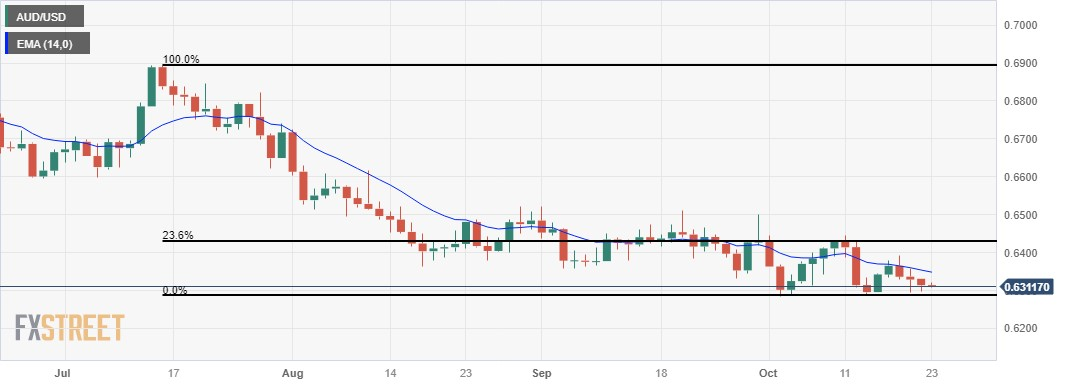
The Australian Dollar trades lower around 0.6310 on Monday, aligning with notable support at the 0.6300 level. A further support level is indicated by the monthly low at 0.6285. Looking upward, a crucial resistance is identified around the 14-day Exponential Moving Average (EMA) at 0.6347, following a major level at 0.6400. A breakthrough above this resistance holds the potential to reach around the 23.6% Fibonacci retracement level at 0.6429.
AUD/USD: Daily Chart
Australian Dollar price today
The table below shows the percentage change of Australian Dollar (AUD) against listed major currencies today. Australian Dollar was the weakest against the Euro.
| USD | EUR | GBP | CAD | AUD | JPY | NZD | CHF | |
| USD | -0.04% | -0.01% | 0.20% | 0.28% | 0.02% | 0.18% | -0.02% | |
| EUR | 0.04% | 0.04% | 0.25% | 0.32% | 0.07% | 0.23% | 0.05% | |
| GBP | 0.03% | -0.04% | 0.22% | 0.29% | 0.05% | 0.20% | 0.02% | |
| CAD | -0.19% | -0.25% | -0.25% | 0.06% | -0.17% | -0.03% | -0.21% | |
| AUD | -0.28% | -0.30% | -0.26% | -0.08% | -0.23% | -0.09% | -0.26% | |
| JPY | -0.02% | -0.08% | -0.07% | 0.17% | 0.21% | 0.13% | -0.03% | |
| NZD | -0.18% | -0.22% | -0.19% | 0.01% | 0.09% | -0.15% | -0.18% | |
| CHF | 0.00% | -0.05% | -0.01% | 0.20% | 0.26% | 0.03% | 0.18% |
The heat map shows percentage changes of major currencies against each other. The base currency is picked from the left column, while the quote currency is picked from the top row. For example, if you pick the Euro from the left column and move along the horizontal line to the Japanese Yen, the percentage change displayed in the box will represent EUR (base)/JPY (quote).
Economic Indicator
Australia S&P Global Manufacturing PMI
The Manufacturing Purchasing Managers Index (PMI) released by both the Commonwealth Bank of Australia and the S&P Global captures business conditions in the manufacturing sector. As the manufacturing sector dominates a large part of total GDP, the Manufacturing PMI is an important indicator of business conditions and the overall economic condition in Australia. A result above 50 signals is bullish for the AUD, whereas a result below 50 is seen as bearish.
Read more.Author
Akhtar Faruqui
FXStreet
Akhtar Faruqui is a Forex Analyst based in New Delhi, India. With a keen eye for market trends and a passion for dissecting complex financial dynamics, he is dedicated to delivering accurate and insightful Forex news and analysis.

















