Australian Dollar remains calm amid an improved US Dollar ahead of US Inflation data
- Australian Dollar loses ground amid a stable US Dollar.
- Australian Consumer Confidence jumped 6.2% to 86 in February.
- The US Dollar holds ground despite subdued US Treasury yields.
- US CPI YoY and MoM could moderate to 2.9% and 0.2%, respectively, in January.


The Australian Dollar (AUD) retreats after posting gains in the previous two sessions, despite the release of improved Australia Consumer Confidence data on Tuesday. The Westpac-Melbourne Institute Consumer Sentiment index surged 6.2% to 86 in February from 81 in January, marking its highest reading in 20 months. However, the index remained below the neutral 100 mark since February 2022.
Australian Dollar faces downward pressure as Australian inflation moderates, leading to the market sentiment that the Reserve Bank of Australia (RBA) has completed its monetary tightening cycle. This downward trend in the Aussie Dollar weighs on the AUD/USD pair. Additionally, the Australian money market's decline may further constrain the AUD's performance.
The US Dollar Index (DXY) holds steady after recent gains, with the decline in US Treasury yields capping the strength of the US Dollar (USD). Market sentiment is mixed, as traders exercise caution ahead of the release of important US inflation data scheduled for Tuesday, which could influence expectations regarding interest rates.
Daily Digest Market Movers: Australian Dollar declines amid a stable US Dollar
- National Australia Bank's Business Confidence improved to the reading of 1 in January from the previous flat of 0.
- National Australia Bank's Business Conditions decreased to 6 in January from 8 prior.
- RBA's Head of Economic Analysis, Marion Kohler, emphasized uncertainty regarding current inflation projections for the Australian economy. However, she anticipates that price growth will eventually return to a more moderate level by 2025.
- The Commonwealth Bank of Australia (CBA) forecasted a reduction of 75 basis points in the benchmark interest rate for 2024, with the initial cut anticipated in September.
- China’s headline CPI declined by 0.8%, exceeding the anticipated decline of 0.5% and the previous decline of 0.3%.
- Dallas Federal Reserve (Fed) Bank President Lorie K. Logan remarked on Friday that there is currently no pressing need to lower interest rates. She acknowledged "tremendous progress" in curbing inflation but emphasized the necessity for additional evidence to ensure the sustainability of this progress.
- US Monthly Budget Statement came in with the reading of $-22B in January, against the expected reading of $-21B and $-129B prior.
- 3-Month and 6-Month US Bill was auctioned at the rate of 5.23% and 5.065%, respectively.
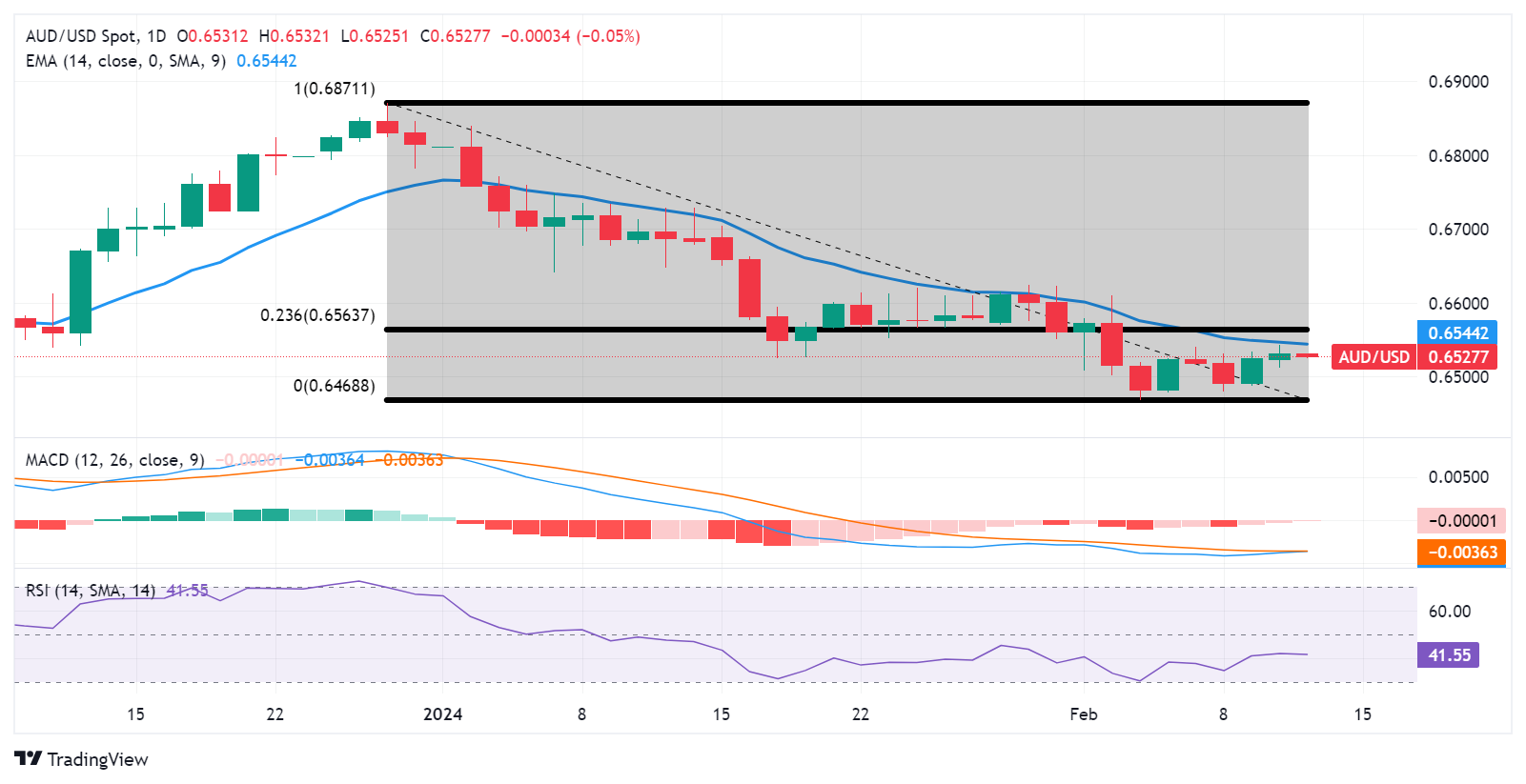
Technical Analysis: Australian Dollar trades near 0.6530 before the 14-day EMA
The Australian Dollar trades near 0.6520 on Tuesday, situated below the immediate resistance of the 14-day Exponential Moving Average (EMA) at 0.6544 aligned with the major barrier at 0.6550 level. A breakthrough above this major level could potentially prompt the AUD/USD pair to target key levels such as the 23.6% Fibonacci retracement level at 0.6563 and the psychological resistance at 0.6600. On the downside, the psychological level of 0.6500 could act as immediate support. A break below the latter could push the AUD/USD pair to revisit the previous week’s low at 0.6468 followed by the major support level of 0.6450.
AUD/USD: Daily Chart
Australian Dollar price today
The table below shows the percentage change of Australian Dollar (AUD) against listed major currencies today. Australian Dollar was the strongest against the Swiss Franc.
| USD | EUR | GBP | CAD | AUD | JPY | NZD | CHF | |
| USD | 0.03% | -0.15% | 0.02% | 0.19% | 0.18% | 0.41% | 0.60% | |
| EUR | -0.03% | -0.16% | -0.01% | 0.16% | 0.16% | 0.37% | 0.57% | |
| GBP | 0.15% | 0.19% | 0.17% | 0.34% | 0.33% | 0.56% | 0.73% | |
| CAD | -0.03% | 0.01% | -0.17% | 0.15% | 0.15% | 0.38% | 0.58% | |
| AUD | -0.19% | -0.15% | -0.34% | -0.17% | -0.01% | 0.22% | 0.42% | |
| JPY | -0.18% | -0.13% | -0.33% | -0.16% | 0.02% | 0.22% | 0.42% | |
| NZD | -0.39% | -0.37% | -0.54% | -0.38% | -0.22% | -0.22% | 0.22% | |
| CHF | -0.59% | -0.55% | -0.74% | -0.56% | -0.42% | -0.41% | -0.20% |
The heat map shows percentage changes of major currencies against each other. The base currency is picked from the left column, while the quote currency is picked from the top row. For example, if you pick the Euro from the left column and move along the horizontal line to the Japanese Yen, the percentage change displayed in the box will represent EUR (base)/JPY (quote).
Pound Sterling FAQs
What is the Pound Sterling?
The Pound Sterling (GBP) is the oldest currency in the world (886 AD) and the official currency of the United Kingdom. It is the fourth most traded unit for foreign exchange (FX) in the world, accounting for 12% of all transactions, averaging $630 billion a day, according to 2022 data.
Its key trading pairs are GBP/USD, aka ‘Cable’, which accounts for 11% of FX, GBP/JPY, or the ‘Dragon’ as it is known by traders (3%), and EUR/GBP (2%). The Pound Sterling is issued by the Bank of England (BoE).
How do the decisions of the Bank of England impact on the Pound Sterling?
The single most important factor influencing the value of the Pound Sterling is monetary policy decided by the Bank of England. The BoE bases its decisions on whether it has achieved its primary goal of “price stability” – a steady inflation rate of around 2%. Its primary tool for achieving this is the adjustment of interest rates.
When inflation is too high, the BoE will try to rein it in by raising interest rates, making it more expensive for people and businesses to access credit. This is generally positive for GBP, as higher interest rates make the UK a more attractive place for global investors to park their money.
When inflation falls too low it is a sign economic growth is slowing. In this scenario, the BoE will consider lowering interest rates to cheapen credit so businesses will borrow more to invest in growth-generating projects.
How does economic data influence the value of the Pound?
Data releases gauge the health of the economy and can impact the value of the Pound Sterling. Indicators such as GDP, Manufacturing and Services PMIs, and employment can all influence the direction of the GBP.
A strong economy is good for Sterling. Not only does it attract more foreign investment but it may encourage the BoE to put up interest rates, which will directly strengthen GBP. Otherwise, if economic data is weak, the Pound Sterling is likely to fall.
How does the Trade Balance impact the Pound?
Another significant data release for the Pound Sterling is the Trade Balance. This indicator measures the difference between what a country earns from its exports and what it spends on imports over a given period.
If a country produces highly sought-after exports, its currency will benefit purely from the extra demand created from foreign buyers seeking to purchase these goods. Therefore, a positive net Trade Balance strengthens a currency and vice versa for a negative balance.
Author
Akhtar Faruqui
FXStreet
Akhtar Faruqui is a Forex Analyst based in New Delhi, India. With a keen eye for market trends and a passion for dissecting complex financial dynamics, he is dedicated to delivering accurate and insightful Forex news and analysis.