AUD/USD ticks higher as RBA also expected to delay cutting interest rates
- AUD/USD recovers marginally after the recent steep sell-off.
- Both the Fed and RBA are expected to delay cutting interest rates now.
- This means the interest rate differential, a key driver of FX, is unlikely to widen as much as in other pairs.


AUD/USD climbs about a tenth of a percent into the 0.6440s on Thursday, continuing the correction of the steep sell-off in the pair at the start of April.
As can be seen from the chart below, an overall bearish tone dominates price action after the new year-to-date low made on Tuesday at 0.6389.
AUD/USD Daily Chart
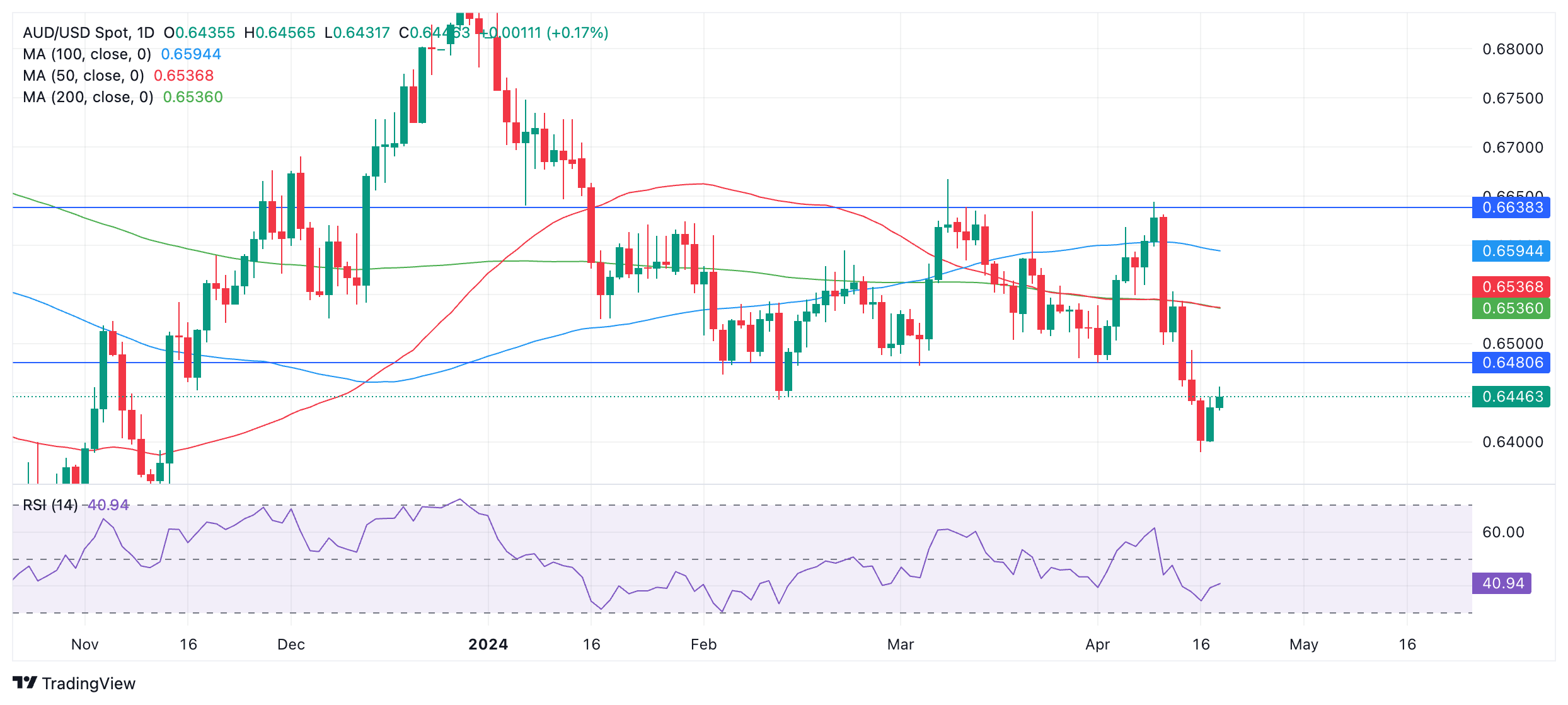
The most recent leg down, which started on April 10, was driven by a sudden strengthening in the US Dollar (USD).
A run of strong macroeconomic data from the US, a solid labor market and persistently high inflation means the US Federal Reserve (Fed) cannot go ahead and cut interest rates as soon as it had been planning.
The expectation of interest rates remaining higher for longer in the US in order to continue cooling down the economy, has supported the US Dollar because higher interest rates attract greater inflows of foreign capital.
The sell-off in AUD/USD was not as steep as in other Dollar pairs, however, because stubbornly high inflation in Australia means the Reserve Bank of Australia (RBA) is also expected to delay cutting interest rates. It was less vocal about cutting them at the start of the year, however, unlike the Federal Reserve (Fed).
In Australia, a similar delay means the Reserve Bank of Australia (RBA) is now not expected to lower the 4.35% overnight cash rate until November 2024.
“Markets currently price the RBA cash rate to be unchanged at the next meeting on 7 May, with a 60% chance of a cut by November,” said Westpac in a recent note.
There has been a surprising down shift in the number of cuts the RBA is expected to make in 2024 over the past month, which mirrors what has happened in the US with the Fed.
“The market is pricing in 90% odds of a 25 bp rate cut in 2024 vs. almost 50 bp of total easing that was seen earlier this month,” according to BBH.
The main macroeconomic data to come out of Australia over the last few sessions was the Australian Bureau of Statistics Labour Force Survey (LFS).
This showed employment down by 6.6k (from plus 117.6k in February), the Unemployment Rate rising to 3.8% (from 3.7%) and the Participation Rate at 66.6% (from 66.7%).
The data failed to move the dial with regards to the Aussie Dollar.
“It provided a slightly better read on the underlying state of labour market conditions over the opening quarter,” according to Westpac.
Even though the Unemployment Rate rose to 3.8%, it is still below the RBA’s estimated full employment range of 4.0% - 5.75%, so is unlikely to impact their policy decisions in the near term, and therefore the Australian Dollar.
Author
Joaquin Monfort
FXStreet
Joaquin Monfort is a financial writer and analyst with over 10 years experience writing about financial markets and alt data. He holds a degree in Anthropology from London University and a Diploma in Technical analysis.