AUD/USD hung out to dry on familiar low end
- AUD/USD continues to keep a tight grip on 0.6200.
- Market sentiment drifted in favor of safe havens to start 2025.
- Aussie traders await further hints from RBA on policy direction before picking a side.


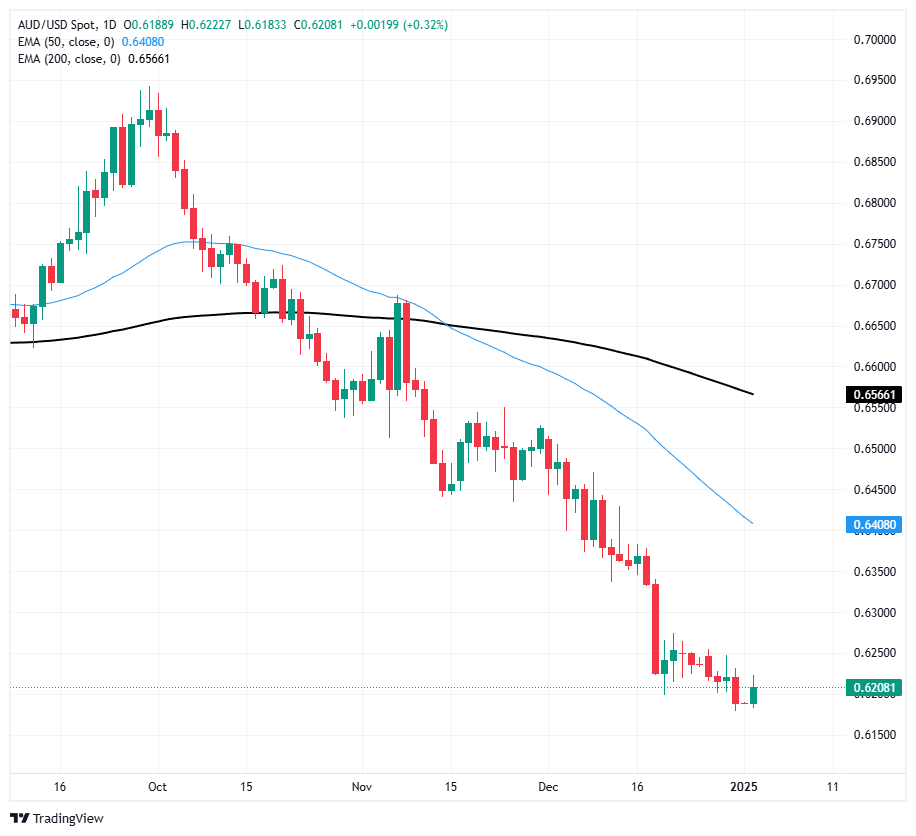
AUD/USD tried and failed to spark a bull run during the first trading session of 2025, rising on thin volumes before collapsing back into the 0.6200 handle in the later hours of the day. A broad-market push into the safe haven Greenback kept the Aussie pair on the defensive, and the AUD is mired in congestion on the weak side of two-year lows.
The economic data calendar is largely dark on the Antipoodean side for the rest of the week, leaving investors to grapple with US Purchasing Managers Index (PMI) figures due on Friday and a cloudy picture on the Aussie’s interest rate differential outlook.
The Federal Reserve (Fed) is poised to make fewer interest rate cuts through 2025 than previously expected, keeping the US Dollar well-bid across the board alongside a general malaise that has struck market participants in recent months. Market flows are still constrained by the New Year’s holidays that shuttered markets during the midweek market session, but a wobbly stance to fresh volumes at the outset of the new trading season bode poorly for near-term gains for the Aussie.
US ISM Manufacturing PMI survey results on Friday are expected to hold flat at a contractionary 48.2.
AUD/USD price forecast
AUD/USD bulls will be look for a fresh breakout to the topside in the coming days as bids appear to be pumping the brakes on further declines. However, a fresh round of short-selling isn’t entirely off the table, especially if the bottom falls out of near-term price action and sends bids below last week’s floor set near 0.6180.
AUD/USD daily chart
Australian Dollar FAQs
One of the most significant factors for the Australian Dollar (AUD) is the level of interest rates set by the Reserve Bank of Australia (RBA). Because Australia is a resource-rich country another key driver is the price of its biggest export, Iron Ore. The health of the Chinese economy, its largest trading partner, is a factor, as well as inflation in Australia, its growth rate and Trade Balance. Market sentiment – whether investors are taking on more risky assets (risk-on) or seeking safe-havens (risk-off) – is also a factor, with risk-on positive for AUD.
The Reserve Bank of Australia (RBA) influences the Australian Dollar (AUD) by setting the level of interest rates that Australian banks can lend to each other. This influences the level of interest rates in the economy as a whole. The main goal of the RBA is to maintain a stable inflation rate of 2-3% by adjusting interest rates up or down. Relatively high interest rates compared to other major central banks support the AUD, and the opposite for relatively low. The RBA can also use quantitative easing and tightening to influence credit conditions, with the former AUD-negative and the latter AUD-positive.
China is Australia’s largest trading partner so the health of the Chinese economy is a major influence on the value of the Australian Dollar (AUD). When the Chinese economy is doing well it purchases more raw materials, goods and services from Australia, lifting demand for the AUD, and pushing up its value. The opposite is the case when the Chinese economy is not growing as fast as expected. Positive or negative surprises in Chinese growth data, therefore, often have a direct impact on the Australian Dollar and its pairs.
Iron Ore is Australia’s largest export, accounting for $118 billion a year according to data from 2021, with China as its primary destination. The price of Iron Ore, therefore, can be a driver of the Australian Dollar. Generally, if the price of Iron Ore rises, AUD also goes up, as aggregate demand for the currency increases. The opposite is the case if the price of Iron Ore falls. Higher Iron Ore prices also tend to result in a greater likelihood of a positive Trade Balance for Australia, which is also positive of the AUD.
The Trade Balance, which is the difference between what a country earns from its exports versus what it pays for its imports, is another factor that can influence the value of the Australian Dollar. If Australia produces highly sought after exports, then its currency will gain in value purely from the surplus demand created from foreign buyers seeking to purchase its exports versus what it spends to purchase imports. Therefore, a positive net Trade Balance strengthens the AUD, with the opposite effect if the Trade Balance is negative.
Author
Joshua Gibson
FXStreet
Joshua joins the FXStreet team as an Economics and Finance double major from Vancouver Island University with twelve years' experience as an independent trader focusing on technical analysis.