|

AUD/NZD slips into new lows, aiming for 1.0800, Aussie manufacturing PMI slides

  • AUD/NZD is seeing extended declines, continuing Wednesday's backslide.
  • Aussie is reaching lower against the Kiwi, down 0.95% for the week.
  • Australian PMI figures came in mixed with manufacturing seeing further declines.

The AUD/NZD has broken out of recent consolidation on the weak side, and the pair shrugged off a mixed trade balance printing from New Zealand (NZ) as markets focus on weakened manufacturing figures from the Australian Purchasing Manager Index (PMI) printing.

Read more:

Australia: S&P Global Manufacturing PMI drops to 48.2, Services PMI improves to 50.5 in September

New Zealand Trade Balance came in mixed for August, NZD/USD remains flat above 0.5900

Australian PMI figures came in mixed, with the services component seeing a minor bump into 50.5 from 47.8, but weak spots in the manufacturing component are keeping the Aussie (AUD) on the weak side, with the Manufacturing PMI declining further to 48.2 from 49.6.

AUD/NZD technical outlook

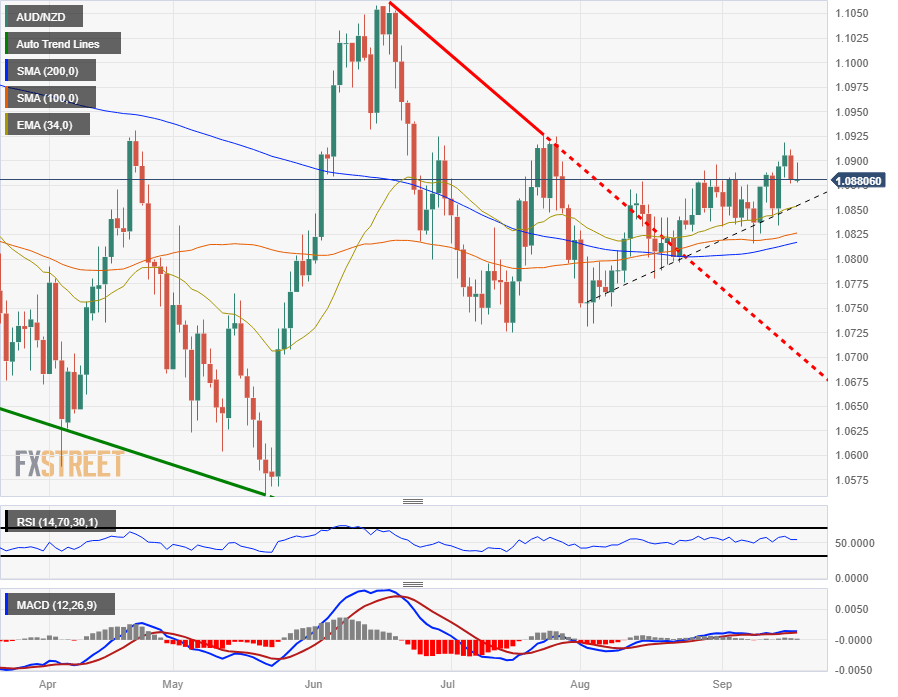
The Aussie-Kiwi pair has tumbled into the 200-day Simple Moving Average currently capping off prices near 1.0820.

Continued declines will see the pair testing August's early lows near 1.0720, while a bullish recovery will see the AUD/NZD challenging the recent swing high into 1.0920.

AUD/NZD daily chart
AUD/NZD technical outlook

AUD/NZD

Overview
Today last price1.0808
Today Daily Change-0.0068
Today Daily Change %-0.63
Today daily open1.0876
 
Trends
Daily SMA201.0866
Daily SMA501.0838
Daily SMA1001.0828
Daily SMA2001.0818
 
Levels
Previous Daily High1.0892
Previous Daily Low1.0855
Previous Weekly High1.0919
Previous Weekly Low1.0825
Previous Monthly High1.0897
Previous Monthly Low1.0732
Daily Fibonacci 38.2%1.0878
Daily Fibonacci 61.8%1.0869
Daily Pivot Point S11.0857
Daily Pivot Point S21.0837
Daily Pivot Point S31.082
Daily Pivot Point R11.0894
Daily Pivot Point R21.0911
Daily Pivot Point R31.0931

Author

Joshua Gibson

Joshua joins the FXStreet team as an Economics and Finance double major from Vancouver Island University with twelve years' experience as an independent trader focusing on technical analysis.


More from Joshua Gibson
Share:

Editor's Picks

EUR/USD meets initial support around 1.1800

EUR/USD remains on the back foot, although it has managed to reverse the initial strong pullback toward the 1.1800 region and regain some balance, hovering around the 1.1850 zone as the NA session draws to a close on Tuesday. Moving forward, market participants will now shift their attention to the release of the FOMC Minutes and US hard data on Wednesday.
 

GBP/USD bounces off lows, retargets 1.3550

After bottoming out just below the 1.3500 yardstick, GBP/USD now gathers some fresh bids and advances to the 1.3530-1.3540 band in the latter part of Tuesday’s session. Cable’s recovery comes as the Greenback surrenders part of its advance, although it keeps the bullish bias well in place for the day.

Gold remains offered below $5,000

Gold stays on the defensive on Tuesday, receding to the sub-$5,000 region per troy ounce on the back of the persistent move higher in the Greenback. The precious metal’s decline is also underpinned by the modest uptick in US Treasury yields across the spectrum.

Ethereum Price Forecast: BitMine extends ETH buying streak, says long-term outlook remains positive

Ethereum (ETH) treasury firm BitMine Immersion continued its weekly purchase of the top altcoin last week after acquiring 45,759 ETH.

UK jobs market weakens, bolstering rate cut hopes

In the UK, the latest jobs report made for difficult reading. Nonetheless, this represents yet another reminder for the Bank of England that they need to act swiftly given the collapse in inflation expected over the coming months. 

Ripple slides to $1.45 as downside risks surge

Ripple edges lower at the time of writing on Tuesday, from the daily open of $1.48, as headwinds persist across the crypto market. A short-term support is emerging at $1.45, but a buildup of bearish positions could further weaken the derivatives market and prolong the correction.