|

AUD/JPY Price Analysis: Surges to six-day high amid risk-on sentiment

  • AUD/JPY rises late in the session, supported by a risk-on sentiment fueled by Wall Street's advance.
  • Buyers in control as the pair surpasses 97.00, aiming for a daily close above 98.00 for further gains.
  • Despite the ascent, pullback risks persist; sellers may target levels below 97.00 for bearish momentum.

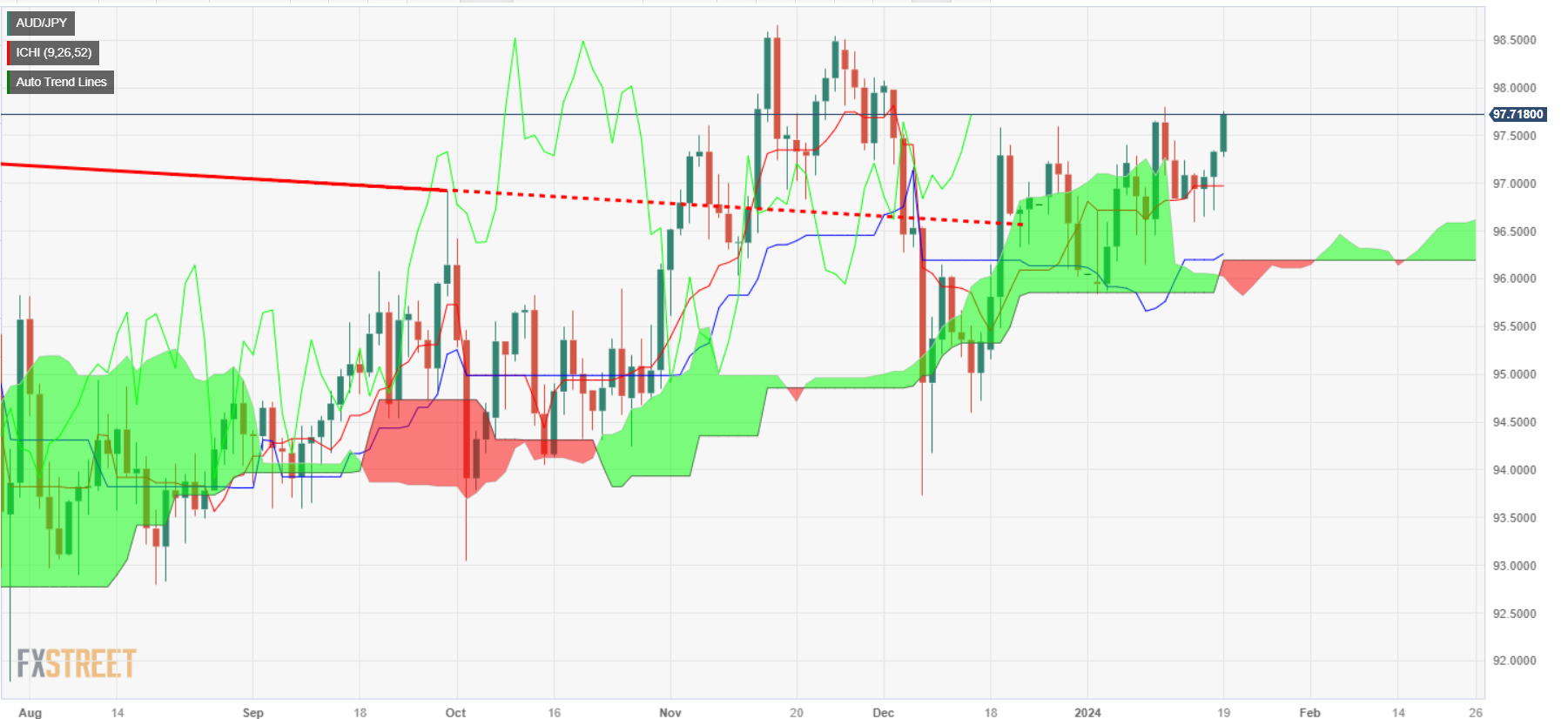
AUD/JPY edges higher late in Friday’s North American session, sponsored by a risk-on impulse, as the advance in Wall Street could appreciate it. Therefore, safe-haven peers are pressured while US Treasury yields retrace, a tailwind for riskier assets. At the time of writing, the AUD/JPY exchanged hands at 97.79, printing a new six-day high.

The pair began the week at around the lows of the week, below the Tenkan-Sen, but the AUD/JPY exchange rate was already above the Ichimoku Cloud (Kumo), suggesting that buyers were in charge. Consequently, they reclaimed 97.00 and, on Friday, extended its gains. Still, pullback risks remain, as buyers need a daily close above the 98.00 figure so they can remain hopeful of testing last year’s high of 98.58. Once those levels are surpassed, the next stop would be the 99.00 figure.

For a bearish case, sellers need to drive prices below 97.00, through the Tenkan Sen at 96.97, toward the January 16 low of 96.58. A breach of the latter will expose the Kijun-Sen at 96.18, ahead of the Senkou Span B and A, each at 96.14 and 96.01.

AUD/JPY Price Action – Daily Chart
AUD/JPY Key Technical Levels

AUD/JPY

Overview
Today last price97.72
Today Daily Change0.39
Today Daily Change %0.40
Today daily open97.33
 
Trends
Daily SMA2096.84
Daily SMA5096.88
Daily SMA10096.05
Daily SMA20094.66
 
Levels
Previous Daily High97.34
Previous Daily Low96.71
Previous Weekly High97.8
Previous Weekly Low96.15
Previous Monthly High98.07
Previous Monthly Low93.73
Daily Fibonacci 38.2%97.1
Daily Fibonacci 61.8%96.96
Daily Pivot Point S196.92
Daily Pivot Point S296.5
Daily Pivot Point S396.28
Daily Pivot Point R197.55
Daily Pivot Point R297.76
Daily Pivot Point R398.18

Author

Christian Borjon Valencia

Markets analyst, news editor, and trading instructor with over 14 years of experience across FX, commodities, US equity indices, and global macro markets.


More from Christian Borjon Valencia
Share:

Editor's Picks

EUR/USD clings to gains around 1.1800

EUR/USD manages to regain composure and retests the 1.1800 region in quite a positive start to the week. The pair’s bounce follows the US Dollar’s offered stance post-SCOTUS ruling ahead of important US data and Fedspeak on Tuesday.

GBP/USD looks stuck around 1.3500 amid firm gains

GBP/USD is pushing further north on Monday, revisiting the 1.3500 hurdle and beyond. Cable’s uptick is largely being fuelled by the broader softness in the Greenback, amid lingering uncertainty around tariffs.

Gold pops above $5,200, four-week highs

Gold is holding onto its bullish tone on Monday, reaching new multi-week highs just past the $5,200 mark per troy ounce. Fresh trade-war concerns, coupled with rising geopolitical tensions in the Middle East, are keeping demand for the yellow metal well on the rise.

Ethereum Price Forecast: BitMine's holdings reach 4.42 million ETH as Fundstrat predicts 87% win-ratio

Ethereum (ETH) treasury firm BitMine Immersion Technologies (BMNR) scooped up 51,162 ETH last week, marking its largest purchase since December.

Supreme Court nixes tariffs, Trump teases 15% global tariff

On February 20th, the Supreme Court ruled that Trump’s global tariffs under IEEPA authority were unconstitutional, effectively nullifying the framework. However, the relief was short-lived. Within hours, Trump floated a 15% blanket tariff under an alternative legal authority.

XRP recovers slightly as bearish sentiment dominates crypto market

Ripple is rising above $1.40 at the time of writing on Monday amid fresh tariff-triggered headwinds in the broader cryptocurrency market. The sell-off to $1.33, the token’s intraday low, can be attributed to macroeconomic uncertainty, geopolitical tensions and risk-averse sentiment among other factors.