|

AUD/JPY Price Analysis: Drops toward 94.20 area as bearish pressure mounts

  • AUD/JPY was seen near the 94.30 zone on Friday ahead of the Asian session, retreating toward the lower end of its daily range.
  • Despite mixed signals from oscillators, moving averages tilt the broader technical bias to the downside.
  • Support lies near 94.00 and 93.88, while resistance is seen just above 94.40; indicators remain conflicted with bearish lean.

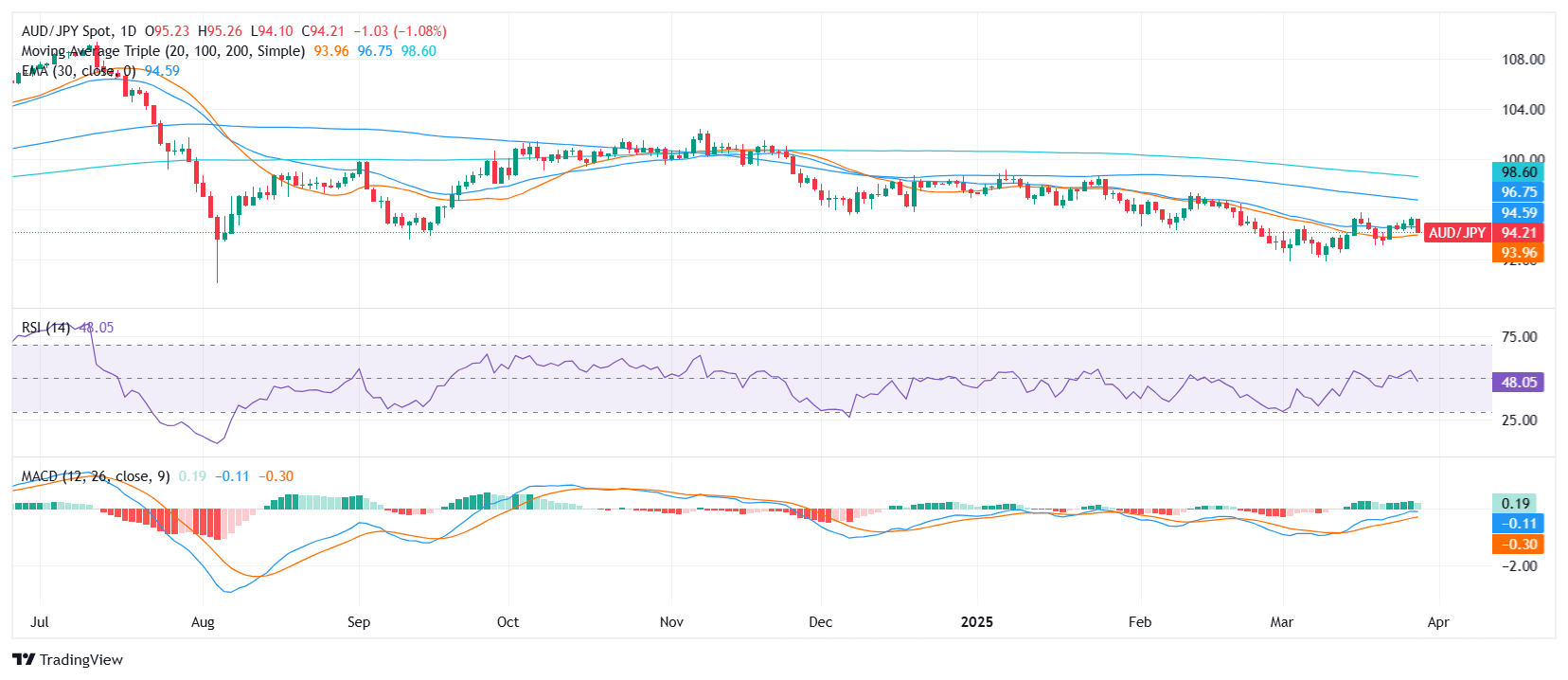
The AUD/JPY pair extended its decline on Friday, hovering near the 94.30 zone after the European session and slipping closer to the lower end of its intraday range. The pair is down notably on the day, reflecting an increase in selling interest. While some momentum indicators remain neutral or even slightly constructive, broader technical signals continue to favor a bearish bias for the near term.

Looking at the indicators, the Relative Strength Index (RSI) fell below 50, yet neutral in tone, while the MACD posts a slight buy signal , hinting at possible short-term correction. However, the Bull Bear Power stands at 0.641, reinforcing the underlying selling pressure, and the Williams Percent Range remains neutral, failing to offer a clear reversal signal.

Moving averages present a split picture. The short-term 20-day Simple Moving Average (SMA) at 94.02 continues to signal a buy, offering dynamic support. However, the 10-day EMA (94.45) and SMA (94.58), along with the 100-day (96.85) and 200-day (98.70) SMAs, all lean bearish, suggesting that upside potential remains capped unless a structural shift occurs.

In terms of levels, immediate support emerges at 94.16, followed by 94.02 and 93.88. On the flip side, resistance is seen around 94.35, 94.42, and 94.45—just ahead of key short-term moving averages that could act as selling zones if bulls attempt to regain control.

AUD/JPY daily chart
Author

Patricio Martín

Patricio is an economist from Argentina passionate about global finance and understanding the daily movements of the markets.


More from Patricio Martín
Share:

Markets move fast. We move first.

Orange Juice Newsletter brings you expert driven insights - not headlines. Every day on your inbox.

By subscribing you agree to our Terms and conditions.

Editor's Picks

EUR/USD falls toward 1.1700 on broad USD recovery

EUR/USD turns south and declines toward 1.1700 on Wednesday. The US Dollar gathers recovery momentum and forces the pair to stay on the back foor, as traders look to USD short-covering ahead of US inflation report on Thursday. However, the downside could be capped by hawkish ECB expectations. 

GBP/USD trades deep in red below 1.3350 after soft UK inflation data

GBP/USD stays under strong selling pressure midweek and trades below 1.3350. The UK annual headline and core CPI rose by 3.2% each, missing estimates of 3.5% and 3.4%, respectively, reaffirming dovish BoE expectations and smashing the Pound Sterling across the board ahead of Thurday's BoE policy announcements. 

Gold clings to moderate daily gains above $4,300

Following Tuesday's volatile action, Gold regains its traction on Wednesday and trades in positive territory above $4,300. While the buildup in the USD recovery momentum caps XAU/USD's upside, the cautious market stance helps the pair hold its ground.

Bitcoin risks deeper correction as ETF outflows mount, derivative traders stay on the sidelines

Bitcoin (BTC) remains under pressure, trading below $87,000 on Wednesday, nearing a key support level. A decisive daily close below this zone could open the door to a deeper correction.

Monetary policy: Three central banks, three decisions, the same caution

While the Fed eased its monetary policy on 10 December for the third consecutive FOMC meeting, without making any guarantees about future action, the BoE, the ECB and the BoJ are holding their respective meetings this week. 

AAVE slips below $186 as bearish signals outweigh the SEC investigation closure

Aave (AAVE) price continues its decline, trading below $186 at the time of writing on Wednesday after a rejection at the key resistance zone. Derivatives positioning and momentum indicators suggest that bearish forces still dominate in the near term.













