AUD/JPY rises to five-month highs ahead of BoJ's policy decision
- AUD/JPY continues its winning streak after the stronger Australian CPI was released on Wednesday.
- Australia’s 10-year government bond yield has surged to 4.49% near five-month highs on waning expectations of the RBA rate cuts.
- The Japanese Yen continues to depreciate as the BoJ is expected to abstain from implementing rate hikes on Friday.


AUD/JPY edges higher for the fourth consecutive session on Thursday. The Australian Dollar (AUD) found support following the release of Australian Consumer Price Index (CPI) data on Wednesday, which exceeded expectations. This development hints at a potentially hawkish stance for the Reserve Bank of Australia’s (RBA) monetary policy, bolstering the AUD and subsequently supporting the AUD/JPY pair.
Australia’s 10-year government bond yield has surged above 4.49%, nearing five-month highs, as robust domestic inflation figures have strengthened expectations of the RBA delaying interest rate cuts. Moreover, easing tensions in the Middle East has fostered a positive market sentiment, benefiting risk-sensitive currencies like the AUD.
The Japanese Yen (JPY) continues to depreciate ahead of the upcoming release of the Bank of Japan’s (BoJ) Monetary Policy Statement scheduled for Friday. It's widely anticipated that the BoJ will abstain from implementing rate hikes in this meeting.
According to reports from Nikkei, the BoJ is likely to deliberate on the "impact of accelerating Yen depreciation," indicating that the central bank may intervene in the foreign exchange markets if the JPY weakens.
Daily Digest Market Movers: AUD/JPY appreciates on hawkish sentiment surrounding RBA
- According to Luci Ellis, Westpac's chief economist and former Assistant Governor (Economic) at the Reserve Bank of Australia, inflation slightly surpassed expectations in the March quarter. They anticipate the Board will maintain interest rates in May and have revised the projected date for the initial rate reduction from September to November this year.
- According to analysts at Barrenjoey Capital Partners, a leading Australian investment banking firm, advised to utilize the trimmed mean to rank Australia's inflation. Australia's six-month annualized rate of trimmed mean inflation, standing at 3.6%, is notably the highest worldwide, surpassing even the United States' 3.2% six-month annualized rate of trimmed mean inflation.
- Australia’s Consumer Price Index (CPI) rose by 1.0% QoQ in the first quarter of 2024, against the expected 0.8% and 0.6% prior. CPI (YoY) increased by 3.6% compared to the forecast of 3.4% for Q1 and 4.1% prior.
- Australia’s Monthly Consumer Price Index (YoY) rose by 3.5% in March, against the market expectations and the previous reading of 3.4%.
- On Tuesday, Australia's Judo Bank Composite Purchasing Managers Index (PMI) surged to a 24-month high, indicating an improvement from the previous month. While the Manufacturing PMI reached an eight-month high, the Services PMI declined to a two-month low. This has bolstered the hawkish sentiment for the RBA’s stance on its interest rate trajectory.
- According to the Japan Times, the proportion of Japanese companies intending to increase their pay scales reached 70.7%, marking a rise of 6.3 percentage points from the previous year. Additionally, the number of companies planning to implement pay-scale hikes and regular pay increases totaling 5% or more amounted to 36.5%, nearly doubling from the previous year. This could provide support for the Yen.
- Reuters reported that Bank of Japan (BoJ) Governor Kazuo Ueda reiterated on Tuesday that the central bank would raise interest rates again if trend inflation accelerates toward its 2% target, in line with its forecast. Ueda also said that it is hard to predict in advance the ideal timeframe for the Bank of Japan (BoJ) to gather sufficient data before considering a policy change.
- The Tokyo Consumer Price Index (CPI) for the year ended April is scheduled to be released during the early Friday session in Japan.
Technical Analysis: AUD/JPY moves toward the major level of 101.50
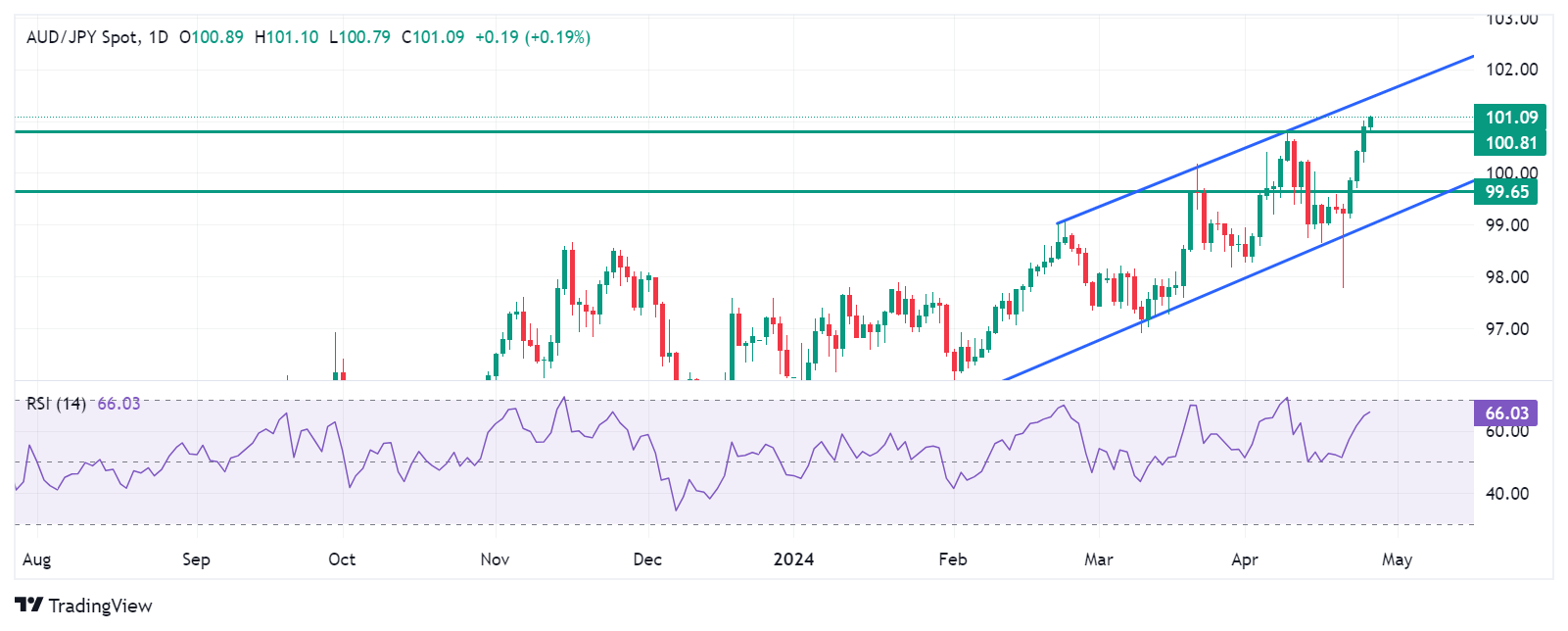
The AUD/JPY trades around 101.40 on Thursday, edging towards the upper boundary of the daily ascending channel after surpassing April’s high of 100.81. Moreover, the 14-day Relative Strength Index (RSI) is trending above the 50-level, backing the bullish sentiment. The immediate resistance is seen at the major level of 101.50.
In case of a downside movement, immediate support for the AUD/JPY pair could be found at the psychological level of 101.00. A breach below this level might lead to a further decline toward the psychological level of 100.00, followed by the support level of 99.65 and the lower boundary of the ascending channel around the level of 99.00.
AUD/JPY: Daily Chart
Japanese Yen price today
The table below shows the percentage change of Japanese Yen (JPY) against listed major currencies today. Japanese Yen was the weakest against the Australian Dollar.
| USD | EUR | GBP | CAD | AUD | JPY | NZD | CHF | |
| USD | -0.12% | -0.11% | -0.11% | -0.23% | 0.26% | -0.15% | -0.05% | |
| EUR | 0.12% | 0.02% | 0.02% | -0.11% | 0.37% | -0.03% | 0.07% | |
| GBP | 0.11% | -0.02% | 0.00% | -0.13% | 0.35% | -0.06% | 0.05% | |
| CAD | 0.12% | -0.01% | 0.01% | -0.12% | 0.35% | -0.03% | 0.05% | |
| AUD | 0.23% | 0.12% | 0.13% | 0.13% | 0.48% | 0.08% | 0.18% | |
| JPY | -0.24% | -0.36% | -0.35% | -0.36% | -0.46% | -0.41% | -0.32% | |
| NZD | 0.15% | 0.03% | 0.04% | 0.03% | -0.09% | 0.40% | 0.13% | |
| CHF | 0.05% | -0.07% | -0.05% | -0.06% | -0.18% | 0.32% | -0.10% |
The heat map shows percentage changes of major currencies against each other. The base currency is picked from the left column, while the quote currency is picked from the top row. For example, if you pick the Euro from the left column and move along the horizontal line to the Japanese Yen, the percentage change displayed in the box will represent EUR (base)/JPY (quote).
Japanese Yen FAQs
The Japanese Yen (JPY) is one of the world’s most traded currencies. Its value is broadly determined by the performance of the Japanese economy, but more specifically by the Bank of Japan’s policy, the differential between Japanese and US bond yields, or risk sentiment among traders, among other factors.
One of the Bank of Japan’s mandates is currency control, so its moves are key for the Yen. The BoJ has directly intervened in currency markets sometimes, generally to lower the value of the Yen, although it refrains from doing it often due to political concerns of its main trading partners. The current BoJ ultra-loose monetary policy, based on massive stimulus to the economy, has caused the Yen to depreciate against its main currency peers. This process has exacerbated more recently due to an increasing policy divergence between the Bank of Japan and other main central banks, which have opted to increase interest rates sharply to fight decades-high levels of inflation.
The BoJ’s stance of sticking to ultra-loose monetary policy has led to a widening policy divergence with other central banks, particularly with the US Federal Reserve. This supports a widening of the differential between the 10-year US and Japanese bonds, which favors the US Dollar against the Japanese Yen.
The Japanese Yen is often seen as a safe-haven investment. This means that in times of market stress, investors are more likely to put their money in the Japanese currency due to its supposed reliability and stability. Turbulent times are likely to strengthen the Yen’s value against other currencies seen as more risky to invest in.
Author
Akhtar Faruqui
FXStreet
Akhtar Faruqui is a Forex Analyst based in New Delhi, India. With a keen eye for market trends and a passion for dissecting complex financial dynamics, he is dedicated to delivering accurate and insightful Forex news and analysis.