AUD/JPY extends winning streak following positive Australian Consumer Inflation data
- AUD/JPY appreciates due to the stronger-than-expected Australian consumer inflation data.
- The ASX 200 Index appreciates, primarily fueled by advancements in technology and healthcare stocks.
- The Japanese Yen faces challenges as the yield gap widens between Japan and other major countries.


AUD/JPY gains ground for the third successive day after paring intraday losses on Wednesday. Additionally, the Australian Bureau of Statistics (ABS) released the better-than-expected Consumer Price Index (CPI) data on Wednesday, guiding the outlook for the Reserve Bank of Australia’s (RBA) monetary policy. This has bolstered the Australian Dollar (AUD), consequently underpinning the AUD/JPY cross.
The Australian Dollar (AUD) receives upward support due to the improved risk appetite, along with the higher ASX 200 Index, particularly driven by gains in technology and healthcare stocks. Australian shares followed the positive trend seen on Wall Street, buoyed by robust corporate earnings reports, which have lifted market sentiment. Additionally, diminishing tensions in the Middle East have contributed to a positive market atmosphere.
The Japanese Yen (JPY) encounters difficulties due to the widening yield gap between Japan and numerous other major countries, leading traders to borrow JPY and seek higher yields in other assets. Despite this trend, intervention by Japanese authorities to buy Yen has not yet occurred. With the Bank of Japan (BoJ) commencing its two-day policy meeting on Thursday, Tokyo may refrain from intervening in the currency market until at least next week, as per a Reuters report.
Daily Digest Market Movers: AUD/JPY appreciates on stronger CPI, risk-on mood
- Australia’s Consumer Price Index (CPI) rose by 1.0% QoQ in the first quarter of 2024, against the expected 0.8% and 0.6% prior. CPI (YoY) increased by 3.6% compared to the forecasted 3.4% for Q1 and 4.1% prior.
- Australia’s Monthly Consumer Price Index (YoY) rose by 3.5% in March, against the market expectations and the previous reading of 3.4%.
- According to the Japan Times, the proportion of Japanese companies intending to increase their pay scales reached 70.7%, marking a rise of 6.3 percentage points from the previous year. Additionally, the number of companies planning to implement pay-scale hikes and regular pay increases totaling 5% or more amounted to 36.5%, nearly doubling from the previous year. This could provide support for the Yen.
- On Tuesday, Australia's Judo Bank Composite Purchasing Managers Index (PMI) showed a surge to a 24-month high of 53.6 in April, marking an improvement from the previous month's 53.3. Manufacturing PMI rose to an eight-month high of 49.9 in April, compared to March's 47.3. Services PMI declined to a 2-month low of 54.2 compared to the previous reading of 54.4.
- Japan’s Jibun Bank Manufacturing PMI improved to 49.9 in April as data showed on Tuesday, compared to the expected reading of 48.0 and 48.2 prior. Meanwhile, Services PMI rose to 54.6 from the previous reading of 54.1.
- Reuters reported that Bank of Japan (BoJ) Governor Kazuo Ueda reiterated on Tuesday that the central bank would raise interest rates again if trend inflation accelerates toward its 2% target, in line with its forecast. Ueda also said that it is hard to predict in advance the ideal timeframe for the Bank of Japan (BoJ) to gather sufficient data before considering a policy change.
- Japan's Finance Minister Shunichi Suzuki stated on Tuesday that last week's trilateral meeting with his counterparts from the US and South Korea likely established a foundation for Tokyo to undertake necessary measures in the foreign exchange market, according to a Reuters report.
Technical Analysis: AUD/JPY rises to the psychological level of 101.00
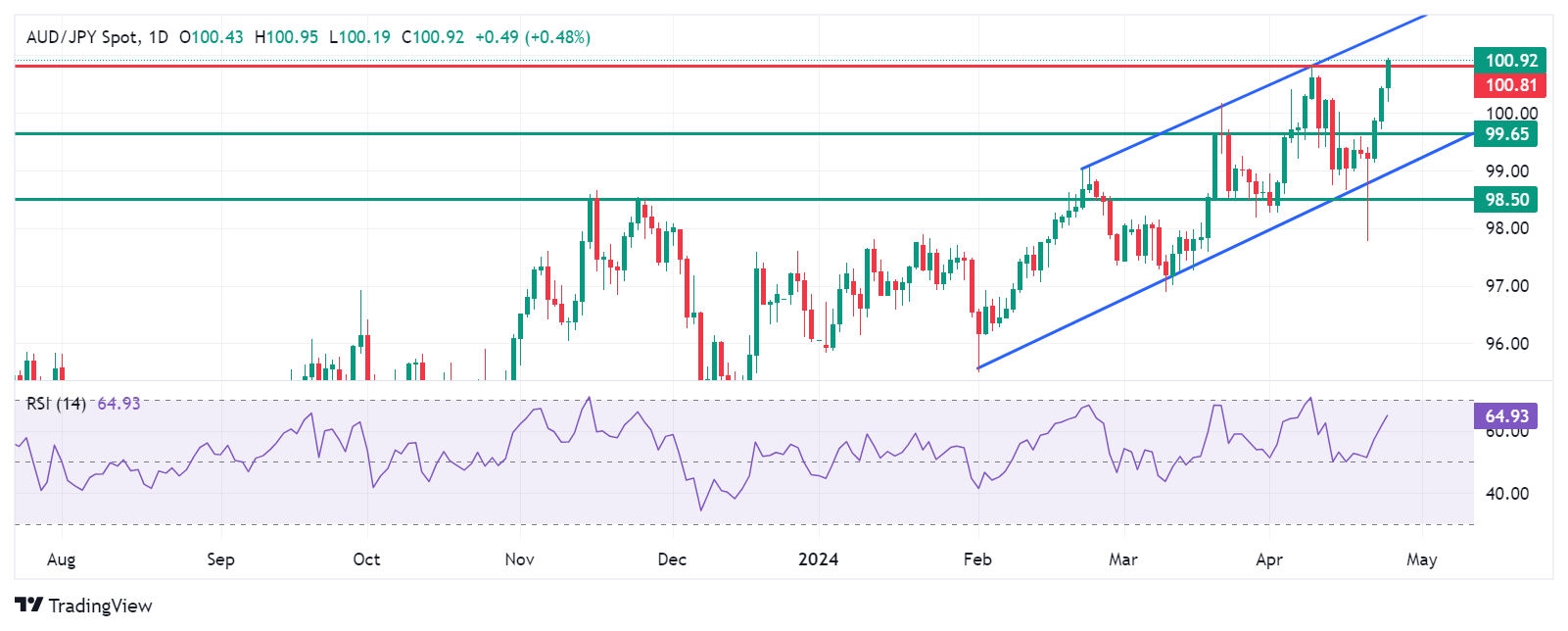
The AUD/JPY trades around 100.90 on Wednesday. The currency cross moves above April’s high of 100.81. The daily ascending channel, coupled with the 14-day Relative Strength Index (RSI) reacting above the 50 level, indicates a strengthening bullish sentiment. The immediate barrier appears at the psychological level of 101.00. A breakthrough above this level could prompt the AUD/JPY cross to test the upper boundary of the ascending channel at 101.50.
On the downside, the AUD/JPY cross could find key support at the major level of 100.50. A break below this level could lead the currency cross to the support level of 99.65, followed by the lower boundary of the ascending channel around the level of 99.00.
AUD/JPY: Daily Chart
Australian Dollar price today
The table below shows the percentage change of the Australian Dollar (AUD) against listed major currencies today. The Australian Dollar was the strongest against the Swiss Franc.
| USD | EUR | GBP | CAD | AUD | JPY | NZD | CHF | |
| USD | 0.12% | 0.15% | 0.13% | -0.26% | 0.09% | 0.02% | 0.20% | |
| EUR | -0.12% | 0.03% | 0.01% | -0.35% | -0.03% | -0.09% | 0.07% | |
| GBP | -0.15% | -0.02% | -0.01% | -0.38% | -0.05% | -0.12% | 0.07% | |
| CAD | -0.13% | -0.01% | 0.01% | -0.39% | -0.04% | -0.10% | 0.05% | |
| AUD | 0.25% | 0.36% | 0.39% | 0.38% | 0.29% | 0.28% | 0.43% | |
| JPY | -0.09% | 0.00% | 0.06% | 0.04% | -0.32% | -0.03% | 0.12% | |
| NZD | 0.00% | 0.10% | 0.15% | 0.10% | -0.28% | 0.04% | 0.16% | |
| CHF | -0.19% | -0.05% | -0.07% | -0.08% | -0.43% | -0.10% | -0.18% |
The heat map shows percentage changes of major currencies against each other. The base currency is picked from the left column, while the quote currency is picked from the top row. For example, if you pick the Euro from the left column and move along the horizontal line to the Japanese Yen, the percentage change displayed in the box will represent EUR (base)/JPY (quote).
Australian Dollar FAQs
One of the most significant factors for the Australian Dollar (AUD) is the level of interest rates set by the Reserve Bank of Australia (RBA). Because Australia is a resource-rich country another key driver is the price of its biggest export, Iron Ore. The health of the Chinese economy, its largest trading partner, is a factor, as well as inflation in Australia, its growth rate and Trade Balance. Market sentiment – whether investors are taking on more risky assets (risk-on) or seeking safe-havens (risk-off) – is also a factor, with risk-on positive for AUD.
The Reserve Bank of Australia (RBA) influences the Australian Dollar (AUD) by setting the level of interest rates that Australian banks can lend to each other. This influences the level of interest rates in the economy as a whole. The main goal of the RBA is to maintain a stable inflation rate of 2-3% by adjusting interest rates up or down. Relatively high interest rates compared to other major central banks support the AUD, and the opposite for relatively low. The RBA can also use quantitative easing and tightening to influence credit conditions, with the former AUD-negative and the latter AUD-positive.
China is Australia’s largest trading partner so the health of the Chinese economy is a major influence on the value of the Australian Dollar (AUD). When the Chinese economy is doing well it purchases more raw materials, goods and services from Australia, lifting demand for the AUD, and pushing up its value. The opposite is the case when the Chinese economy is not growing as fast as expected. Positive or negative surprises in Chinese growth data, therefore, often have a direct impact on the Australian Dollar and its pairs.
Iron Ore is Australia’s largest export, accounting for $118 billion a year according to data from 2021, with China as its primary destination. The price of Iron Ore, therefore, can be a driver of the Australian Dollar. Generally, if the price of Iron Ore rises, AUD also goes up, as aggregate demand for the currency increases. The opposite is the case if the price of Iron Ore falls. Higher Iron Ore prices also tend to result in a greater likelihood of a positive Trade Balance for Australia, which is also positive of the AUD.
The Trade Balance, which is the difference between what a country earns from its exports versus what it pays for its imports, is another factor that can influence the value of the Australian Dollar. If Australia produces highly sought after exports, then its currency will gain in value purely from the surplus demand created from foreign buyers seeking to purchase its exports versus what it spends to purchase imports. Therefore, a positive net Trade Balance strengthens the AUD, with the opposite effect if the Trade Balance is negative.
Author
Akhtar Faruqui
FXStreet
Akhtar Faruqui is a Forex Analyst based in New Delhi, India. With a keen eye for market trends and a passion for dissecting complex financial dynamics, he is dedicated to delivering accurate and insightful Forex news and analysis.