
Markets at all-time highs often leave investors with a tough decision — should you jump in now or wait for a pullback? The fear of "buying at the top" is real, but sitting on the sidelines can mean missing out on long-term growth. Instead of trying to time the market, investors can consider Dollar-Cost Averaging (DCA) as a more measured approach.
What is Dollar-cost averaging (DCA)?
Dollar-Cost Averaging (DCA) is an investment strategy where you divide your total investment amount into smaller, regular contributions over time. Instead of investing a lump sum all at once, you invest the same fixed amount on a regular schedule, regardless of the market’s price movements.
By consistently investing, DCA smooths out the impact of market volatility. This approach allows you to buy whole shares, purchasing more when prices are low and fewer when prices are high, resulting in a balanced average cost.
How does DCA work?
To understand how DCA works, let’s consider a simple example:
-
Imagine you have $12,000 to invest in a stock or an exchange-traded fund (ETF).
-
Instead of investing the entire amount on day one, you decide to invest $1,000 each month for 12 months.
-
Since you can only buy whole shares, any leftover cash is carried over to the next month. Here’s how it might play out:
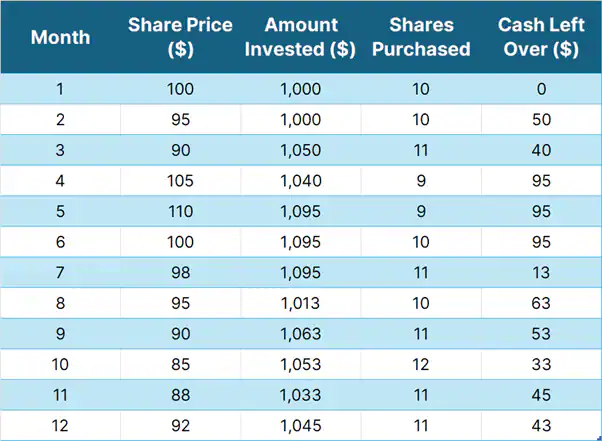
Source: Saxo
Summary:
-
Total invested = $12,000.
-
Total shares purchased = 125 shares (all whole shares).
-
Cash remaining = $43 (carried over).
-
Average cost per share = $96.00.
If you had invested the full $12,000 at the start of the year when the share price was $100, you would have purchased 120 shares. But by using DCA, you bought more shares during the dips, ending up with 125 shares at a lower average cost per share of $96.00.
Why should investors Use DCA?
DCA offers a systematic approach to investing, especially during periods of uncertainty. Here’s why it works so well:
-
Reduces emotional decision-making: It’s difficult to predict market tops or bottoms. DCA eliminates the pressure to "get the timing right." By following a set schedule, you avoid the emotional trap of chasing highs or selling lows.
-
Lowers the risk of investing at the top: When you invest in regular intervals, you reduce the risk of putting a large amount into the market just before a correction.
-
Takes advantage of market dips: When prices fall, your regular investment amount buys more shares, giving you a lower average cost per share.
-
Builds discipline and consistency: Investing on a schedule turns investing into a habit, making it easier to stay on track with long-term goals.
When should you use DCA?
DCA works well in a range of market conditions, but it is particularly useful in the following situations:
-
When markets are at all-time highs: Many investors worry about buying at the peak, but DCA provides a way to "ease into" the market rather than going all in.
-
When you're nervous about volatility: If you expect markets to be choppy, DCA allows you to spread your investment over time and potentially benefit from price drops.
-
When you have a lump sum to invest: Instead of investing it all at once, splitting it into smaller, consistent payments can make you feel more comfortable about market uncertainty.
DCA can be applied to both stocks and ETFs, making it a versatile strategy for different types of portfolios.
Pros and cons of DCA
Like any investment strategy, DCA has its strengths and limitations. Here’s a balanced view:
Benefits of DCA
-
Lowers the risk of "bad timing" by spreading investments over time.
-
Reduces stress since you don't have to worry about short-term market fluctuations.
-
Makes it easier to start investing, especially if you’re hesitant about current market levels.
-
Can be automated with investment apps and platforms, creating a “set-it-and-forget-it” system.
Drawbacks of DCA
-
If markets rise steadily, you may have been better off investing the full amount at the beginning.
-
It requires patience, as you are only partially invested at any point in time.
-
If you have a long-term horizon and the market is expected to grow, lump-sum investing could generate higher returns.
How DCA compares to lump sum investing
One of the biggest debates among investors is whether to invest a lump sum all at once or to stagger it using DCA. Research has shown that lump-sum investing tends to outperform DCA in the majority of market scenarios because markets generally trend higher over time.
However, DCA is more about managing risk and emotions than about maximizing returns. If you are concerned about volatility or feel anxious about investing a large sum all at once, DCA allows you to participate in market growth while reducing your exposure to sharp corrections.
Practical tips to start using DCA
-
Set a schedule: Decide how frequently you will invest (e.g., monthly or bi-weekly) and commit to the plan.
-
Choose an investment vehicle: DCA works well with ETFs, index funds, and individual stocks. ETFs are particularly useful because they offer diversification.
-
Automate your contributions: Many brokerage platforms allow you to set up recurring contributions, so you don't have to worry about missing a month.
-
Stick with the plan: It can be tempting to "pause" investments during market declines, but remember that DCA works best when you maintain consistency.
Read the original analysis: Worried about investing at market highs? Dollar-cost averaging (DCA) can help
The Saxo Bank Group entities each provide execution-only service and access to Analysis permitting a person to view and/or use content available on or via the website. This content is not intended to and does not change or expand on the execution-only service. Such access and use are at all times subject to (i) The Terms of Use; (ii) Full Disclaimer; (iii) The Risk Warning; (iv) the Rules of Engagement and (v) Notices applying to Saxo News & Research and/or its content in addition (where relevant) to the terms governing the use of hyperlinks on the website of a member of the Saxo Bank Group by which access to Saxo News & Research is gained. Such content is therefore provided as no more than information. In particular no advice is intended to be provided or to be relied on as provided nor endorsed by any Saxo Bank Group entity; nor is it to be construed as solicitation or an incentive provided to subscribe for or sell or purchase any financial instrument. All trading or investments you make must be pursuant to your own unprompted and informed self-directed decision. As such no Saxo Bank Group entity will have or be liable for any losses that you may sustain as a result of any investment decision made in reliance on information which is available on Saxo News & Research or as a result of the use of the Saxo News & Research. Orders given and trades effected are deemed intended to be given or effected for the account of the customer with the Saxo Bank Group entity operating in the jurisdiction in which the customer resides and/or with whom the customer opened and maintains his/her trading account. Saxo News & Research does not contain (and should not be construed as containing) financial, investment, tax or trading advice or advice of any sort offered, recommended or endorsed by Saxo Bank Group and should not be construed as a record of our trading prices, or as an offer, incentive or solicitation for the subscription, sale or purchase in any financial instrument. To the extent that any content is construed as investment research, you must note and accept that the content was not intended to and has not been prepared in accordance with legal requirements designed to promote the independence of investment research and as such, would be considered as a marketing communication under relevant laws.
Editors’ Picks

EUR/USD stays below 1.1800 as markets await Fed speeches
EUR/USD remains trapped in a tight range below 1.1800 in the second half of the day on Tuesday. The pair struggles amid a modest US Dollar strength and an improvement in risk sentiment, even as US tariff uncertainty lingers. The focus now remains on comments from Federal Reserve officials.

GBP/USD stays defensive below 1.3500 as USD firms up
GBP/USD stays on the back foot below 1.3500 in the European trading hours on Tuesday. The pair declines as the US Dollar rebounds from losses recorded over the previous two sessions. Traders will focus on the US weekly ADP Employment Change and Consumer Confidence data due later in the day, along with speeches from Federal Reserve officials.

USD/JPY climbs to 156.00 area as markets doubt BoJ rate hikes
USD/JPY catches a fresh bid wave and challenges the 156.00 region on Tuesday. The pair rallies as the Japanese Yen (JPY) falls hard on reports that Japan's PM Takaichi voiced concerns to BoJ Governor Ueda on interest rate hikes.
Editors’ Picks
EUR/USD stays below 1.1800 as markets await Fed speeches
EUR/USD remains trapped in a tight range below 1.1800 in the second half of the day on Tuesday. The pair struggles amid a modest US Dollar strength and an improvement in risk sentiment, even as US tariff uncertainty lingers. The focus now remains on comments from Federal Reserve officials.
USD/JPY climbs to 156.00 area as markets doubt BoJ rate hikes
USD/JPY catches a fresh bid wave and challenges the 156.00 region on Tuesday. The pair rallies as the Japanese Yen (JPY) falls hard on reports that Japan's PM Takaichi voiced concerns to BoJ Governor Ueda on interest rate hikes.

Gold retreats below $5,200 on renewed USD strength
Gold stages a deep correction following Monday's rally and trades below $5,200. Following the previous day's knee-jerk fall in reaction to US President Donald Trump's new global tariffs and the subsequent bounce, the US Dollar gathers strength and weighs on XAU/USD ahead of Fed policymakers' speeches.

Dogecoin, Shiba Inu, and Pepe extend losses on bearish signals
Meme coins are facing renewed selling pressure amid fading broad risk-on sentiment so far this week, with Dogecoin, Shiba Inu, and Pepe extending their losses after recent corrections.

AI-scare trade and tariff uncertainty takes hold
It was quite a day, with AI-disruption fears and tariff uncertainty triggering a risk-off session. By now, it's nearly impossible to have missed the Supreme Court's 6-3 decision that struck down US President Donald Trump's reciprocal tariffs last Friday.
RECOMMENDED LESSONS
Making money in forex is easy if you know how the bankers trade!

I’m often mystified in my educational forex articles why so many traders struggle to make consistent money out of forex trading. The answer has more to do with what they don’t know than what they do know. After working in investment banks for 20 years many of which were as a Chief trader its second knowledge how to extract cash out of the market.
5 Forex News Events You Need To Know

In the fast moving world of currency markets where huge moves can seemingly come from nowhere, it is extremely important for new traders to learn about the various economic indicators and forex news events and releases that shape the markets. Indeed, quickly getting a handle on which data to look out for, what it means, and how to trade it can see new traders quickly become far more profitable and sets up the road to long term success.
Top 10 Chart Patterns Every Trader Should Know

Chart patterns are one of the most effective trading tools for a trader. They are pure price-action, and form on the basis of underlying buying and selling pressure. Chart patterns have a proven track-record, and traders use them to identify continuation or reversal signals, to open positions and identify price targets.
7 Ways to Avoid Forex Scams

The forex industry is recently seeing more and more scams. Here are 7 ways to avoid losing your money in such scams: Forex scams are becoming frequent. Michael Greenberg reports on luxurious expenses, including a submarine bought from the money taken from forex traders. Here’s another report of a forex fraud. So, how can we avoid falling in such forex scams?
What Are the 10 Fatal Mistakes Traders Make
Trading is exciting. Trading is hard. Trading is extremely hard. Some say that it takes more than 10,000 hours to master. Others believe that trading is the way to quick riches. They might be both wrong. What is important to know that no matter how experienced you are, mistakes will be part of the trading process.
The challenge: Timing the market and trader psychology

Successful trading often comes down to timing – entering and exiting trades at the right moments. Yet timing the market is notoriously difficult, largely because human psychology can derail even the best plans. Two powerful emotions in particular – fear and greed – tend to drive trading decisions off course.