 Markus Heitkoetter
Rockwell Trading
Anyone that has been around the markets and trading for any period of time has probably heard that most traders lose money.
In fact, there’s actually an old trading adage that says:
90% of new traders will lose 90% of their account within 90 days.
So after reading that, before you reach for your broker’s phone number to wire out all of your money… how about I let you in on a little secret:
If you follow some simple rules and avoid these 3 mistakes, you can be in that minority of traders that actually make money consistently in the markets.
And if you are currently making one or all of the mistakes, I’ll also show you exactly how to fix it.
So let’s dive in!
1) Most Traders Enter A Trade Too Late
The first thing on my top 3 reasons why traders lose money is: Most traders get into trades WAY too late!
There are a lot of reasons this happens, but most commonly it’s because new traders are basically gambling. They’re buying stocks or options based on news, or a hot stock tip, which really isn’t what I would consider a strategy.
So let me give you a great example with a company I’m sure you’ve heard of: Uber Technologies (Yes, enemy #1 for taxi drivers worldwide.)
Last year Uber, known for its popular ride-sharing and food delivery services, IPO’d in May (2019).
With the disruption this company caused, their IPO had a lot of hype surrounding it, bringing a lot of investors to the table.
On the day of their IPO, UBER opened at $42/share and people poured into the stock.
For a few weeks, the stock had a turbulent, roller coaster of a ride all the way to as high as $47.08/share, a little over a 13% increase since its IPO.
And around this new high, more and more inexperienced retail traders piled in thinking that it would continue its bullish run with dollar signs in their eyes.
The mainstream media was continuing to hype it and more and more and investors and traders gobbled up more of the stock.
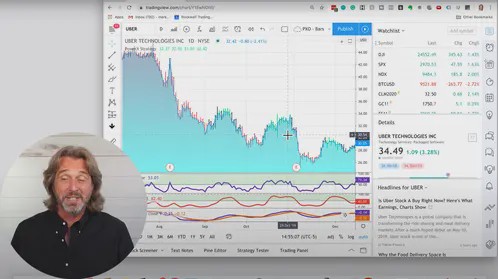
Looking at the image below, you’ll see after that high of $47 things got UGLY fast, with UBER falling day-after-day, week-after-week.
It wasn’t until November of 2019, about 7 months after their IPO that UBER found a temporary bottom at $25.58, down more than 45% from its high of $47.08… and I would bet there were a LOT of people who bought near or at the highs and were still holding at that point.
So what did retailer traders do when UBER made a bottom?
Yes, once again most (losing) retail traders didn’t get in at, or even around the bottom… once again, they piled as UBER neared its previous highs.
And as you’ll see yet again, UBER rolled over on its way to making another new all-time low this past March 2020 going all the way down to $13.71/share.
That’s more than a 70% decrease from its ATH and yes, I’m sure some investors rode it all the way to the bottom.
Now I want to share a second example with you, so let’s take a look at Amazon (AMZN).
So as you know, AMZN’s is a HOT STOCK and last year it has a crazy move where it crossed $2000/share…. and yes, just like our example with UBER, inexperienced retail traders piled in at the very top.
Once again, in the weeks that followed, AMZN’s stock tanked leaving those who’d piled in dazed and confused, now holding onto sizable losses.
So as you can see, the first of my top 3 reasons most traders are losing money is simply because they’re piling in way too late in a stock’s move, generally near a high.
Now on to reason number 2:
2) Most Traders EXIT Too Late
Yes, as you can imagine if people are getting in too late, well, they’re also typically getting out too late as well.
So let’s talk about why this happens. Why do retail traders tend to hold onto trades way too long, either turning a small loss into a BIG loss or sometimes even more painful, turning a winner into a loser?
Let’s take a look at another example with an UBER competitor, LYFT.
Like UBER, LYFT also had its IPO in 2019, opening up at $87.24/share… but that didn’t last long.
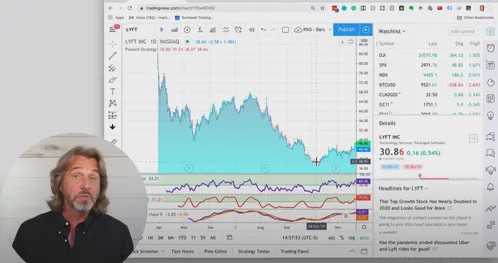
n less than two months, LYFT went as low as $47.17… and what do you think those who bought during the IPO are saying right about now:
“Oh, I’m holding it because IT WILL TURN AROUND!”
This is generally where I see traders get religious
Instead of ‘taking their medicine’ and getting out when the trade moved against them, they held on and are now pleading and praying the stock will turn around.
I hate to be the one to break it to you, but ‘hope’ is not a strategy… at least not one with a winning trading record.
Now on to number three in our list of top reasons why most traders lose money:
3) They Don’t Have A Trading Strategy
As you’ll see, I’ve saved the best for last as this one alone can help fix or eliminate the other two we just discussed.
So first, let’s answer this question: What Is A Trading Strategy?
Well, a trading strategy gives you three key pieces of information you need before ever entering a trade:
1) It tells you WHAT you are trading. Is it stocks, options, futures, cryptocurrencies? This is answered in your trading strategy.
2) It answers when you ENTER a trade.
3) It answers when you EXIT a trade and that’s exiting with a profit or loss.
Now, let’s take a look at an example here using TSLA on how I make decisions trading.
I like to look at three different indicators, that when in alignment, give me a clear signal to go long or short a stock or ETF.
As you can see on the charts, back in December of last year (2019) my indicators gave us a long signal on TSLA at around $370/share.
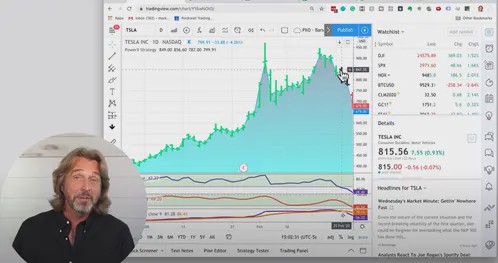
And the indicators told me we were good to go until around $850/share. All I had to do is let the indicators tell me when to get in and when to get out… no guessing, hoping or praying.
Summary
So as you can see, there’s actually no big secret to why most traders are losing money.
It’s actually pretty simple to see and correct, but it takes a plan and a little bit of discipline.
If you’re brand new and not sure where to get started, I’ve written The PowerX Strategy, a book that outlines my EXACT trading strategy for trading stocks and options.
Trading Futures, options on futures and retail off-exchange foreign currency transactions involves substantial risk of loss and is not suitable for all investors. You should carefully consider whether trading is suitable for you in light of your circumstances, knowledge, and financial resources. You may lose all or more of your initial investment. The lower the day trade margin, the higher the leverage and riskier the trade. Leverage can work for you as well as against you; it magnifies gains as well as losses. Past performance is not necessarily indicative of future results.
Editors’ Picks

EUR/USD stays well offered below 1.1800
The selling pressure on EUR/USD is picking up pace, with the pair slipping decisively below the key 1.1800 level and sliding to fresh two week lows as Wednesday’s session draws to a close. The move lower comes as the US Dollar finds renewed strength after the latest round of US data and the release of the FOMC Minutes. Next of note on the docket will be the US weekly Initial Jobless Claims.

GBP/USD reaches multi-day lows near 1.3500
GBP/USD reverses its initial upside momentum and is now adding to previous declines, approaching the 1.3500 region on Wednesday. Cable’s downtick comes on the back of decent gains in the Greenback and easing UK inflation figures, which seem to have reinforced the case for a BoE rate cut in March.

USD/JPY holds gains near 154.00 ahead of the Fed’s minutes
USD/JPY retraces Tuesday's losses and returns near weekly highs in the area of 154.00. The US Dollar trims losses in quiet markets with all eyes on the Fed's minutes. Weak Japanese GDP data resurfaced concerns about Japan's fiscal stability and halted JPY's recovery.
Editors’ Picks

AUD/USD: Further weakness could retest 0.7000
AUD/USD resumes its decline, leaving behind two daily gains in a row and approaching the area of multi-day lows in the 0.7040-0.7030 band ahead of the opening bell in Asia. Moving forward, the Aussie is expected to remain under scrutiny in light of the publication of the jobs report in Australia.
EUR/USD stays well offered below 1.1800
The selling pressure on EUR/USD is picking up pace, with the pair slipping decisively below the key 1.1800 level and sliding to fresh two week lows as Wednesday’s session draws to a close. The move lower comes as the US Dollar finds renewed strength after the latest round of US data and the release of the FOMC Minutes. Next of note on the docket will be the US weekly Initial Jobless Claims.

Gold battle to regain $5,000 continues
Gold is back on the front foot on Wednesday, shaking off part of the early week softness and challenging two-day highs near the $5,000 mark per troy ounce. The move comes ahead of the FOMC Minutes and is unfolding despite an intense rebound in the US Dollar.

Bitcoin has found or is near a bottom, extended consolidation to follow: K33
Bitcoin (BTC) is nearing or has already established a bottom, which could be followed by a sustained period of slow price movement, according to K33.

Mixed UK inflation data no gamechanger for the Bank of England
Food inflation plunged in January, but service sector price pressure is proving stickier. We continue to expect Bank of England rate cuts in March and June. The latest UK inflation read is a mixed bag for the Bank of England, but we doubt it drastically changes the odds of a March rate cut.
RECOMMENDED LESSONS
Making money in forex is easy if you know how the bankers trade!

I’m often mystified in my educational forex articles why so many traders struggle to make consistent money out of forex trading. The answer has more to do with what they don’t know than what they do know. After working in investment banks for 20 years many of which were as a Chief trader its second knowledge how to extract cash out of the market.
5 Forex News Events You Need To Know

In the fast moving world of currency markets where huge moves can seemingly come from nowhere, it is extremely important for new traders to learn about the various economic indicators and forex news events and releases that shape the markets. Indeed, quickly getting a handle on which data to look out for, what it means, and how to trade it can see new traders quickly become far more profitable and sets up the road to long term success.
Top 10 Chart Patterns Every Trader Should Know

Chart patterns are one of the most effective trading tools for a trader. They are pure price-action, and form on the basis of underlying buying and selling pressure. Chart patterns have a proven track-record, and traders use them to identify continuation or reversal signals, to open positions and identify price targets.
7 Ways to Avoid Forex Scams

The forex industry is recently seeing more and more scams. Here are 7 ways to avoid losing your money in such scams: Forex scams are becoming frequent. Michael Greenberg reports on luxurious expenses, including a submarine bought from the money taken from forex traders. Here’s another report of a forex fraud. So, how can we avoid falling in such forex scams?
What Are the 10 Fatal Mistakes Traders Make
Trading is exciting. Trading is hard. Trading is extremely hard. Some say that it takes more than 10,000 hours to master. Others believe that trading is the way to quick riches. They might be both wrong. What is important to know that no matter how experienced you are, mistakes will be part of the trading process.
The challenge: Timing the market and trader psychology

Successful trading often comes down to timing – entering and exiting trades at the right moments. Yet timing the market is notoriously difficult, largely because human psychology can derail even the best plans. Two powerful emotions in particular – fear and greed – tend to drive trading decisions off course.