
Reactive trading and news trading - the strategies that are based on your interpretation of the events - are always a hot topic. While it is popular among cryptocurrency enthusiasts, who may have access to the best first-hand knowledge about the coins they are trading, it may be not the best strategy when trading Forex.
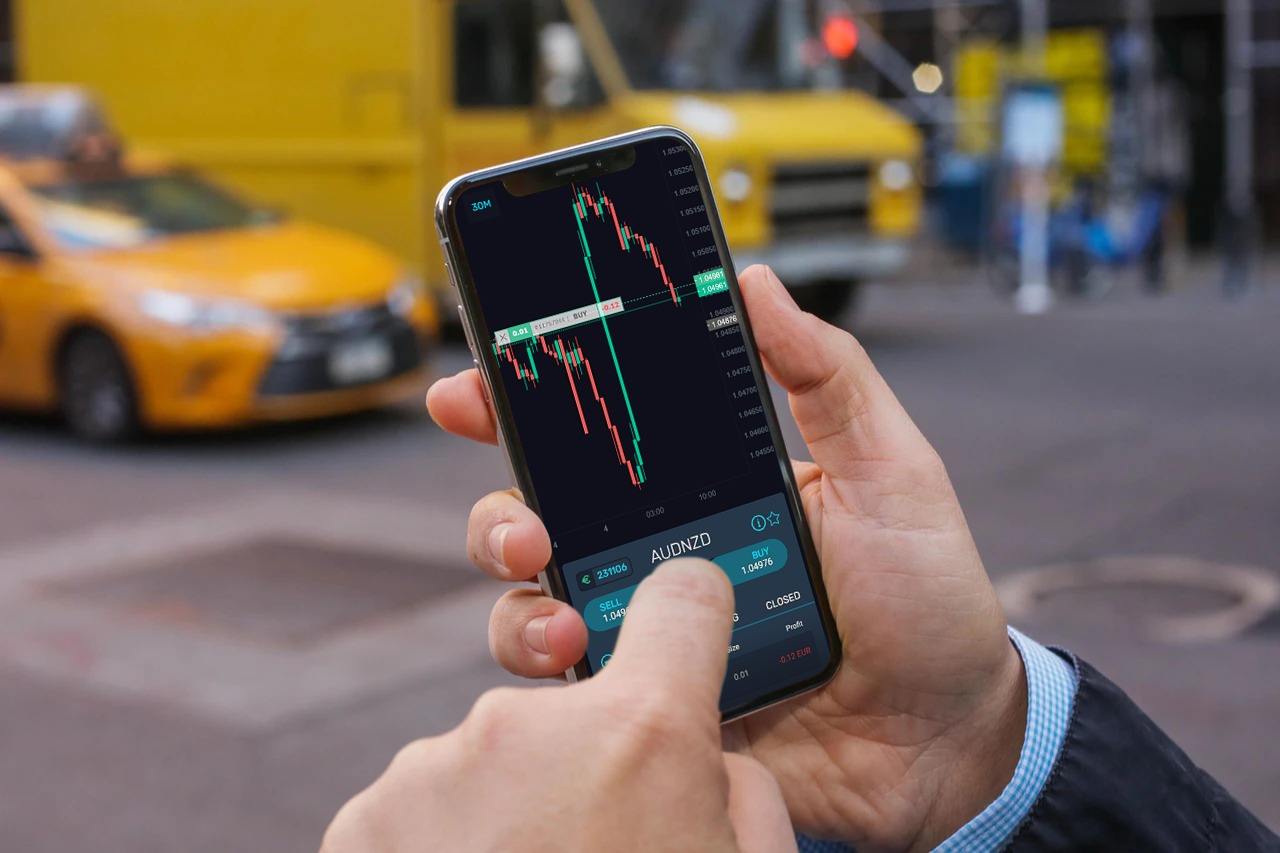
In this post, SimpleFX will introduce you to a currency pair that may suit traders that want to make decisions based on technical analysis, not news. In this case, you want to avoid the drama and forex mainstream. You don't want to trade pound sterling among the Brexit turmoil. You want volatility, strong trends with no prolonged consolidations on relatively high volumes - a choppy market trading sideways.
There is a currency pair that shares these features - it's AUD NZD called within forex lingo Aussie/Kiwi.
Both currencies are considered risk-on. This combination helps you avoid situations where a big economical or political event blows-up the strategy you built on the technical analysis. If you are trading a risk-on currency - like the Australian dollar or New Zealand dollar - against a risk-off currency that is considered a safe investment in times of high uncertainty - such as Japanese yen - you are prone to unexpected situations.
Trading two risk-on currencies at the same time make your trading strategy more robust.
On the other hand, both Australia and New Zealand have been able to stay away from the global headlines. There's hardly ever a top breaking news story about these markets.
As for the currency pair itself, it has all the qualities a day trader looks for. It is highly volatile (although not the most volatile pair there is, which may expect the relatively low popularity of Aussie/Kiwi).
As you can see in the 1D chart below AUD NZD trends strongly. There are very short sideways drifts in the pair, and most often you can identify them clearly as consolidation periods due to a lower trading volume.
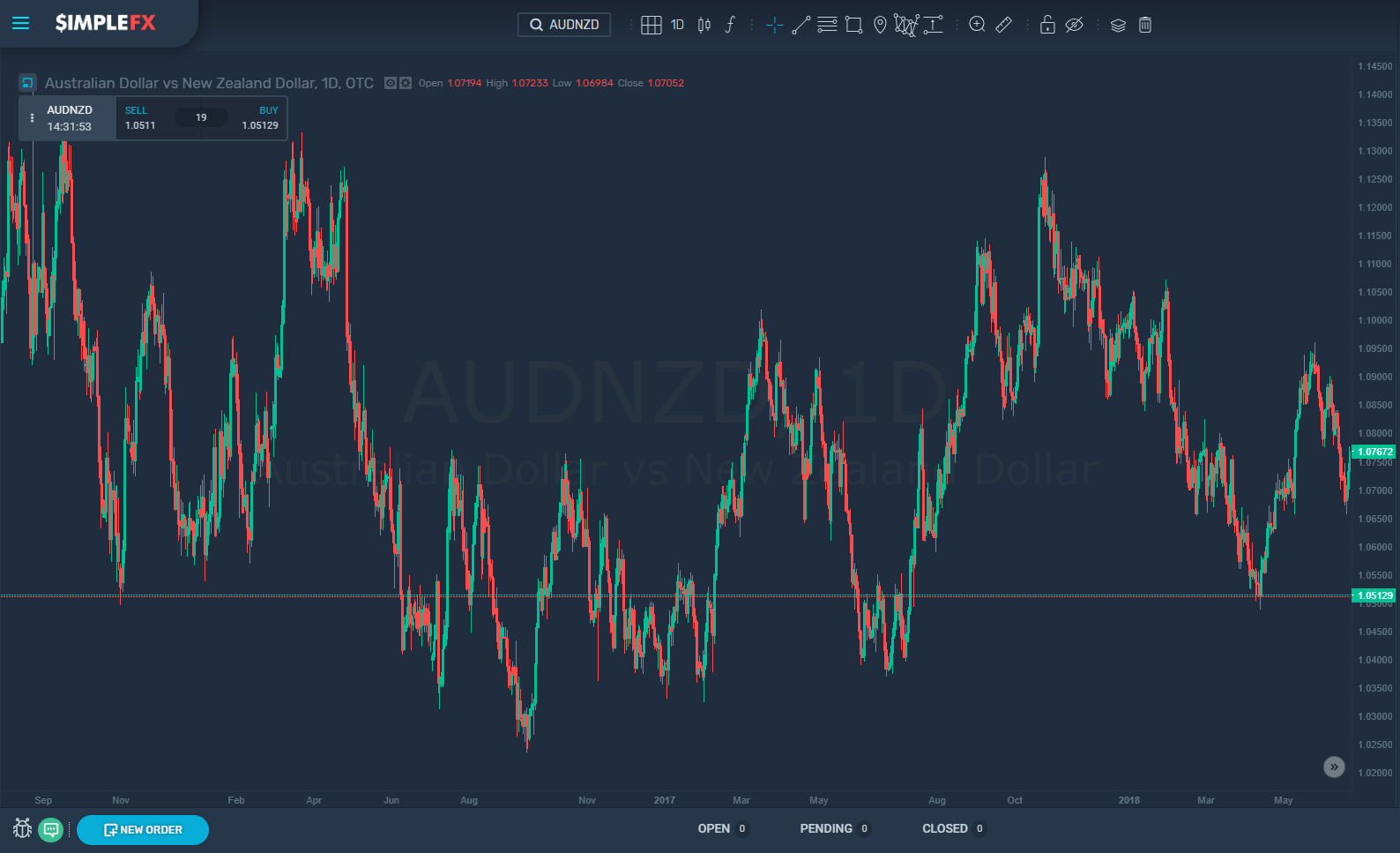
AUDNZD is showing some serious volatility. Source: SimpleFX WebTrader
Strong trends are much easier to trade. Nevertheless, many forex traders choose pairs that are very tricky. Just take a look at the very popular EURUSD. You can see very long periods where the market is undecided and it is very difficult to make money trading at this time frame. These sideway trends are not obvious consolidations, so it's even more difficult to implement any trading strategy effectively.
The volatility is quite strong since the two currencies although in the same region don't correlate much. Being relative neighbors the two economies are perceived more like rivals big institutional investors can choose from.
One last but not least feature of the Aussie/Kiwi pair is the early timezone. If you are trading daily candlesticks from Europe, the Americas, Africa or the even Middle East, the news that may affect your strategy come very early in the cycle. You can adjust your positions if anything unexpected happens, which makes it an even more comfortable forex instrument for traders that want to focus on technical analysis rather than reactions to the news.
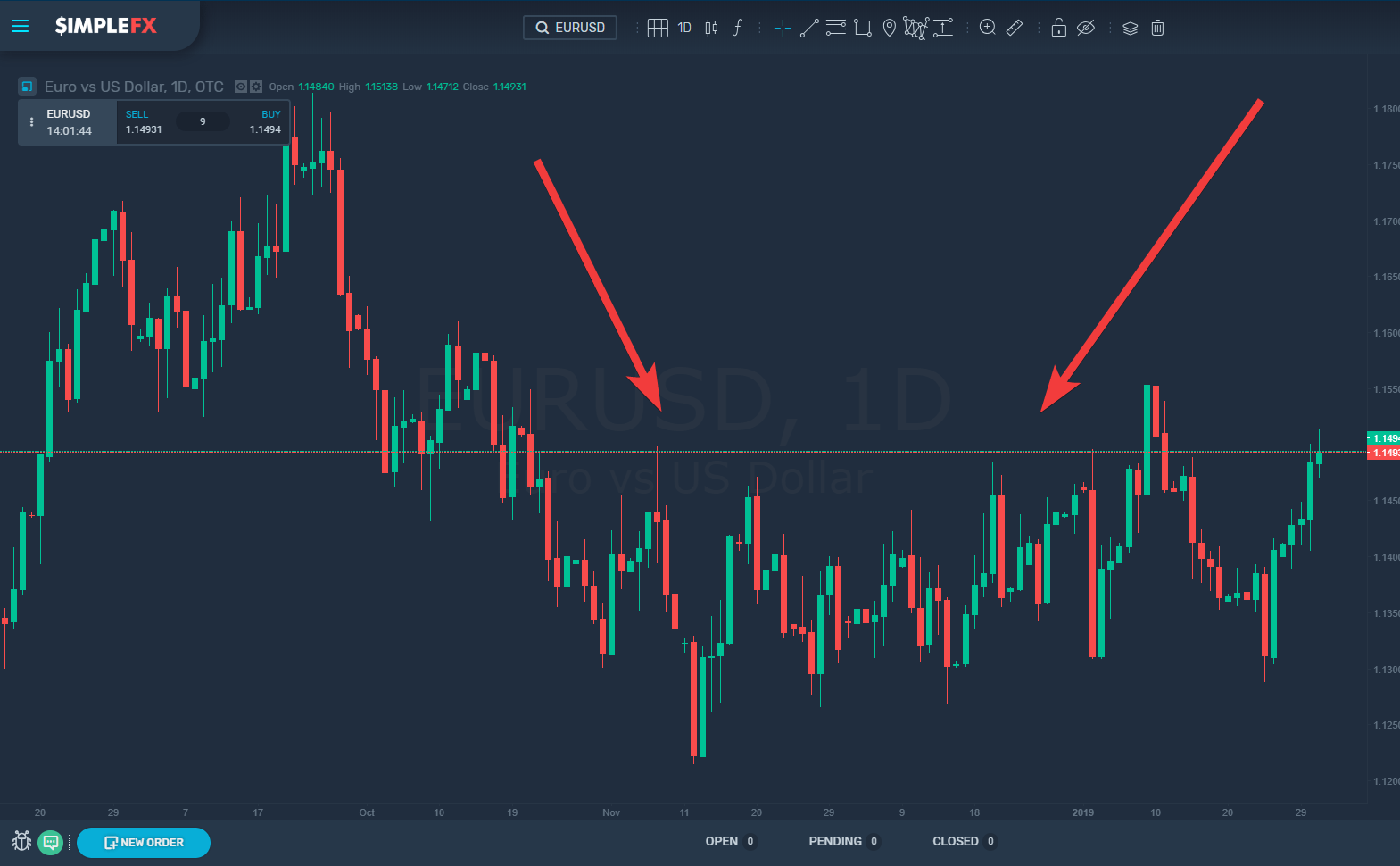
Trading EURUSD can be very tricky
Because of all the above characteristics, AUD NZD is a good pair to test your trading system, since there are not many external events that may blow up your otherwise sound trading strategy.
Trading in the products and services of SimpleFX may result in losses as well as profits. In particular trading in leveraged products, such as but not limited to, cryptocurrency, foreign exchange, derivatives and commodities can be very speculative. Losses and profits may fluctuate both violently and rapidly.
Editors’ Picks

EUR/USD looks offered below 1.1900
EUR/USD keeps its bearish tone unchanged ahead of the opening bell in Asia, returning to the sub-1.1900 region following a firmer tone in the US Dollar. Indeed, the pair reverses two consecutive daily gains amid steady caution ahead of Wednesday’s key US Nonfarm Payrolls release.

GBP/USD slips back to daily lows near 1.3640
GBP/USD drops to daily lows near 1.3640 as sellers push harder and the Greenback extends its rebound in the latter part of Tuesday’s session. Looking ahead, the combination of key US releases, including NFP and CPI, alongside important UK data, should keep the pound firmly in focus over the coming days.

USD/JPY extends backslide as election fallout bolsters Yen
USD/JPY is trading in a choppy, range-bound structure on the daily chart, oscillating between the January high near 159.450 and the late-January swing low at 152.100. Price closed Monday at 154.410, dropping sharply by 1.47 yen (0.94%) after an initial gap higher following Prime Minister Takaichi's landslide election victory was met with verbal intervention from Finance Minister Katayama and Japan's top currency official Mimura, both signaling readiness to act on yen volatility.
Editors’ Picks

When are the China’s CPI, PPI and how could they affect AUD/USD?
The National Bureau of Statistics of China will publish its data for January at 01.30 GMT. The Consumer Price Index is expected to show a rise of 0.4% YoY in January, compared to 0.8% in December. The Producer Price Index is projected to show a decline of 1.5% in January versus a fall of 1.9% prior.
USD/JPY extends backslide as election fallout bolsters Yen
USD/JPY is trading in a choppy, range-bound structure on the daily chart, oscillating between the January high near 159.450 and the late-January swing low at 152.100. Price closed Monday at 154.410, dropping sharply by 1.47 yen (0.94%) after an initial gap higher following Prime Minister Takaichi's landslide election victory was met with verbal intervention from Finance Minister Katayama and Japan's top currency official Mimura, both signaling readiness to act on yen volatility.

Gold declines to near $5,050, focus shifts to US jobs data
Gold price falls to near $5,045 during the early Asian session on Wednesday. Traders assess whether prices have found a floor following a historic sell-off. The delayed US employment report for January, which was pushed back due to the recently ended four-day government shutdown, will take center stage later on Wednesday.

Ethereum: Whales buy the dip amid rising short bets
Following one of Ethereum's largest weekly drawdowns, whales are slowly returning to action alongside a drop in retail selling pressure. After slightly selling into the decline at the start of the month, whales or wallets with a balance of 10K-100K ETH began buying the dip last Wednesday as prices crashed further.

Dollar drops and stocks rally: The week of reckoning for US economic data
Following a sizeable move lower in US technology Stocks last week, we have witnessed a meaningful recovery unfold. The USD Index is in a concerning position; the monthly price continues to hold the south channel support.
RECOMMENDED LESSONS
Making money in forex is easy if you know how the bankers trade!

I’m often mystified in my educational forex articles why so many traders struggle to make consistent money out of forex trading. The answer has more to do with what they don’t know than what they do know. After working in investment banks for 20 years many of which were as a Chief trader its second knowledge how to extract cash out of the market.
5 Forex News Events You Need To Know

In the fast moving world of currency markets where huge moves can seemingly come from nowhere, it is extremely important for new traders to learn about the various economic indicators and forex news events and releases that shape the markets. Indeed, quickly getting a handle on which data to look out for, what it means, and how to trade it can see new traders quickly become far more profitable and sets up the road to long term success.
Top 10 Chart Patterns Every Trader Should Know

Chart patterns are one of the most effective trading tools for a trader. They are pure price-action, and form on the basis of underlying buying and selling pressure. Chart patterns have a proven track-record, and traders use them to identify continuation or reversal signals, to open positions and identify price targets.
7 Ways to Avoid Forex Scams

The forex industry is recently seeing more and more scams. Here are 7 ways to avoid losing your money in such scams: Forex scams are becoming frequent. Michael Greenberg reports on luxurious expenses, including a submarine bought from the money taken from forex traders. Here’s another report of a forex fraud. So, how can we avoid falling in such forex scams?
What Are the 10 Fatal Mistakes Traders Make
Trading is exciting. Trading is hard. Trading is extremely hard. Some say that it takes more than 10,000 hours to master. Others believe that trading is the way to quick riches. They might be both wrong. What is important to know that no matter how experienced you are, mistakes will be part of the trading process.
The challenge: Timing the market and trader psychology

Successful trading often comes down to timing – entering and exiting trades at the right moments. Yet timing the market is notoriously difficult, largely because human psychology can derail even the best plans. Two powerful emotions in particular – fear and greed – tend to drive trading decisions off course.