 Sam Seiden
Independent Analyst
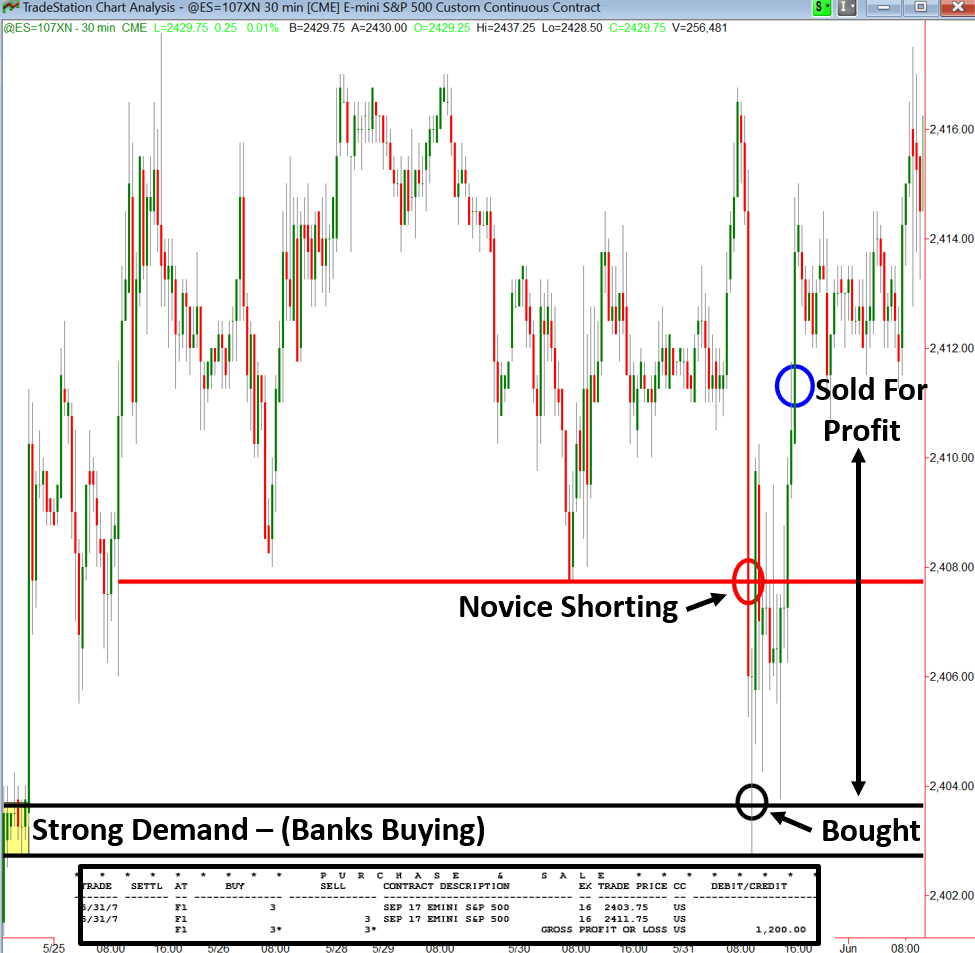
The chart below is an income trade in the S&P that I took on 5/31/17. The S&P declined into one of my strong demand zones and then proceeded to rally for a couple days. As you can see on the chart below, I followed the simple rules I have been sharing and bought near the low, into a clear demand zone where banks were buying also. Then, I took a profit of $1,200 when price reached my target (blue circle). What surprised me was seeing many traders sell short in that red circle area, when price broke below those prior pivot lows. Watching the markets, I saw this happening and know why it happens so I wanted to talk about it here to help others not make this novice mistake.
People who shorted the S&P just below that 2408 level (red line) did so because conventional technical analysis rules tell them to short there. Bearish engulfing candles and a break of pivot lows is a clear sell signal for traders to follow the rules of technical analysis. The reason you don’t see people making a consistent low risk living from the markets with this school of thought is because there is a major flaw in it. The flaw is that all the chart patterns, indicators, oscillators and so on never take one thing into consideration – where are the buy orders (demand) and sell orders (supply). Yes, believe it or not, conventional technical analysis which is what dominates the trading/investing books and the internet IGNORES the only thing that matters when making a proper buy and sell decision, demand and supply! In the S&P here, this group was selling just above a price point where banks, and I, were buying, which is a very novice mistake.
S&P Income Trade 5/31/17 – Profit: $1,200.00
It’s simply a matter of how you “think the markets” that separates those who make a living in the markets from those who don’t. To be successful at trading and investing, you must focus on what is real, not what you feel. What’s real is that price movement in any and all markets is a simple function of an ongoing supply and demand relationship. Prices turn at levels where this simple and straight forward equation is out of balance, like my demand zone and entry into the S&P trade. There are only two groups at play in the markets, those who achieve consistent profits and those who provide those profits. So, before you put your hard – earned money at risk in the markets, make sure your trading and investing strategy is reality based and focused on how you make money buying and selling anything in life. This is the key financial mindset that allows you to produce the income and wealth needed to start living the life you choose to live.
Note: All information on this page is subject to change. The use of this website constitutes acceptance of our user agreement. Please read our privacy policy and legal disclaimer. Opinions expressed at FXstreet.com are those of the individual authors and do not necessarily represent the opinion of FXstreet.com or its management. Risk Disclosure: Trading foreign exchange on margin carries a high level of risk, and may not be suitable for all investors. The high degree of leverage can work against you as well as for you. Before deciding to invest in foreign exchange you should carefully consider your investment objectives, level of experience, and risk appetite. The possibility exists that you could sustain a loss of some or all of your initial investment and therefore you should not invest money that you cannot afford to lose. You should be aware of all the risks associated with foreign exchange trading, and seek advice from an independent financial advisor if you have any doubts.
Editors’ Picks

EUR/USD keeps the rangebound trade near 1.1850
EUR/USD is still under pressure, drifting back towards the 1.1850 area as Monday’s session draws to a close. The modest decline in spot comes as the US Dollar picks up a bit of support, while thin liquidity and muted volatility, thanks to the US market holiday, are exaggerating price swings and keeping trading conditions choppy.

GBP/USD flirts with daily lows near 1.3630
GBP/USD has quickly given back Friday’s solid gains, turning lower at the start of the week and drifting back towards the 1.3630 area. The focus now shifts squarely to Tuesday’s UK labour market report, which is likely to keep the quid firmly in the spotlight and could set the tone for Cable’s next move.

USD/JPY advances on weak Japanese GDP, holiday-thinned trading
USD/JPY rises while US and Japanese markets remain closed for holidays. Weak Japanese Gross Domestic Product figures curb tightening expectations. Investors await speeches from Federal Reserve Vice Chair for Supervision.
Editors’ Picks

AUD/USD retargets 0.7100 ahead of RBA Minutes
AUD/USD keeps the slightly bid bias around 0.7070 ahead of the opening bell in Asia. Indeed, the pair reverses two daily pullbacks in a row, meeting some initial contention around 0.7050 while investors gear up for the release of the RBA Minutes early on Tuesday.
EUR/USD keeps the rangebound trade near 1.1850
EUR/USD is still under pressure, drifting back towards the 1.1850 area as Monday’s session draws to a close. The modest decline in spot comes as the US Dollar picks up a bit of support, while thin liquidity and muted volatility, thanks to the US market holiday, are exaggerating price swings and keeping trading conditions choppy.

Gold battle around $5,000 continues
Gold is giving back part of Friday’s sharp rebound, deflating below the key $5,000 mark per troy ounce as the new week gets underway. Modest gains in the US Dollar are keeping the metal in check, while thin trading conditions, due to the Presidents Day holiday in the US, are adding to the choppy and hesitant tone across markets.

AI Crypto Update: Bittensor eyes breakout as AI tokens falter
The artificial intelligence (AI) cryptocurrency segment is witnessing heightened volatility, with top tokens such as Near Protocol (NEAR) struggling to gain traction amid the persistent decline in January and February.

The week ahead: Key inflation readings and why the AI trade could be overdone
It is likely to be a quiet start to the week, with US markets closed on Monday for Presidents Day. European markets are higher across the board and gold is clinging to the $5,000 level after the tamer than expected CPI report in the US reduced haven flows to precious metals.
RECOMMENDED LESSONS
Making money in forex is easy if you know how the bankers trade!

I’m often mystified in my educational forex articles why so many traders struggle to make consistent money out of forex trading. The answer has more to do with what they don’t know than what they do know. After working in investment banks for 20 years many of which were as a Chief trader its second knowledge how to extract cash out of the market.
5 Forex News Events You Need To Know

In the fast moving world of currency markets where huge moves can seemingly come from nowhere, it is extremely important for new traders to learn about the various economic indicators and forex news events and releases that shape the markets. Indeed, quickly getting a handle on which data to look out for, what it means, and how to trade it can see new traders quickly become far more profitable and sets up the road to long term success.
Top 10 Chart Patterns Every Trader Should Know

Chart patterns are one of the most effective trading tools for a trader. They are pure price-action, and form on the basis of underlying buying and selling pressure. Chart patterns have a proven track-record, and traders use them to identify continuation or reversal signals, to open positions and identify price targets.
7 Ways to Avoid Forex Scams

The forex industry is recently seeing more and more scams. Here are 7 ways to avoid losing your money in such scams: Forex scams are becoming frequent. Michael Greenberg reports on luxurious expenses, including a submarine bought from the money taken from forex traders. Here’s another report of a forex fraud. So, how can we avoid falling in such forex scams?
What Are the 10 Fatal Mistakes Traders Make
Trading is exciting. Trading is hard. Trading is extremely hard. Some say that it takes more than 10,000 hours to master. Others believe that trading is the way to quick riches. They might be both wrong. What is important to know that no matter how experienced you are, mistakes will be part of the trading process.
The challenge: Timing the market and trader psychology

Successful trading often comes down to timing – entering and exiting trades at the right moments. Yet timing the market is notoriously difficult, largely because human psychology can derail even the best plans. Two powerful emotions in particular – fear and greed – tend to drive trading decisions off course.