
By Rob Jones
Trading CFDs is what is generally referred to as directional trading; while one can make money whether the price of the underlying asset goes up or down, this will only happen if the direction of the move can be correctly predicted.
Going long just before a price drop or going short before a price increase will have only one consequence: the trader will lose money.
Technical Indicators – the Ichimoku Kinko Hyo
There are literally hundreds of technical indicators out there that a trader can use to help predict market direction. One of them is the Ichimoku Kinko Hyo, which was developed in Japan during the previous century and which is gaining increasing popularity in the West because of its ability to identify trends.
The Ichimoku is actually a combination of different indicators that together form a formidable asset in many traders’ arsenals. With the help of this indicator it is possible to identify not only whether the market is in an up- or downtrend, but also where the vital support and resistance points can be found.
The indicator consists of five lines: The kijun-sen, tenkan-sen, senkou span A, senkou span B and chickou span. Fig. 11.05(a) is a candle stick price chart of the AUD/USD together with an Ichimoku Kinko Hyo chart
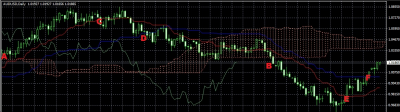
Fig. 11.05(a)
The Ichimoku Cloud is of paramount importance here. When the price is between the upper and lower levels of the cloud, i.e. inside the cloud, it is not recommended that the trader should enter into a new trade.
When the price breaks out from the top of the cloud, such as was the case at point A in Fig. 11.05(a), this confirms that an uptrend is underway. This is a good point to enter into a long CFD trade.
For an exit level the trader then has several choices. He/she can exit the trade as soon as it drops below the red Tenkan Sen line at point C, which acts as primary point of support. A more adventurous trader could hang on until the trade breaks down through the second support level of the blue Kijun Sen at point D, but at this stage a lot of the profit in the trade would already have been lost.
Some traders even wait until the price drops back into the Ichimoku cloud again, but in the above example this would have meant giving up most of the profit the trade offered.
A similar approach is followed in a bear market: go short when the price drops below the cloud at point B; remain in the trade until it turns around and crosses the red Tenkan Sen line at point E (first resistance), or wait for it to cross the blue Kijun Sen at point F (second resistance). If the price turned around between points E and F this would have worked in the trader’s favour, but in this case it would have meant giving up much of the profit the trade offered.
Waiting until the trade entered the Ichimoku cloud again would have resulted in the trade barely breaking even or even making a loss.
Foreign exchange (forex) trading carries a high level of risk and may not be suitable for all investors. The risk grows as the leverage is higher.
investment objectives, risk appetite and the trader’ level of experience should be carefully weighed before entering the forex market. There is always a possibility of losing some or all of your initial investment / deposit, so you should not invest money which is which it can’t afford to lose. The high risk that is involved with currency trading must be known to you. Please ask for advice from an independent financial advisor before entering this market.
Any comments made on Forex Crunch or on other sites that have received permission to republish the content originating on Forex Crunch reflect the opinions of the individual authors and do not necessarily represent the opinions of any of Forex Crunch’s authorized authors. Forex Crunch has not verified the accuracy or basis-in-fact of any claim or statement made by any independent author: Omissions and errors may occur.
Any news, analysis, opinion, price quote or any other information contained on Forex Crunch and permitted re-published content should be taken as general market commentary. This is by no means investment advice. Forex Crunch will not accept liability for any damage, loss, including without limitation to, any profit loss, which may either arise directly or indirectly from use of such information.
Editors’ Picks

EUR/USD consolidates around 1.0900, bullish bias remains ahead of key US data
The EUR/USD pair is seen consolidating its strong gains registered over the past two days and oscillating in a narrow band during the Asian session on Tuesday. Spot prices currently trade around the 1.1900 mark, just below an over one-week high touched the previous day.

GBP/USD tilts bullish as markets barrel toward mid-week NFP print
GBP/USD is holding a broader bullish structure on the daily chart, with price trading well above the 50 Exponential Moving Average at 1.3507 and the 200 EMA at 1.3310, confirming the intermediate uptrend that has been in place since the November 2025 low near 1.2300.

USD/JPY slumps below 156.00 as Japanese Yen strengthens after Takaichi's landslide victory
The USD/JPY pair tumbles to near 155.90 during the early Asian session on Tuesday. The Japanese Yen strengthens against the US Dollar after Japanese Prime Minister Sanae Takaichi led the ruling Liberal Democratic Party to a historic landslide win. Traders braced for key US economic data that could offer more clues on the Federal Reserve's monetary policy.
Editors’ Picks

AUD/USD taps three-year highs on broad US Dollar weakness
AUD/USD is trading near three-year highs after a strong break above the 0.7000 psychological level for the first time since February 2023, supported by the Reserve Bank of Australia's surprise 25 basis point rate hike to 3.85% at its February meeting. The daily chart shows the pair in a well-defined uptrend, holding above both the 50-day Exponential Moving Average near 0.6970 and the 200-day EMA around 0.6700.

Gold falls below $5,050 as traders await US jobs data
Gold price attracts some sellers near $5,035 during the early Asian session on Tuesday. The precious metal edges lower amid improved risk sentiment and some profit-taking. Traders brace for key US economic data later this week, including delayed employment and inflation reports.
USD/JPY slumps below 156.00 as Japanese Yen strengthens after Takaichi's landslide victory
The USD/JPY pair tumbles to near 155.90 during the early Asian session on Tuesday. The Japanese Yen strengthens against the US Dollar after Japanese Prime Minister Sanae Takaichi led the ruling Liberal Democratic Party to a historic landslide win. Traders braced for key US economic data that could offer more clues on the Federal Reserve's monetary policy.

Litecoin eyes $50 as heavy losses weigh on investors
Following a strong downtrend across the crypto market over the past week, Litecoin holders are under immense pressure. The Bitcoin fork has trimmed about $1.81 billion from its market capitalization since the beginning of the year, sending it below the top 20 cryptos by market cap.

The market is buying everything again but is it dancing on a borrowed floor
The market has a short memory and a fast trigger finger. Last week’s liquidation barely cooled before risk came roaring back, pushing the S&P toward record territory and reinstalling Big Tech as the engine of choice. This is not discovery. It is re exposure.
RECOMMENDED LESSONS
Making money in forex is easy if you know how the bankers trade!

I’m often mystified in my educational forex articles why so many traders struggle to make consistent money out of forex trading. The answer has more to do with what they don’t know than what they do know. After working in investment banks for 20 years many of which were as a Chief trader its second knowledge how to extract cash out of the market.
5 Forex News Events You Need To Know

In the fast moving world of currency markets where huge moves can seemingly come from nowhere, it is extremely important for new traders to learn about the various economic indicators and forex news events and releases that shape the markets. Indeed, quickly getting a handle on which data to look out for, what it means, and how to trade it can see new traders quickly become far more profitable and sets up the road to long term success.
Top 10 Chart Patterns Every Trader Should Know

Chart patterns are one of the most effective trading tools for a trader. They are pure price-action, and form on the basis of underlying buying and selling pressure. Chart patterns have a proven track-record, and traders use them to identify continuation or reversal signals, to open positions and identify price targets.
7 Ways to Avoid Forex Scams

The forex industry is recently seeing more and more scams. Here are 7 ways to avoid losing your money in such scams: Forex scams are becoming frequent. Michael Greenberg reports on luxurious expenses, including a submarine bought from the money taken from forex traders. Here’s another report of a forex fraud. So, how can we avoid falling in such forex scams?
What Are the 10 Fatal Mistakes Traders Make
Trading is exciting. Trading is hard. Trading is extremely hard. Some say that it takes more than 10,000 hours to master. Others believe that trading is the way to quick riches. They might be both wrong. What is important to know that no matter how experienced you are, mistakes will be part of the trading process.
The challenge: Timing the market and trader psychology

Successful trading often comes down to timing – entering and exiting trades at the right moments. Yet timing the market is notoriously difficult, largely because human psychology can derail even the best plans. Two powerful emotions in particular – fear and greed – tend to drive trading decisions off course.