
Is what you're doing unique? And why ask?
Because your success hinges on your ability to uncover unique opportunities hidden from the crowd.
Why?
Trading is a competitive endeavour.
So you only succeed in trading by beating the competition. And you can't do that if you join them. Make sense?
How do you do that?
One way is to focus on a single instrument.
Even though you might feel the need to scan the market far and wide for opportunities - it's the wrong approach and here's why:
Looking at many markets is surface-deep. Agree? You're only identifying the same opportunities as the crowd.
On the other hand
Focusing solely on a single instrument is your ticket to diving deep and uncovering those hidden opportunities the crowd overlooks.
According to Brent Donnelly - respected seasoned institutional trader and interbank FX market maker:
"Dabbling in 14 different products won't give you an edge... Successful traders possess specialized knowledge that's deep and narrow, not shallow and wide."
What is deep and narrow?
A universe of information is available beyond price charts, support and resistance and the common indicators available freely on trading platforms.
What information exactly?
In this highly competitive realm where gaining an edge is paramount, you won't stumble upon the answer in a YouTube video, short course, or trading book.
If edges were simple to uncover more folks would be successful traders.
Truth is
It comes back to you to find out - whether going alone or via professional mentorship/internship if you seek certainty (and the fastest path).
What happens next?
Imagine you've accomplished the expertise to spot what eludes the majority of traders.
Unlocking unique opportunities consistently is incredibly satisfying and one you deserve to take pride in. Congratulations if you've reached this stage.
Yet it only represents part of the success formula.
Transforming your unique idea into a low-risk, high-odds trade demands a distinct skill set.
What skills?
When you understand how the market works you know price has predefined boundaries telling you in advance:
-
Where price reverses.
-
Where price rotates (think 'choppy markets').
-
Where price moves at a slow grinding pace (challenging to trade).
-
Where price makes strong directional moves (best trading conditions and ideal for adding).
Think of these boundaries as the equivalent of sports fields or playing courts, dictating when your trades are 'in-bounds' or 'out-of-bounds'
Understanding the distinction between 'in-bounds' and 'out-of-bounds' solves 3 problems plaguing traders:
-
Taking profits too soon or leaving too much profit on the table.
-
Entering into the market only to experience a lack of price movement and your trade ends moving against you.
-
Adding to your trade only to see the market immediately reverse - turning your winning trade into an overall loser.
These boundaries are called 'trading playing fields,' where your trade moves from one side to another within the 'in-bounds' zone. You exit as the price approaches the 'out-of-bounds' area.
Yet not all playing fields are equal in size (price range) or market behaviour. Adding to trades for example only occurs in the playing field conducive to aggressive trading.
FYI:
The playing field concept owes its development to systematic thinking. This mode of thought reaches full potential when your brain typically reaches 50 years of age.
To better understand the benefits of mature-age trading skills and the concept of trading playing fields - check out this real-life trading case study in the following video:
Where you can trade versus when you trade
Understanding where you can and can't open a trade is crucial, and trading playing fields help with that. However, they won't guide you on when it's the right time to enter.
Equally challenging is timing your entry. Agree?
You try to use tight risk management (stop losses close to your entry).
But when you do - you find the market 'stops you out' and then the price moves without you. Or worse - you're stopped out many times in a row eating up any profits should the market move your way.
Frustrated, you widen your stops. Right?
What happens next?
Widening stops is a curse. Issues you now face include:
-
You need a much higher win rate because now your winners are equal to or less than your losing trades. Yet statistically successful trading only wins about half the time. So over time, you win some but lose more.
-
You increase your profit targets to compensate for wider stops only to discover most of the time - the price never reaches your larger profit targets. Now you are giving back any profits that do come your way.
-
Price spends much of the time trading at a far worse price than you entered. Not only does it feel uncomfortable - there's the opportunity cost of missing other trades you can't take because you committed to the one you're trapped in.
Much like your unique trade idea, timing your trades effectively hinges on having access to information that eludes the majority of traders.
The good news is that when you concentrate on a single instrument, you can spot recurring themes and behaviours. These observations become valuable evidence points for your future trades.
As long as you're leveraging data hidden from the crowd, you'll be in the company of professional traders with specialised knowledge that sets them apart from the trading majority.
Hint to underscore the point
Trading View, a popular platform provider, boasts an impressive 50 million users. What unique insights do these 50 million users not have access to through Trading View?
Combining a repeating sequence of 8-12 unique points of evidence becomes one of the strategies to time trading your unique idea.
Looking at Tuesday's execution chart below you see short selling (pink arrows) and profit taking (blue arrows).
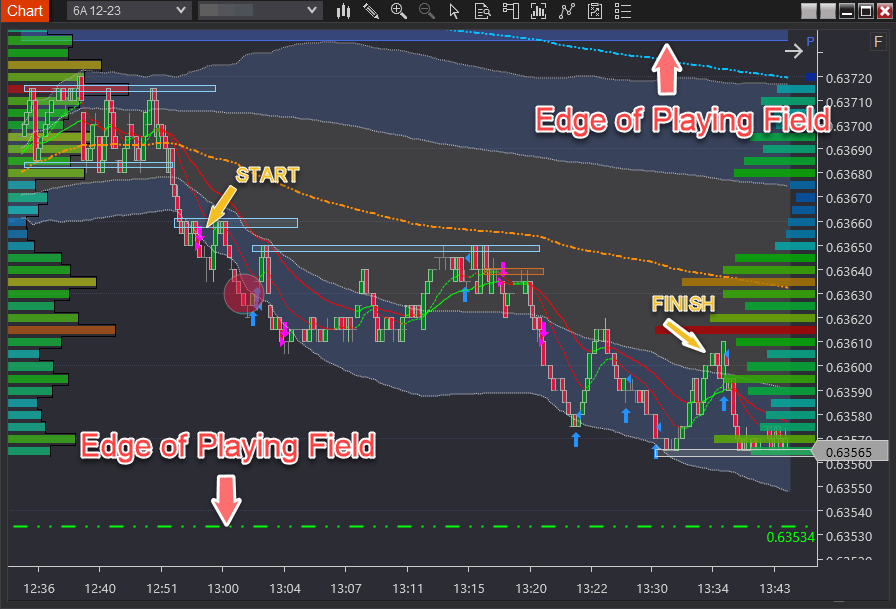
Yet, what's missing is the critical foundation for these buying and selling decisions including:
-
A unique idea the crowd isn't aware of.
-
A current theme in play the crowd isn't aware of.
-
A playing field which is ideally suited to adding to your position.
-
A playing field with a clear price boundary where you can no longer hold your short trade (at 0.6353).
-
Multiple points of evidence to time your entry almost perfectly.
You can bet on it
A poor trade entry and/or poor trade exit will come down to a lack of evidence.
Or worse, a mounting case of evidence against the trade.
To sum it up, as Dr. Brett Steenbarger aptly puts it:
"'Success in markets necessitates both deep idea generation and swift trading execution".
Lastly
It's worth noting the principles discussed here are the very same steps you'd follow when trading at a professional firm.
So if you're considering external training it should be firmly grounded in these fundamental principles.
Forex and derivatives trading is a highly competitive and often extremely fast-paced environment. It only rewards individuals who attain the required level of skill and expertise to compete. Past performance is not indicative of future results. There is a substantial risk of loss to unskilled and inexperienced players. The high degree of leverage can work against you as well as for you. Before deciding to trade any such leveraged products you should carefully consider your investment objectives, level of experience, and risk appetite. The possibility exists that you could sustain a loss of some or all of your initial investment and therefore you should not invest money that you cannot afford to lose. You should be aware of all the risks associated with trading on margin, and seek advice from an independent
Editors’ Picks

EUR/USD holds firm near 1.1850 amid USD weakness
EUR/USD remains strongly bid around 1.1850 in European trading on Monday. The USD/JPY slide-led broad US Dollar weakness helps the pair build on Friday's recovery ahead of the Eurozone Sentix Investor Confidence data for February.

GBP/USD holds medium-term bullish bias above 1.3600
The GBP/USD pair trades on a softer note around 1.3605 during the early European session on Monday. Growing expectation of the Bank of England’s interest-rate cut weighs on the Pound Sterling against the Greenback.

USD/JPY keeps the red below 157.00 on intervention risks
The Japanese Yen sticks to its modest intraday recovery gains against a broadly weaker US Dollar on the back of speculations that authorities will step in to stem weakness in the domestic currency. In fact, Japanese officials stepped up intervention warnings and confirmed close coordination with the US against disorderly FX moves. This, in turn, triggered an intraday USD/JPY turnaround from the 157.65 region, or a two-week top, touched in reaction to Prime Minister Sanae Takaichi's landslide win in Sunday's election.
Editors’ Picks
EUR/USD holds firm near 1.1850 amid USD weakness
EUR/USD remains strongly bid around 1.1850 in European trading on Monday. The USD/JPY slide-led broad US Dollar weakness helps the pair build on Friday's recovery ahead of the Eurozone Sentix Investor Confidence data for February.
USD/JPY keeps the red below 157.00 on intervention risks
The Japanese Yen sticks to its modest intraday recovery gains against a broadly weaker US Dollar on the back of speculations that authorities will step in to stem weakness in the domestic currency. In fact, Japanese officials stepped up intervention warnings and confirmed close coordination with the US against disorderly FX moves. This, in turn, triggered an intraday USD/JPY turnaround from the 157.65 region, or a two-week top, touched in reaction to Prime Minister Sanae Takaichi's landslide win in Sunday's election.

Gold remains supported by China's buying and USD weakness as traders eye US data
Gold struggles to capitalize on its intraday move up and remains below the $5,100 mark heading into the European session amid mixed cues. Data released over the weekend showed that the People's Bank of China extended its buying spree for a 15th month in January. Moreover, dovish US Fed expectations and concerns about the central bank's independence drag the US Dollar lower for the second straight day, providing an additional boost to the non-yielding yellow metal.

Cardano steadies as whale selling caps recovery
Cardano (ADA) steadies at $0.27 at the time of writing on Monday after slipping more than 5% in the previous week. On-chain data indicate a bearish trend, with certain whales offloading ADA. However, the technical outlook suggests bearish momentum is weakening, raising the possibility of a short-term relief rebound if buying interest picks up.
Japanese PM Takaichi nabs unprecedented victory – US data eyed this week
I do not think I would be exaggerating to say that Japanese Prime Minister Sanae Takaichi’s snap general election gamble paid off over the weekend – and then some. This secured the Liberal Democratic Party (LDP) an unprecedented mandate just three months into her tenure.
RECOMMENDED LESSONS
Making money in forex is easy if you know how the bankers trade!

I’m often mystified in my educational forex articles why so many traders struggle to make consistent money out of forex trading. The answer has more to do with what they don’t know than what they do know. After working in investment banks for 20 years many of which were as a Chief trader its second knowledge how to extract cash out of the market.
5 Forex News Events You Need To Know

In the fast moving world of currency markets where huge moves can seemingly come from nowhere, it is extremely important for new traders to learn about the various economic indicators and forex news events and releases that shape the markets. Indeed, quickly getting a handle on which data to look out for, what it means, and how to trade it can see new traders quickly become far more profitable and sets up the road to long term success.
Top 10 Chart Patterns Every Trader Should Know

Chart patterns are one of the most effective trading tools for a trader. They are pure price-action, and form on the basis of underlying buying and selling pressure. Chart patterns have a proven track-record, and traders use them to identify continuation or reversal signals, to open positions and identify price targets.
7 Ways to Avoid Forex Scams

The forex industry is recently seeing more and more scams. Here are 7 ways to avoid losing your money in such scams: Forex scams are becoming frequent. Michael Greenberg reports on luxurious expenses, including a submarine bought from the money taken from forex traders. Here’s another report of a forex fraud. So, how can we avoid falling in such forex scams?
What Are the 10 Fatal Mistakes Traders Make
Trading is exciting. Trading is hard. Trading is extremely hard. Some say that it takes more than 10,000 hours to master. Others believe that trading is the way to quick riches. They might be both wrong. What is important to know that no matter how experienced you are, mistakes will be part of the trading process.
The challenge: Timing the market and trader psychology

Successful trading often comes down to timing – entering and exiting trades at the right moments. Yet timing the market is notoriously difficult, largely because human psychology can derail even the best plans. Two powerful emotions in particular – fear and greed – tend to drive trading decisions off course.