
In this edition of my industry insights article series for FXStreet, I would like to present and discuss a topic on which I receive many questions by traders when speaking at expos and conferences worldwide – the spreads’ role in margin trading. It seems to be one of the most important factors when selecting a broker, a pain point and a key indicator for evaluating account performance. And in order to further this topic, in my next industry insights article I will cover the various execution models that can be applied to your Live Trading Accounts, since you can have the best spreads to roll-out your strategy, if it does not execute... it will be pointless! As we are all here passionate about trading, always feel free to share with myself and the trading community your personal thoughts and experience on the topic in the comments box.
If you are among the community of well-versed and experienced FOREX and CFD traders, you clearly understand the importance of the spread as a critical factor in the success of any short- or long-term manual or automated strategy. Most likely, when looking for a new broker to open a live account with, you experience the following situation which may be quite difficult to deal with: numerous options of Live Trading Account types (mini, standard, premium, pro, ECN and so on) offering one of the following 2 different spread models:
- All-in spread (commission included to the spread as a mark-up, based on fixed or floating spreads)
- Core interbanking spread (commission charged separately, always offered alongside floating spreads)
In such a dilemma one question comes naturally: What is the best option for me? Although both of them sound equally reasonable when applied to specific trading conditions, there are certain differences that every serious investor should consider.
What is the spread impact on your overall performance?
The core interbanking spread improves the trading efficiency while helping to mitigate the risks from unexpected adverse price movements. Moreover, if backed by a spread stability in either highly volatile or calm market conditions thanks to a deep liquidity pool, it leads to better predictability (ie stability) that has a very strong impact on EAs or any other automated trading algorithm. Therefore, deciding to trade on core spreads can possibly optimise your overall performance, measured by a long-term growth in your account’s balance (as illustrated on the chart), coupled with a higher ROI thanks to the better execution and the greater level of control over every open position.
Chart 1. Effects of the spread types on cumulative trading performance
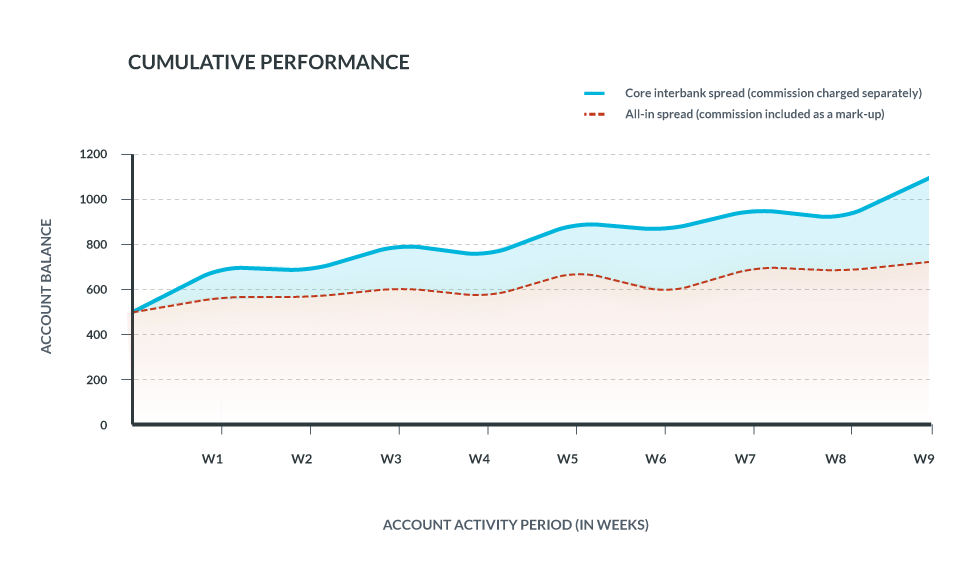
In the example above, the cumulative effect of the 2 different spread models to the performance in an intra-day trading style is shown. Taking into consideration the execution quality and the possibilities for higher spread spikes during market news reaching Stop Loss and Take Profit levels, core interbanking spread lead to a higher yield from trading. Based on extensive research and analysis, such an example is statistically reliable.
Bottom line, if calculating the end cost of each trade is your main burden (because of an EA that takes this factor into account, for example), an all-in spread model may definitely make your life easier. However, as with any ‘packaged’ product, this option would give you less flexibility when fine-tuning your trades against close price movements as well as when setting conditions for entering or exiting the market.
As far as I am concerned, the core interbanking spread with commissions charged separately will always come out as the better alternative. Indeed, it provides you with cost transparency (displaying how much the broker earns upon your trades) and higher levels of control when setting up T/P and S/L levels as well as opening pending orders. If these are key ingredients of your trading style and strategy, the core interbanking spreads will most probably be a better fit to facilitate your efficiency.
Now, being aware of the differences between the spread types and the impact each of them may have on your overall performance, it’s time to dig a little deeper.
How do the various spread models work in reality when applied to your trading strategy?
Comparing the total costs of trading at core interbanking spreads (commission charged separately) or at spreads with a mark-up (commission included) is important, yet you may ask yourself a question: ‘Is this the whole story?’
When the market conditions change rapidly or unexpectedly, using pending orders is definitely a highly recommended tactic to mitigate the risk, prevent dramatic losses or secure reasonable profits. But is it only the trader’s intention and skills that matter?
Unfortunately, not! It’s true that calculating the total cost of a trade is important but what is critical and can truly make or break your strategy is the spread type that your broker is offering. Let’s explore the following 3 scenarios and see the different outcomes from trading at core interbanking spreads or spreads with a mark-up.
Scenario 1. The client has set S/L and T/P levels in a long position (a buy order)
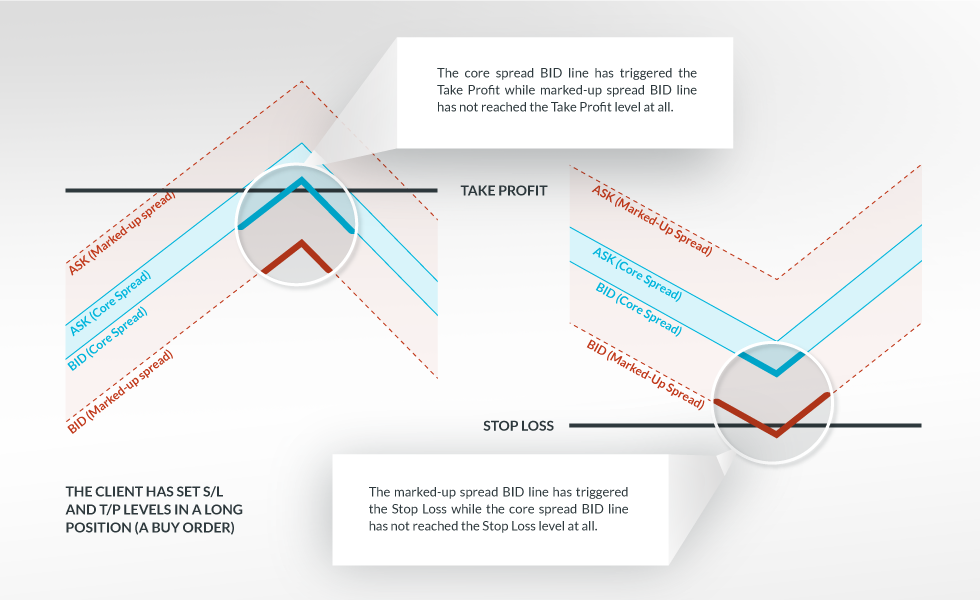
When the price moves in a favorable direction, in many cases what matters the most is whether the Take Profit level could be reached or the opportunity to cash in would be missed. When trading at core interbanking spreads, your BID price will reach the Take Profit level faster and more often being closer to it.
In the opposite situation (unexpected adverse price movement), it will take longer for the BID price of the core interbanking spreads to reach the Stop Loss level. As a result, you will have more chances to benefit from potential positive shifts in the price direction, unlike trading at all-in (marked-up) spreads - when the BID price could have reached the Stop Loss level faster.
Scenario 2. The client has set sell limit and buy limit orders
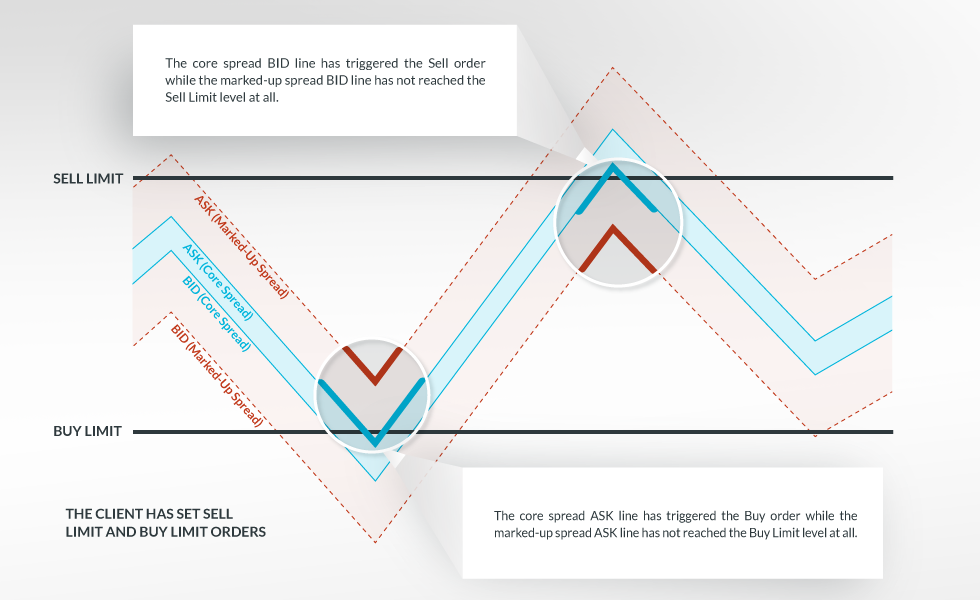
Related to the BID/ASK line, Sell/Buy Limit orders are triggered faster when trading at core interbanking spreads. Therefore, you are able to benefit from well-predicted price movements. In the opposite case, when you trade at all-in (marked-up) spreads, the BID/ASK line may not trigger the limit order at all preventing you from realizing your planned strategy, hence, there will be a negative impact on your overall performance due to several missed opportunities.
Scenario 3. The client has set sell stop and buy stop orders
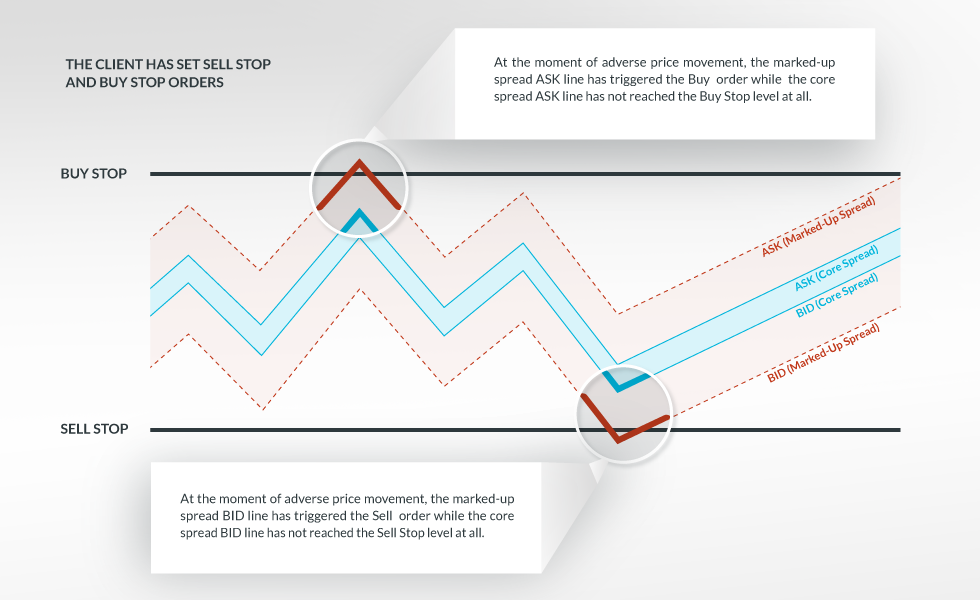
The core interbanking spread’s BID/ASK price triggers the Stop order later than the respective all-in (marked-up) spread BID/ASK price does. Thus, you are less exposed to the risk of unexpected negative market movements. As a result, here again, when you trade at core interbanking spreads, your overall performance is positively influenced.
These situations happen quite often in real-time trading conditions and one shall not underestimate the influence that the spread type has on efficiency and profitability. It all relates to the broader topic of trading costs and how much you can save/earn when trading either in core or marked-up spread conditions. In fact, when I discuss such details in front of large audiences, we systematically reach the conclusion that trading costs are the one and only name of the game.
To illustrate what I mean, I would like to do a simple yet important calculation comparing the 2 types of spreads on EUR/USD (world’s most traded FX pair of all times) applied by 6 sample brokers. One is having a 0.1 pip average core interbank spread with a transparent commission of 40 USD/million per side (equivalent to approx. 1 pip total spread) and the other 5 - a fixed 2 pips spread (commission included). To see the impact of this 1 pip difference, let’s assume that the total monthly trading volume generated by the clients of the above mentioned 5 brokers is 1 thrillion USD. The savings that would have been generated for 1 year by these traders if their broker had used the core spread model equal 1.2 billion USD! Combined with the improved efficiency and profitability (having more money available to invest and diversify the portfolio, thus, mitigating all risks), this I believe is worth much more than the total effect of all types of credit bonuses and promotions offered out there in the market.
The core interbank spread is the only model that aligns any broker’s offering to the institutional-grade conditions applied by the Top Private Banks to their HNW individual or corporate clients. Nowadays, the retail traders also have real-time access to such conditions and people share stories with me on how much their cost efficiency has improved when trading at core interbank spreads. To facilitate your research, there are plenty of websites comparing brokers in this regard. You may consider it when selecting with whom to trade with. After all, it is up to you to decide what will work best for your particular trading style.
The content we produce does not constitute investment advice or investment recommendation (should not be considered as such) and does not in any way constitute an invitation to acquire any financial instrument or product. JFD Group, its affiliates, agents, directors, officers or employees are not liable for any damages that may be caused by individual comments or statements by JFD Group analysts and assumes no liability with respect to the completeness and correctness of the content presented. The investor is solely responsible for the risk of his investment decisions. Accordingly, you should seek, if you consider appropriate, relevant independent professional advice on the investment considered. The analyses and comments presented do not include any consideration of your personal investment objectives, financial circumstances or needs. The content has not been prepared in accordance with the legal requirements for financial analyses and must therefore be viewed by the reader as marketing information. JFD Group prohibits the duplication or publication without explicit approval.
72,99% of the retail investor accounts lose money when trading CFDs with this provider. You should consider whether you can afford to take the high risk of losing your money. Please read the full Risk Disclosure: https://www.jfdbank.com/en/legal/risk-disclosure
Editors’ Picks

EUR/USD hits two-day highs near 1.1820
EUR/USD picks up pace and reaches two-day tops around 1.1820 at the end of the week. The pair’s move higher comes on the back of renewed weakness in the US Dollar amid growing talk that the Fed could deliver an interest rate cut as early as March. On the docket, the flash US Consumer Sentiment improves to 57.3 in February.

GBP/USD reclaims 1.3600 and above
GBP/USD reverses two straight days of losses, surpassing the key 1.3600 yardstick on Friday. Cable’s rebound comes as the Greenback slips away from two-week highs in response to some profit-taking mood and speculation of Fed rate cuts. In addition, hawkish comments from the BoE’s Pill are also collaborating with the quid’s improvement.

USD/JPY drops back below 157.00, as focus shifts to Japan snap election
USD/JPY is back in the red below 157.00 in the Asian session on Friday. The Japanese Yen recovers ground against the US Dollar amid some profit-taking ahead of Japan's snap general election on Sunday. The preliminary reading of the Michigan Consumer Sentiment Index report for February will be released later on Friday.
Editors’ Picks

EUR/USD: US Dollar to remain pressured until uncertainty fog dissipates Premium
The EUR/USD pair lost additional ground in the first week of February, settling at around 1.1820. The reversal lost momentum after the pair peaked at 1.2082 in January, its highest since mid-2021.

Gold: Volatility persists in commodity space Premium
After losing more than 8% to end the previous week, Gold (XAU/USD) remained under heavy selling pressure on Monday and dropped toward $4,400. Although XAU/USD staged a decisive rebound afterward, it failed to stabilize above $5,000.

GBP/USD: Pound Sterling tests key support ahead of a big week Premium
The Pound Sterling (GBP) changed course against the US Dollar (USD), with GBP/USD giving up nearly 200 pips in a dramatic correction.

Bitcoin: The worst may be behind us
Bitcoin (BTC) price recovers slightly, trading at $65,000 at the time of writing on Friday, after reaching a low of $60,000 during the early Asian trading session. The Crypto King remained under pressure so far this week, posting three consecutive weeks of losses exceeding 30%.

Three scenarios for Japanese Yen ahead of snap election Premium
The latest polls point to a dominant win for the ruling bloc at the upcoming Japanese snap election. The larger Sanae Takaichi’s mandate, the more investors fear faster implementation of tax cuts and spending plans.
RECOMMENDED LESSONS
Making money in forex is easy if you know how the bankers trade!

I’m often mystified in my educational forex articles why so many traders struggle to make consistent money out of forex trading. The answer has more to do with what they don’t know than what they do know. After working in investment banks for 20 years many of which were as a Chief trader its second knowledge how to extract cash out of the market.
5 Forex News Events You Need To Know

In the fast moving world of currency markets where huge moves can seemingly come from nowhere, it is extremely important for new traders to learn about the various economic indicators and forex news events and releases that shape the markets. Indeed, quickly getting a handle on which data to look out for, what it means, and how to trade it can see new traders quickly become far more profitable and sets up the road to long term success.
Top 10 Chart Patterns Every Trader Should Know

Chart patterns are one of the most effective trading tools for a trader. They are pure price-action, and form on the basis of underlying buying and selling pressure. Chart patterns have a proven track-record, and traders use them to identify continuation or reversal signals, to open positions and identify price targets.
7 Ways to Avoid Forex Scams

The forex industry is recently seeing more and more scams. Here are 7 ways to avoid losing your money in such scams: Forex scams are becoming frequent. Michael Greenberg reports on luxurious expenses, including a submarine bought from the money taken from forex traders. Here’s another report of a forex fraud. So, how can we avoid falling in such forex scams?
What Are the 10 Fatal Mistakes Traders Make
Trading is exciting. Trading is hard. Trading is extremely hard. Some say that it takes more than 10,000 hours to master. Others believe that trading is the way to quick riches. They might be both wrong. What is important to know that no matter how experienced you are, mistakes will be part of the trading process.
The challenge: Timing the market and trader psychology

Successful trading often comes down to timing – entering and exiting trades at the right moments. Yet timing the market is notoriously difficult, largely because human psychology can derail even the best plans. Two powerful emotions in particular – fear and greed – tend to drive trading decisions off course.