 Russ Allen
Online Trading Academy
In my last article, I suggested that you make an inventory of all of your investment assets, to make sure that you understand what you have to work with. I mentioned that many people may be in a more precarious situation than they realized, because they don’t understand or haven’t yet utilized the power of diversification. That would be the case if all of your money is exposed to any one market, which would usually be the stock market.
For example, let’s say that an investor has the following assets:
-
$150,000 in an employer’s 401(k), invested in three different funds
-
$250,000 in an Indexed Universal Life insurance policy
-
$200,000 in a Variable Annuity from a reputable insurance company
-
$100,000 in a stock brokerage account, in a diversified portfolio of dividend-paying stocks
In good market conditions, all of those assets will show good returns. But this combination has a big problem: 100% of these assets are exposed to the stock market. If the market suffers a big drop (and that is always not an if, but a when), all of them will drop in value significantly, and all at the same time. The fact is, there is no such thing as a stock market portfolio that is diversified enough. When the giant sucking sound of the next market crash starts, all stocks will suffer, and the amount of that suffering will differ only in degree.
To make sure that you are not in the position of being fully exposed to a stock market drop of 20% (like 2011) or even 50% (like 2008-9), it is important that you make sure that a significant part of your assets are in completely different markets. There are other classes of assets, that are easy and convenient to own, that do not follow the waves in the stock market. Such things include:
-
Cash (earning interest with no market-based risk)
-
Bonds (earning interest with little risk, depending on selection)
-
Carefully selected insurance products like fixed annuities
-
Precious metals (volatile, but not synchronized with the stock market)
-
Commodities (also volatile, but will retain purchasing power in case of high inflation)
-
Real Estate
-
And others
Every portfolio should include significant percentages allocated to at least three completely separate asset classes. In that way, we should always have some assets that are doing well when others are not doing so well. This will make us better able to weather any economic environment.
For example, look at the chart below comparing the above assets during a particularly difficult period, from early 2008 to early 2011:
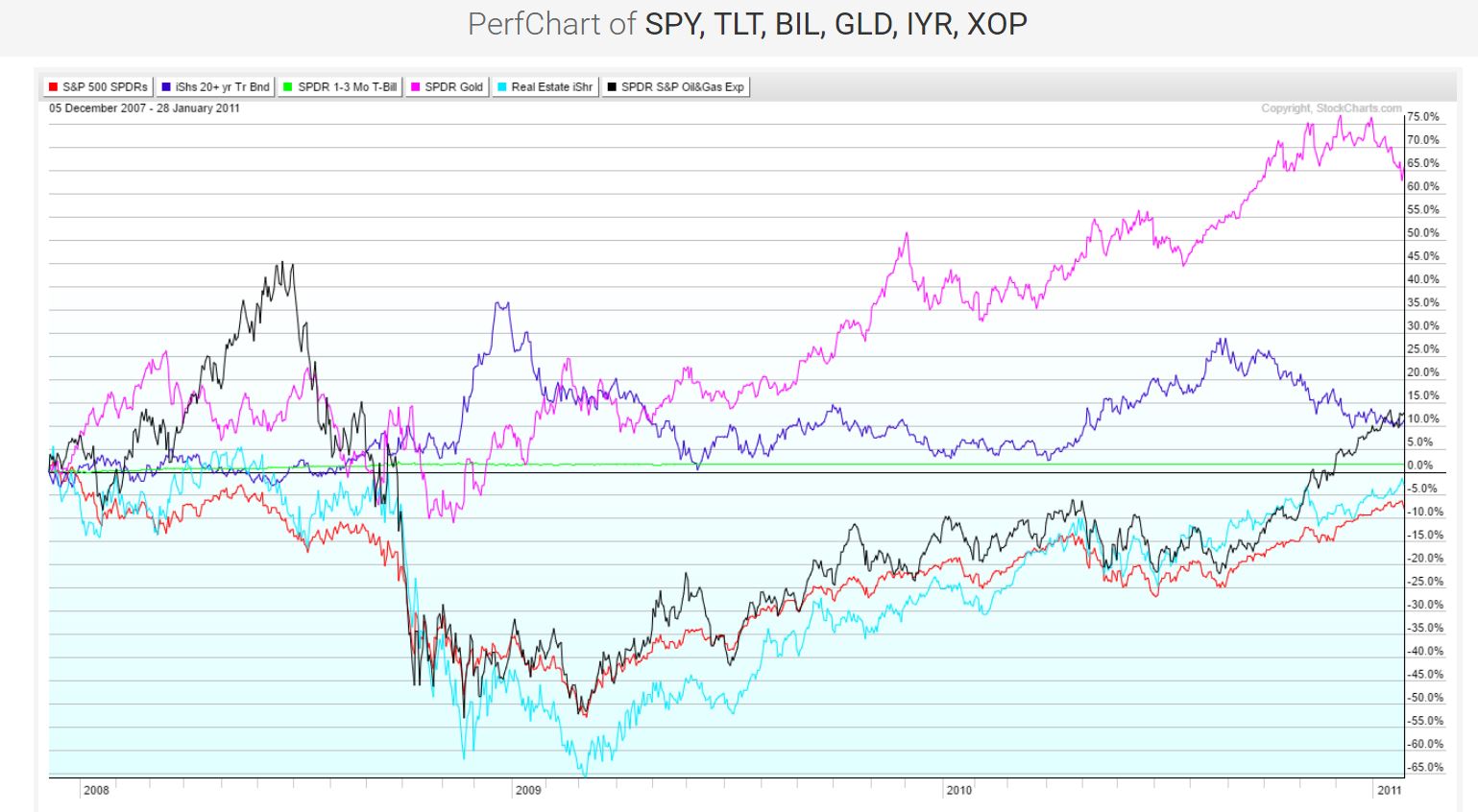
Note the period from the beginning of the chart to the beginning of 2009. That time included the stock market crash of 2008, when the stock market dropped by more than 50% from top to bottom. This is shown by the red line which represents the stock market. During that period the value of commodities (as represented by oil, the black line) and real estate (light blue line) also plunged.
But, cash (green line), of course held steady. Meanwhile U.S. government bonds (purple line) soared in value, and gold (magenta line) was very strong.
So even in the Great Recession, there were assets that did well. And there will almost always be assets that do well. That is why it is vital that you make sure that your investments include multiple asset classes, and particularly some significant amounts in assets that are uncorrelated with the stock market.
A basic tenet of successful investing is this – avoid concentrating your assets in any one market, and instead harness the power of diversification. That is one of the bedrock principles of our Proactive Investing program, and it should be one of yours.
This content is intended to provide educational information only. This information should not be construed as individual or customized legal, tax, financial or investment services. As each individual's situation is unique, a qualified professional should be consulted before making legal, tax, financial and investment decisions. The educational information provided in this article does not comprise any course or a part of any course that may be used as an educational credit for any certification purpose and will not prepare any User to be accredited for any licenses in any industry and will not prepare any User to get a job. Reproduced by permission from OTAcademy.com click here for Terms of Use: https://www.otacademy.com/about/terms
Editors’ Picks

EUR/USD stays defensive below 1.1900 as USD recovers
EUR/USD trades in negative territory for the third consecutive day, below 1.1900 in the European session on Thursday. A modest rebound in the US Dollar is weighing on the pair, despite an upbeat market mood. Traders keep an eye on the US weekly Initial Jobless Claims data for further trading impetus.

GBP/USD holds above 1.3600 after UK data dump
\GBP/USD moves little while holding above 1.3600 in the European session on Thursday, following the release of the UK Q4 preliminary GDP, which showed a 0.1% growth against a 0.2% increase expected. The UK industrial sector activity deteriorated in Decembert, keeping the downward pressure intact on the Pound Sterling.

Japanese Yen strengthens on renewed verbal intervention
USD/JPY extends its losses for the fourth successive session, trading around 152.90 during the Asian hours on Thursday. The pair weakens as the Japanese Yen strengthens following renewed verbal intervention from Tokyo.
Editors’ Picks
GBP/USD holds above 1.3600 after UK data dump
\GBP/USD moves little while holding above 1.3600 in the European session on Thursday, following the release of the UK Q4 preliminary GDP, which showed a 0.1% growth against a 0.2% increase expected. The UK industrial sector activity deteriorated in Decembert, keeping the downward pressure intact on the Pound Sterling.
EUR/USD stays defensive below 1.1900 as USD recovers
EUR/USD trades in negative territory for the third consecutive day, below 1.1900 in the European session on Thursday. A modest rebound in the US Dollar is weighing on the pair, despite an upbeat market mood. Traders keep an eye on the US weekly Initial Jobless Claims data for further trading impetus.

Gold sticks to modest intraday losses as reduced March Fed rate cut bets underpin USD
Gold languishes near the lower end of its daily range heading into the European session on Thursday. The precious metal, however, lacks follow-through selling amid mixed cues and currently trades above the $5,050 level, well within striking distance of a nearly two-week low touched the previous day.

Cardano eyes short-term rebound as derivatives sentiment improves
Cardano (ADA) is trading at $0.257 at the time of writing on Thursday, after slipping more than 4% so far this week. Derivatives sentiment improves as ADA’s funding rates turn positive alongside rising long bets among traders.

The market trades the path not the past
The payroll number did not just beat. It reset the tone. 130,000 vs. 65,000 expected, with a 35,000 whisper. 79 of 80 economists leaning the wrong way. Unemployment and underemployment are edging lower. For all the statistical fog around birth-death adjustments and seasonal quirks, the core message was unmistakable. The labour market is not cracking.
RECOMMENDED LESSONS
Making money in forex is easy if you know how the bankers trade!

I’m often mystified in my educational forex articles why so many traders struggle to make consistent money out of forex trading. The answer has more to do with what they don’t know than what they do know. After working in investment banks for 20 years many of which were as a Chief trader its second knowledge how to extract cash out of the market.
5 Forex News Events You Need To Know

In the fast moving world of currency markets where huge moves can seemingly come from nowhere, it is extremely important for new traders to learn about the various economic indicators and forex news events and releases that shape the markets. Indeed, quickly getting a handle on which data to look out for, what it means, and how to trade it can see new traders quickly become far more profitable and sets up the road to long term success.
Top 10 Chart Patterns Every Trader Should Know

Chart patterns are one of the most effective trading tools for a trader. They are pure price-action, and form on the basis of underlying buying and selling pressure. Chart patterns have a proven track-record, and traders use them to identify continuation or reversal signals, to open positions and identify price targets.
7 Ways to Avoid Forex Scams

The forex industry is recently seeing more and more scams. Here are 7 ways to avoid losing your money in such scams: Forex scams are becoming frequent. Michael Greenberg reports on luxurious expenses, including a submarine bought from the money taken from forex traders. Here’s another report of a forex fraud. So, how can we avoid falling in such forex scams?
What Are the 10 Fatal Mistakes Traders Make
Trading is exciting. Trading is hard. Trading is extremely hard. Some say that it takes more than 10,000 hours to master. Others believe that trading is the way to quick riches. They might be both wrong. What is important to know that no matter how experienced you are, mistakes will be part of the trading process.
The challenge: Timing the market and trader psychology

Successful trading often comes down to timing – entering and exiting trades at the right moments. Yet timing the market is notoriously difficult, largely because human psychology can derail even the best plans. Two powerful emotions in particular – fear and greed – tend to drive trading decisions off course.