 David Smith
Money Metals Exchange
Most readers of this column own (or plan to own) physical precious metals – gold and silver, perhaps even some platinum or palladium. They may also own mining stocks.
But which category is "best"? It's like asking, "What's the most efficient exercise?" or "What's the best fishing lure?" Truth be known, it's really about what you wish to accomplish! Here is my considered opinion...
Precious Metals Offer Insurance First – Profit Second
One should strongly consider holding physical precious metals for "investment first, profit potential second."
The primary function of "metals in hand" is to help offset the possible loss of purchasing power that inflation or a changing business/regulatory climate might visit on a person's other asset classes, such as the broad stock market, real estate, collectibles, and certainly, bonds.
This last category appears to be ending a literal 30-year bull market, during which time interest rates declined (and bonds rose) to levels not seen in many decades.
(A change in the secular trend, to rising interest rates, would have severe ramifications for the value of bonds, whether or not they are held to maturity.)
A side advantage, common in India but not discussed in this country, is that gold and silver can be easily be "pawned" when a person might not have other options for a loan. Just like any item left in the pawn shop owner's care, precious metals can be redeemed when the loan has been paid off.
Indians have a much more nuanced – and relaxed – view about metals' ownership. Outlookindia.com takes the pulse about how its citizens deal with the idea of buying gold and silver, noting, "If you bought gold today and its price falls tomorrow, you don’t say, oh, wish I had not bought gold, I lost money. You just look at your gold and say, I have got 200 grams of gold. That’s it."
Mining Stocks Are Speculations
Mining stocks are an entirely different "investment animal." You're buying shares in companies who explore for and/or produce precious and base metals. Miners have many inherent risks to overcome, which the metal held in your hand, by virtue of having being refined, has already put behind it.
A miner's profit can be adversely affected by all sorts of variables – operational factors like oil prices, the cost of labor, local community support or lack thereof, government regulations, and even nationalization (theft) of a company's assets – which often takes place without compensation to the owners, let alone shareholders. A tailings dam collapse or accidental worker deaths can also affect the share price. Over the years, several such companies have seen theirs drop from multiple dollars each, to a fraction of that... or to zero.
Some companies bill themselves as "pure silver producers." The "purest" of these usually produce a fair amount of base metals – lead, copper and zinc – which are added to the profit mix to yield "equivalent silver ounces." Even the best-known examples may list 30-40% of their annual production in this non-silver category. A geologic fact is that silver veins tend to "pinch and swell," causing ore head grades, and hence the company's share price, to unexpectedly rise or fall.
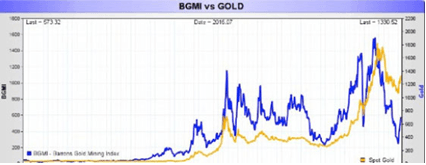
A big argument for holding mining stocks is that because of their increased risk profile, they can be expected to gain at a greater percentage rate – perhaps several times as much – as do gold and silver. For a number of miners in 2016, that was certainly the case. Yet several of the best ones on the board also declined over 50% during last fall's inevitable correction to the strong uptrend... which you may have noticed was not the case with the price of the metals they produced.
For much of the last 20 years, during which time, precious metals rose by multiples of their early bull market price, mining stocks as a group actually underperformed. So, what's the point of taking on additional risk and doing considerably more work, just to find that you could have made a single metals' buy-and-hold decision – which performed better with less downside?
You should also answer these fundamental questions before deciding whether or not to include miners and metals in your investment mix. What are your financial goals? How much risk are you willing to take? How much time can you spend on the "care and maintenance" of your "garden" of stocks?
They can't simply be purchased and placed in a drawer somewhere. Here are just a few of real-life, high-to-low ranges, stated in U.S. dollars, of share prices for several well-run, profitable miners during the cyclical bear market lasting from mid-2011 to late-2015 – $19 down to $7; $10.30 to $0.28; $43 to $5.38; $13 to $1; $36 fell to $3.30.
And did I mention that scores of other companies either reverse-split 20 (or 100):1... or simply went bankrupt?
Why I Hold Mining Stocks and Why, Perhaps, You Should Not
Trading the mining sector is quite literally a job. I write reports, take mining tours, read hundreds of articles and evaluations on scores of companies – and trade mining stocks. But that's my choice. It's great when shares are rising to the sky, as was the case this past January to August. But it was NOT great when the bottom fell out into December.
I am willing to put up with these swings for the possibility of a few home runs, while often settling for base hits, along with the occasional "strike-out." Do you have the temperament, are you willing to put in the research, can you handle the risk, do you want to give up a lot of the time you could spend doing something else?
Perhaps you can answer "yes" to these questions. If not, or the questions aren't relevant to what you're trying to accomplish, then you should seriously consider keeping decision-making about the metals, relevant to your needs and goals.
Instead buy physical gold, silver, and maybe some palladium rounds. Store them in a safe space. Then go out and golf, fish...or spend quality time with your family. In the process, we hope you can achieve what David Morgan wishes for the subscribers to his newsletter at themorganreport.com at the close of each and every issue he pens – "Health above wealth; Wisdom above knowledge."
Money Metals Exchange and its staff do not act as personal investment advisors for any specific individual. Nor do we advocate the purchase or sale of any regulated security listed on any exchange for any specific individual. Readers and customers should be aware that, although our track record is excellent, investment markets have inherent risks and there can be no guarantee of future profits. Likewise, our past performance does not assure the same future. You are responsible for your investment decisions, and they should be made in consultation with your own advisors. By purchasing through Money Metals, you understand our company not responsible for any losses caused by your investment decisions, nor do we have any claim to any market gains you may enjoy. This Website is provided “as is,” and Money Metals disclaims all warranties (express or implied) and any and all responsibility or liability for the accuracy, legality, reliability, or availability of any content on the Website.
Editors’ Picks

EUR/USD faces next resistance near 1.1930
EUR/USD has surrendered its earlier intraday advance on Thursday and is now hovering uncomfortably around the 1.1860 region amid modest gains in the US Dolla. Moving forward, markets are exoected to closely follow Friday’s release of US CPI data.

GBP/USD change course, nears 1.3600
GBP/USD gives away its daily gains and recedes toward the low-1.3600s on Thursday. Indeed, Cable now struggles to regain some upside traction on the back of the sudden bout of buying interest in the Greenback. In the meantime, investors continue to assess a string of underwhelming UK data releases released earlier in the day.

USD/JPY consolidates around 153.00 favoured by lower Fed easing bets
USD/JPY steadies around 153.00 after hitting two-week lows at 152.25. A strong US Nonfarm Payrolls report provided some support for the US Dollar on Wednesday. The Yen remains on track for a 2.6% weekly rally, boosted by Takaichi's victory at Sunday's elections.
Editors’ Picks

AUD/USD: Some profit-taking should not be ruled out
AUD/USD has quickly faded Wednesday’s strong advance despite climbing to new multi-year highs around 0.7150 earlier on Thursday. The pair’s decline comes amid a marginal uptick in the US Dollar, while investors gear up for US CPI data and relevant Chinese releases on Friday.
EUR/USD faces next resistance near 1.1930
EUR/USD has surrendered its earlier intraday advance on Thursday and is now hovering uncomfortably around the 1.1860 region amid modest gains in the US Dolla. Moving forward, markets are exoected to closely follow Friday’s release of US CPI data.

Gold plunges on sudden US Dollar demand
Gold drops markedly on Thursday, challenging the $4,900 mark per troy ounce following a firm bounce in the US Dollar and amid a steep sell-off on Wall Street, with losses led by the tech and housing sectors.

Ripple collaborates with Aviva Investors to tokenize funds as XRP interest declines
Ripple (XRP) exhibits subtle recovery signs, trading slightly above $1.40 at the time of writing on Thursday, as crypto prices broadly edge higher. Despite the metered uptick, risk-off sentiment remains a concern across the crypto market, as retail and institutional interest dwindle.

A tale of two labour markets: Headline strength masks underlying weakness
Undoubtedly, yesterday’s delayed US January jobs report delivered a strong headline – one that surpassed most estimates. However, optimism quickly faded amid sobering benchmark revisions.
RECOMMENDED LESSONS
Making money in forex is easy if you know how the bankers trade!

I’m often mystified in my educational forex articles why so many traders struggle to make consistent money out of forex trading. The answer has more to do with what they don’t know than what they do know. After working in investment banks for 20 years many of which were as a Chief trader its second knowledge how to extract cash out of the market.
5 Forex News Events You Need To Know

In the fast moving world of currency markets where huge moves can seemingly come from nowhere, it is extremely important for new traders to learn about the various economic indicators and forex news events and releases that shape the markets. Indeed, quickly getting a handle on which data to look out for, what it means, and how to trade it can see new traders quickly become far more profitable and sets up the road to long term success.
Top 10 Chart Patterns Every Trader Should Know

Chart patterns are one of the most effective trading tools for a trader. They are pure price-action, and form on the basis of underlying buying and selling pressure. Chart patterns have a proven track-record, and traders use them to identify continuation or reversal signals, to open positions and identify price targets.
7 Ways to Avoid Forex Scams

The forex industry is recently seeing more and more scams. Here are 7 ways to avoid losing your money in such scams: Forex scams are becoming frequent. Michael Greenberg reports on luxurious expenses, including a submarine bought from the money taken from forex traders. Here’s another report of a forex fraud. So, how can we avoid falling in such forex scams?
What Are the 10 Fatal Mistakes Traders Make
Trading is exciting. Trading is hard. Trading is extremely hard. Some say that it takes more than 10,000 hours to master. Others believe that trading is the way to quick riches. They might be both wrong. What is important to know that no matter how experienced you are, mistakes will be part of the trading process.
The challenge: Timing the market and trader psychology

Successful trading often comes down to timing – entering and exiting trades at the right moments. Yet timing the market is notoriously difficult, largely because human psychology can derail even the best plans. Two powerful emotions in particular – fear and greed – tend to drive trading decisions off course.