
Many readers asked why London Brent crude futures price is always lower than Nymex WTI crude oil price. There's nothing related to exchange rate but quality of oil.
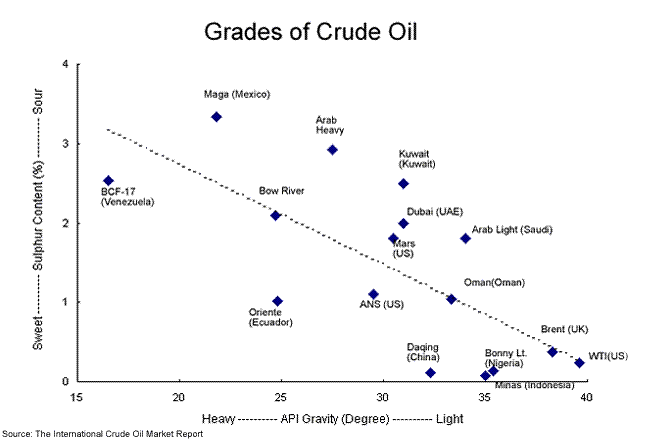
Crude oil is classified into various grades according to density (heavy vs light) and sulphur content (sour vs sweet). The lighter and sweeter the crude, the higher the price it can be sold, because refiners can produce higher yield of high quality refined products from it.
Density is measured by API gravity, a measure developed to compare the density of petroleum with water (API > 10 means the liquid floats on water) but is now widely used to compare among crude oils. API degree is inversely related to the density of crude oil. In general, crudes of API between 40-45 degrees can be sold at greatest commercial values.
Sulphur content determines the quality of a crude oil. Sulphur is a corrosive material which decreases the purity of a crude oil. Therefore, a crude oil with high sulphur content (sour crude) should sell cheaper than one with low sulphur content (sweet crude).
WTI Crude
West Texas Intermediate (WTI) crude oil is of very high quality. It has API gravity of 39.6 and sulphur content of 0.24% only. Its low density and low sulphur content gave it the name 'light, sweet crude' and enabled refiners to produce high yield of gasoline. Most WTI crude oil gets refined in the Midwest region of the country, with some more refined within the Gulf Coast region.
This type of crude oil is used as a benchmark in oil pricing and the underlying commodity of NYMEX's oil futures contracts. Due to its 'lightness' and 'sweetness', WTI crude is normally selling at about $1-$2/ barrel premium to Brent.
Brent
Brent is actually a blend of crude oil from 15 different oil fields the North Sea. It has API gravity of 38.3 degrees and sulphur content of around 0.37%. From these 2 parameters, we can see that Brent crude oil is heavier and less sweet than WTI crude. Therefore, its price is generally lower. Brent is suitable for refinery of gasoline and middle distillates.
Brent was first traded on International Petroleum Exchange in London and then on IntercontinentalExchange (ICE) since 2005. Typically, price of Brent crude oil is around $1 lower than WTI. However, in 2007, due to the depletion of the North Sea Oil field, Brent Crude futures had traded at a premium to WTI of approximately $1 to $3 per barrel.
Information on these pages contains forward-looking statements that involve risks and uncertainties. Markets and instruments profiled on this page are for informational purposes only and should not in any way come across as a recommendation to buy or sell in these assets. You should do your own thorough research before making any investment decisions. FXStreet does not in any way guarantee that this information is free from mistakes, errors, or material misstatements. It also does not guarantee that this information is of a timely nature. Investing in Open Markets involves a great deal of risk, including the loss of all or a portion of your investment, as well as emotional distress. All risks, losses and costs associated with investing, including total loss of principal, are your responsibility. The views and opinions expressed in this article are those of the authors and do not necessarily reflect the official policy or position of FXStreet nor its advertisers. The author will not be held responsible for information that is found at the end of links posted on this page.
If not otherwise explicitly mentioned in the body of the article, at the time of writing, the author has no position in any stock mentioned in this article and no business relationship with any company mentioned. The author has not received compensation for writing this article, other than from FXStreet.
FXStreet and the author do not provide personalized recommendations. The author makes no representations as to the accuracy, completeness, or suitability of this information. FXStreet and the author will not be liable for any errors, omissions or any losses, injuries or damages arising from this information and its display or use. Errors and omissions excepted.
The author and FXStreet are not registered investment advisors and nothing in this article is intended to be investment advice.
Editors’ Picks

EUR/USD ticks lower following the release of FOMC Minutes
The US Dollar found some near-term demand following the release of the FOMC meeting minutes, with the EUR/USD pair currently piercing the 1.1750 threshold. The document showed officials are still willing to trim interest rates. Meanwhile, thinned holiday trading keeps major pairs confined to familiar levels.

GBP/USD remains sub- 1.3500, remains in the red
The GBP/USD lost traction early in the American session, maintaining the sour tone and trading around 1.3460 following the release of the FOMC meeting minutes. Trading conditions remain thin ahead of the New Year holiday, limiting the pair's volatility.

USD/JPY declines as BoJ tightening supports Yen, Fed Minutes awaited
USD/JPY trades slightly lower on Tuesday, hovering around 155.80 at the time of writing, down 0.15% on the day. The pair’s decline reflects a modest strengthening of the Japanese Yen (JPY) following the release of the Bank of Japan (BoJ) Summary of Opinions from its December policy meeting.
Editors’ Picks
EUR/USD ticks lower following the release of FOMC Minutes
The US Dollar found some near-term demand following the release of the FOMC meeting minutes, with the EUR/USD pair currently piercing the 1.1750 threshold. The document showed officials are still willing to trim interest rates. Meanwhile, thinned holiday trading keeps major pairs confined to familiar levels.
GBP/USD remains sub- 1.3500, remains in the red
The GBP/USD lost traction early in the American session, maintaining the sour tone and trading around 1.3460 following the release of the FOMC meeting minutes. Trading conditions remain thin ahead of the New Year holiday, limiting the pair's volatility.

Gold stable above $4,350 as the year comes to an end
Gold price got to recover some modest ground on Tuesday, holding on to intraday gains and changing hands at $4,360 a troy ounce in the American afternoon. The bright metal showed no reaction to the release of the FOMC December meeting minutes.
Ethereum: ETH holds above $2,900 despite rising selling activity
Ethereum (ETH) held the $2,900 level despite seeing increased selling pressure over the past week. The Exchange Netflow metric showed deposits outweighed withdrawals by about 400K ETH. The high value suggests rising selling activity amid the holiday season.
Bitcoin Price Annual Forecast: BTC holds long-term bullish structure heading into 2026
Bitcoin (BTC) is wrapping up 2025 as one of its most eventful years, defined by unprecedented institutional participation, major regulatory developments, and extreme price volatility.
RECOMMENDED LESSONS
Making money in forex is easy if you know how the bankers trade!

I’m often mystified in my educational forex articles why so many traders struggle to make consistent money out of forex trading. The answer has more to do with what they don’t know than what they do know. After working in investment banks for 20 years many of which were as a Chief trader its second knowledge how to extract cash out of the market.
5 Forex News Events You Need To Know

In the fast moving world of currency markets where huge moves can seemingly come from nowhere, it is extremely important for new traders to learn about the various economic indicators and forex news events and releases that shape the markets. Indeed, quickly getting a handle on which data to look out for, what it means, and how to trade it can see new traders quickly become far more profitable and sets up the road to long term success.
Top 10 Chart Patterns Every Trader Should Know

Chart patterns are one of the most effective trading tools for a trader. They are pure price-action, and form on the basis of underlying buying and selling pressure. Chart patterns have a proven track-record, and traders use them to identify continuation or reversal signals, to open positions and identify price targets.
7 Ways to Avoid Forex Scams

The forex industry is recently seeing more and more scams. Here are 7 ways to avoid losing your money in such scams: Forex scams are becoming frequent. Michael Greenberg reports on luxurious expenses, including a submarine bought from the money taken from forex traders. Here’s another report of a forex fraud. So, how can we avoid falling in such forex scams?
What Are the 10 Fatal Mistakes Traders Make
Trading is exciting. Trading is hard. Trading is extremely hard. Some say that it takes more than 10,000 hours to master. Others believe that trading is the way to quick riches. They might be both wrong. What is important to know that no matter how experienced you are, mistakes will be part of the trading process.
The challenge: Timing the market and trader psychology

Successful trading often comes down to timing – entering and exiting trades at the right moments. Yet timing the market is notoriously difficult, largely because human psychology can derail even the best plans. Two powerful emotions in particular – fear and greed – tend to drive trading decisions off course.