 Brandon Wendell, CMT
Brandon Wendell
As prices in the Indian equity markets approach the previous highs set in 2010, there are a lot of stocks that are making 52-week or even all-time highs. As traders, we know that we should participate in the dominant trend but base our exits on supply and demand zones. But where are we supposed to exit when we do not have a zone as a signal?
Fortunately, there are several techniques that we can use to identify probable exit point to protect our profits. Remember, none of these are as strong as actual supply zones but they do seem to offer higher probability targets when we are breaking out into unknown territory.
The first method is one of the easiest. Before prices break to new highs, it often pulls back to gain momentum. If you measure the depth of the pullback and then project that same length at the breakout, it will often mark the area of the first correction after the breakout.
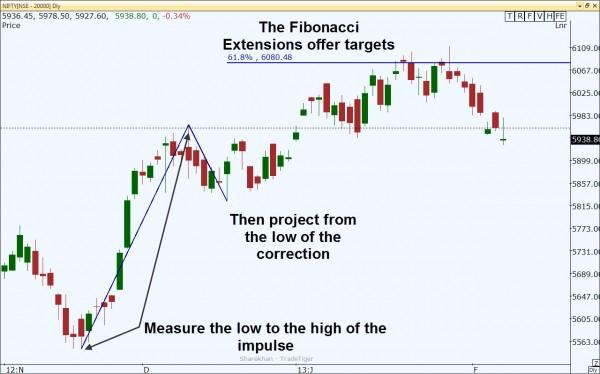
The next method offers multiple targets and uses a tool that is available on most software platforms. The Fibonacci extension tool measures the impulse prior to the breakout and then projects certain measurements of that impulse from the recent lows. By doing this, you can often identify the area where the breakout impulse will stall.
The last method is to simply wait for a signal that the trend has been broken. Moving averages offer a summary of the current trend and the mean price. In a bullish trend, prices should move away from an average and then snap back to it but not close below the moving average. This is called reversion to the mean. If price breaks the moving average by closing below it, then the trend has likely ended.

There are two problems with this technique. First, you will never exit at the top of the move since we wait for a pullback to trigger the exit. That is fine though as we can still participate and profit from the majority of the move.
Secondly, is the choice of the moving average period. We need to select a period or length of the moving average that price will respect for the trend. Stocks and timeframes differ and one moving average may not work for all securities. There are some advanced techniques for finding the best length but I will save that for discussion in our courses.
So if the price of your security breaks to new highs, you might now be better prepared to take your profits at the right time rather than trying to guess. To learn more, contact your local Online Trading Academy center and enroll in the Professional Trader course today.
Neither Freedom Management Partners nor any of its personnel are registered broker-dealers or investment advisers. I will mention that I consider certain securities or positions to be good candidates for the types of strategies we are discussing or illustrating. Because I consider the securities or positions appropriate to the discussion or for illustration purposes does not mean that I am telling you to trade the strategies or securities. Keep in mind that we are not providing you with recommendations or personalized advice about your trading activities. The information we are providing is not tailored to any individual. Any mention of a particular security is not a recommendation to buy, sell, or hold that or any other security or a suggestion that it is suitable for any specific person. Keep in mind that all trading involves a risk of loss, and this will always be the situation, regardless of whether we are discussing strategies that are intended to limit risk. Also, Freedom Management Partners’ personnel are not subject to trading restrictions. I and others at Freedom Management Partners could have a position in a security or initiate a position in a security at any time.
Editors’ Picks

EUR/USD climbs to two-week highs beyond 1.1900
EUR/USD is keeping its foot on the gas at the start of the week, reclaiming the 1.1900 barrier and above on Monday. The US Dollar remains on the back foot, with traders reluctant to step in ahead of Wednesday’s key January jobs report, allowing the pair to extend its upward grind for now.

GBP/USD hits three-day peaks, targets 1.3700
GBP/USD is clocking decent gains at the start of the week, advancing to three-day highs near 1.3670 and building on Friday’s solid performance. The better tone in the British Pound comes on the back of the intense sekk-off in the Greenback and despite re-emerging signs of a fresh government crisis in the UK.

USD/JPY plummets to 156.00 amid rising intervention jitters
USD/JPY retreats markedly and revisits the 156.00 neighbourhod at the beginning of the week amid growing speculation that authorities could step in to curb further currency weakness. That chatter picked up after PM S. Takaichi secured a landslide victory in Sunday’s election, fuelling expectations of a firmer stance on the Yen.
Editors’ Picks
EUR/USD climbs to two-week highs beyond 1.1900
EUR/USD is keeping its foot on the gas at the start of the week, reclaiming the 1.1900 barrier and above on Monday. The US Dollar remains on the back foot, with traders reluctant to step in ahead of Wednesday’s key January jobs report, allowing the pair to extend its upward grind for now.
USD/JPY plummets to 156.00 amid rising intervention jitters
USD/JPY retreats markedly and revisits the 156.00 neighbourhod at the beginning of the week amid growing speculation that authorities could step in to curb further currency weakness. That chatter picked up after PM S. Takaichi secured a landslide victory in Sunday’s election, fuelling expectations of a firmer stance on the Yen.

Gold treads water around $5,000
Gold is trading in an inconclusive fashion around the key $5,000 mark on Monday week. Support is coming from fresh signs of further buying from the PBoC, while expectations that the Fed could turn more dovish, alongside concerns over its independence, keep the demand for the precious metal running.

Crypto Today: Bitcoin steadies around $70,000, Ethereum and XRP remain under pressure
Bitcoin hovers around $70,000, up near 15% from last week's low of $60,000 despite low retail demand. Ethereum delicately holds $2,000 support as weak technicals weigh amid declining futures Open Interest. XRP seeks support above $1.40 after facing rejection at $1.54 during the previous week's sharp rebound.

Japanese PM Takaichi nabs unprecedented victory – US data eyed this week
I do not think I would be exaggerating to say that Japanese Prime Minister Sanae Takaichi’s snap general election gamble paid off over the weekend – and then some. This secured the Liberal Democratic Party (LDP) an unprecedented mandate just three months into her tenure.
RECOMMENDED LESSONS
Making money in forex is easy if you know how the bankers trade!

I’m often mystified in my educational forex articles why so many traders struggle to make consistent money out of forex trading. The answer has more to do with what they don’t know than what they do know. After working in investment banks for 20 years many of which were as a Chief trader its second knowledge how to extract cash out of the market.
5 Forex News Events You Need To Know

In the fast moving world of currency markets where huge moves can seemingly come from nowhere, it is extremely important for new traders to learn about the various economic indicators and forex news events and releases that shape the markets. Indeed, quickly getting a handle on which data to look out for, what it means, and how to trade it can see new traders quickly become far more profitable and sets up the road to long term success.
Top 10 Chart Patterns Every Trader Should Know

Chart patterns are one of the most effective trading tools for a trader. They are pure price-action, and form on the basis of underlying buying and selling pressure. Chart patterns have a proven track-record, and traders use them to identify continuation or reversal signals, to open positions and identify price targets.
7 Ways to Avoid Forex Scams

The forex industry is recently seeing more and more scams. Here are 7 ways to avoid losing your money in such scams: Forex scams are becoming frequent. Michael Greenberg reports on luxurious expenses, including a submarine bought from the money taken from forex traders. Here’s another report of a forex fraud. So, how can we avoid falling in such forex scams?
What Are the 10 Fatal Mistakes Traders Make
Trading is exciting. Trading is hard. Trading is extremely hard. Some say that it takes more than 10,000 hours to master. Others believe that trading is the way to quick riches. They might be both wrong. What is important to know that no matter how experienced you are, mistakes will be part of the trading process.
The challenge: Timing the market and trader psychology

Successful trading often comes down to timing – entering and exiting trades at the right moments. Yet timing the market is notoriously difficult, largely because human psychology can derail even the best plans. Two powerful emotions in particular – fear and greed – tend to drive trading decisions off course.