
What a big week it's been in trading. So, if you're wondering:
"How can I plan for more successful trading without the stress of wild swings and increased volatility?"
Stay tuned.
It's all about the payoff: what to follow, what to trade, when to trade... How to trade, who to listen to, and what skills to develop.
But with a payoff, there's a cost: cost of losing, cost of stress and the cost of emotional discomfort...
Cost of your time, cost of research, cost to develop skills, Agree?
Keep reading to see how being more boring increases your payoff while massively reducing financial and emotional cost.
Plus, you'll get the chance to watch real-life trading to illustrate.
Being boring
Since moving to Evernote in 2020 to document my daily trading plan (game plan), I've developed 1057 plans.
Each takes 30-60 minutes for a total of 700-800 hours of planning (Yawn).
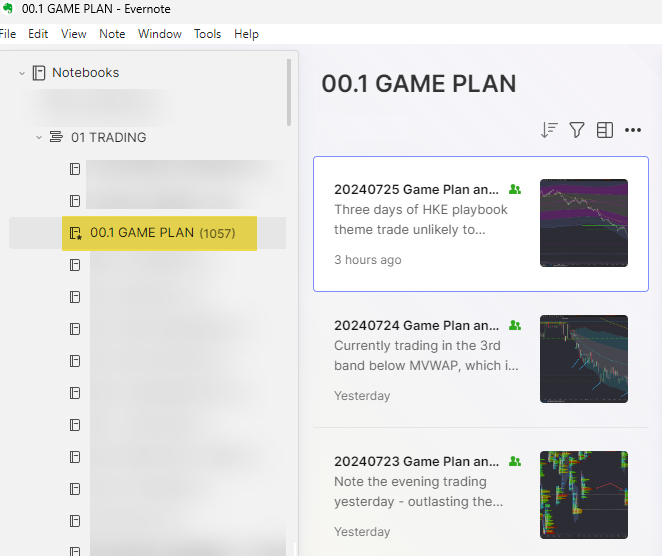
Imagine doing the same thing every single day. Boring, right? But can we get more boring? You bet.
Imagine doing the same thing daily on the same instrument for the last 1000 trading days. (More Yawn)
Specialisation payoff
Check out what Dr Brett Steenbarger has to say on specialising:
"I've seen very successful product/asset class specialists as well as macro generalists; much to be said for depth of knowledge over broad surface knowledge"
What happens next?
You become an expert at trading that instrument when you specialise.
Trading is fiercely competitive. You are up against the likes of Michael Jordan, Roger Federer, and Lionel Messi every single moment you trade.
Stop for a second to consider the luxury of being an expert in a world of superstars.
Now hold that thought while considering the following extract from a recent publication from Capital Flows Research:
"Unless you have a latency edge.... the only way to generate alpha is by having the highest quality interpretation of all relevant information.
Once you establish the correct interpretation of the data, you must time your actions correctly in order to establish a position that has a different time preference or risk tolerance than the market."
Simply put
-
You solve what the market is doing/likely to do.
-
You follow multiple points of evidence waiting for a trade you know intimately to show up.
-
You take money from the market like a world poker champion repeatedly taking the pot at a table of amateurs.
But what's in the plan?
You're okay with the daily ritual of completing a plan, the source of trades that make you money. But the problem is you need to know what goes in the plan. Right?
To illustrate, imagine a crime investigation show.
The first step in solving a homicide is to gather all crucial evidence/discard irrelevant evidence.
You'll often see a wall with photos of items and people of interest, maybe a timeline, and notes relevant to solving the crime.
But the real work is solving when, how and who.
Your game plan also gathers essential evidence. But we're not trying to solve what happened in the past; We're solving what's likely to occur in the upcoming trading session.
At a minimum, my game plan gathers the following evidence.
-
Identify market themes.
-
Determine other players' positioning.
-
Gauging buyers' or sellers' intent.
-
Determine which traders will get outplayed (trapped).
From here, I can:
-
Create a map of where, how, and how far price will move.
-
Identify where and where not to trade for the safest and easiest opportunities.
Tangible payoffs
A little-understood concept is that profits come from planning. Buying and selling are merely executing your plan.
Real-time execution is a separate skill and equally crucial for intraday traders.
But game planning is a problem-solving skill that reaches its optimum potential at approximately 50.
It is an exciting prospect if you are not there yet, knowing you'll only get better.
Or, if you are there, it's equally as exciting because it's where you can develop a genuine competitive advantage over younger traders.
You can see 90 minutes of trading from early Thursday evening—just one of many similar sequences doing exactly the same thing this week.
No emotional discomfort or stress of sitting in trades deep in the red.
Executing the plan to make money safely. Boring right?
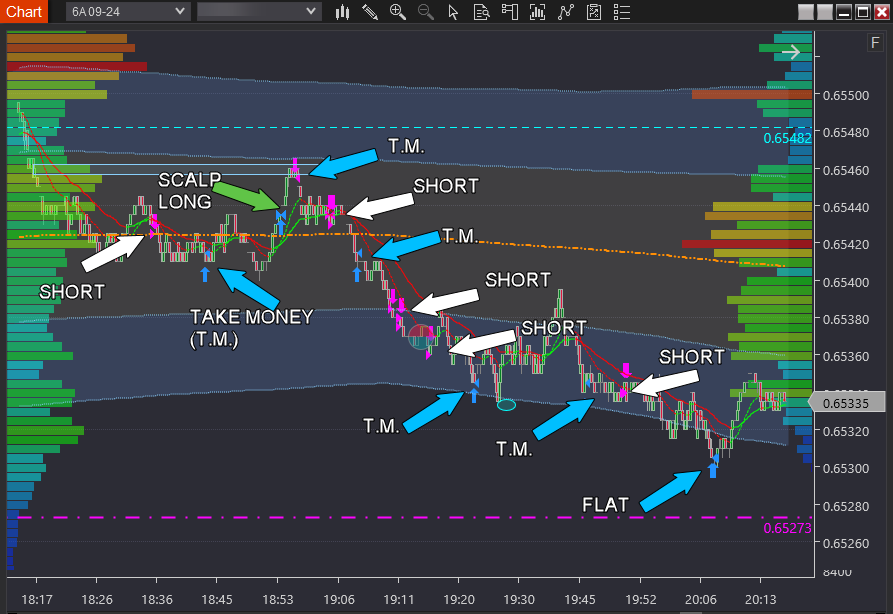
Watch the real-life trading advantages of a specialist [Video]
Forex and derivatives trading is a highly competitive and often extremely fast-paced environment. It only rewards individuals who attain the required level of skill and expertise to compete. Past performance is not indicative of future results. There is a substantial risk of loss to unskilled and inexperienced players. The high degree of leverage can work against you as well as for you. Before deciding to trade any such leveraged products you should carefully consider your investment objectives, level of experience, and risk appetite. The possibility exists that you could sustain a loss of some or all of your initial investment and therefore you should not invest money that you cannot afford to lose. You should be aware of all the risks associated with trading on margin, and seek advice from an independent
Editors’ Picks

EUR/USD loses traction, breaks below 1.1900
EUR/USD comes under extra downside pressure, breaching below the 1.1900 support once again on Tuesday. The improved tone in the US Dollar keeps the pair on the back foot after two consecutive daily advances. In the meantime, prudence is expected to kick in ahead of the release of the key US Nonfarm Payrolls on Wednesday.

GBP/USD slips back to daily lows near 1.3640
GBP/USD drops to daily lows near 1.3640 as sellers push harder and the Greenback extends its rebound in the latter part of Tuesday’s session. Looking ahead, the combination of key US releases, including NFP and CPI, alongside important UK data, should keep the pound firmly in focus over the coming days.

USD/JPY drops toward 155.00 as focus shifts to US data
USD/JPY meets fresh supply and inches closer toward 155.00 in the Asian session on Tuesday. The Japanese Yen holds the upper hand over the US Dollar after Japanese Prime Minister Sanae Takaichi led the ruling Liberal Democratic Party to a historic landslide win and on intervention talks. Traders brace for key US economic data that could offer more clues on the Federal Reserve's monetary policy.
Editors’ Picks
EUR/USD loses traction, breaks below 1.1900
EUR/USD comes under extra downside pressure, breaching below the 1.1900 support once again on Tuesday. The improved tone in the US Dollar keeps the pair on the back foot after two consecutive daily advances. In the meantime, prudence is expected to kick in ahead of the release of the key US Nonfarm Payrolls on Wednesday.
GBP/USD slips back to daily lows near 1.3640
GBP/USD drops to daily lows near 1.3640 as sellers push harder and the Greenback extends its rebound in the latter part of Tuesday’s session. Looking ahead, the combination of key US releases, including NFP and CPI, alongside important UK data, should keep the pound firmly in focus over the coming days.

Gold the battle of wills continues with bulls not ready to give up
Gold remains on the defensive and approaches the key $5,000 region per troy ounce on Tuesday, giving back part of its recent two day. The precious metal’s pullback unfolds against a firmer tone in the US Dollar, declining US Treasury yields and steady caution ahead of upcoming key US data releases.

Bitcoin's downtrend caused by ETF redemptions and AI rotation: Wintermute
Bitcoin's (BTC) fall from grace since the October 10 leverage flush has been spearheaded by sustained ETF outflows and a rotation into the AI narrative, according to Wintermute.
Dollar drops and stocks rally: The week of reckoning for US economic data
Following a sizeable move lower in US technology Stocks last week, we have witnessed a meaningful recovery unfold. The USD Index is in a concerning position; the monthly price continues to hold the south channel support.
RECOMMENDED LESSONS
Making money in forex is easy if you know how the bankers trade!

I’m often mystified in my educational forex articles why so many traders struggle to make consistent money out of forex trading. The answer has more to do with what they don’t know than what they do know. After working in investment banks for 20 years many of which were as a Chief trader its second knowledge how to extract cash out of the market.
5 Forex News Events You Need To Know

In the fast moving world of currency markets where huge moves can seemingly come from nowhere, it is extremely important for new traders to learn about the various economic indicators and forex news events and releases that shape the markets. Indeed, quickly getting a handle on which data to look out for, what it means, and how to trade it can see new traders quickly become far more profitable and sets up the road to long term success.
Top 10 Chart Patterns Every Trader Should Know

Chart patterns are one of the most effective trading tools for a trader. They are pure price-action, and form on the basis of underlying buying and selling pressure. Chart patterns have a proven track-record, and traders use them to identify continuation or reversal signals, to open positions and identify price targets.
7 Ways to Avoid Forex Scams

The forex industry is recently seeing more and more scams. Here are 7 ways to avoid losing your money in such scams: Forex scams are becoming frequent. Michael Greenberg reports on luxurious expenses, including a submarine bought from the money taken from forex traders. Here’s another report of a forex fraud. So, how can we avoid falling in such forex scams?
What Are the 10 Fatal Mistakes Traders Make
Trading is exciting. Trading is hard. Trading is extremely hard. Some say that it takes more than 10,000 hours to master. Others believe that trading is the way to quick riches. They might be both wrong. What is important to know that no matter how experienced you are, mistakes will be part of the trading process.
The challenge: Timing the market and trader psychology

Successful trading often comes down to timing – entering and exiting trades at the right moments. Yet timing the market is notoriously difficult, largely because human psychology can derail even the best plans. Two powerful emotions in particular – fear and greed – tend to drive trading decisions off course.