
Imagine you're a new trader at a professional firm. Are you struggling? You look around at your also new colleagues. Are they struggling? You know they're not.
But WHY will surprise you
If you're looking at charts, lines, indicators, footprints, volume, market profiles, patterns, VWAP, Time & Sales, the DOM (draws breath)... For your reason to take a trade. You finally find something that seems it's working. Phew!
And then without warning you're shaken up realising it's no longer working.

It's back to square one, and trading feels like a struggle
Agree? so why's it happening? Can you put an end to it?
Remember the movie The Matrix? The main character Neo is a computer programmer who awakens to the world he's known is an . Turns out he's living in a virtual world. What he thought was a city he was walking through:

Is really some sort of simulation.

And there's a similar in trading. You sit down at your screens to trade and you see 'this stuff'.
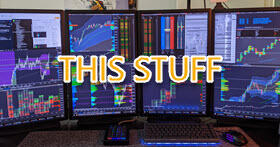
Tell me: How many 100's - 1000's of hours have you painstakingly looked at this stuff:
-
Comparing different time settings.
-
Zooming in, zooming out.
-
Drawing channels or support lines.
-
Adding indicators.
-
Maybe some order flow stuff.
-
And so on.
Right? Okay try this:
Imagine you're sitting at your screens. You lean in, squint your eyes and really concentrate. Here's a visual:

It's a big crowd of people?
Yes.
It's clear in the 3-minute video:
In a trading nutshell
Professional traders see who the other people trading are, how they trade and what makes them tick. The stuff on the charts are tools to monetise knowing who's doing what and why in the markets.
What about when something was working? People come and go and the reasons why they're trading change. Agree? Mess about enough (those hundreds or thousands of hours), and you randomly stumble upon monetising the current who and what they're up to in the market. Make sense?
But it's short-lived, spectacular trade example
One of the best trades ever was when China retaliated against former Prime Minister Scott Morrison's call for an inquiry into the origin of COVID and China's subsequent handling of it.
Quick refresher: China increased tariffs on a range of Australian exports even banning some altogether.
What didn't make it into the news: Massive aggressive short positions hit the bid in the Australian dollar futures during the Asian stock market hours.
It created the of a whale getting short. And thinking - "that's some massive institution who knows something we don't" - speculators joined in. Now how else do you hurt Australia's export market? By increasing the price of AUD.
Those significant sell positions were a combination of red herrings and or profit-taking on long positions accumulated at lower prices but done so more evasively. When enough copycat traders were short the prominent selling would disappear. At the flick of a switch the artificial price ceiling on AUD evaporated.
Ever seen footage of a damn wall break? The sudden release of all that built-up pressure creates a canon-like explosion of water firing through the break. It's what happened in the AUD.
An eruption of vertical price moves aka 'short squeezes' caused by short traders urgently exiting - fighting it out amongst each other to escape rapidly escalating losses.
Now the trader who derives their trading from stuff on a chart (lines, indicators, etc) isn't going to know when the jig is up.
So if they were fortunate enough to stumble on a way to monetise that event - - they'll give it all back, continuing to do the same thing once the people in the market responsible for that move have long vanished.
Back to traders who avoid the struggle
It's true: Combining all the jigsaw pieces to uncover the above trade is more advanced. Hold that thought for a moment.
A reputable firm or mentor gives you a war chest of ideas to trade based on how different people behave in markets and how you can monetise them. Trading this way is a healthy challenge. It's not a struggle.
Establish this baseline, and you can naturally evolve to uncovering and taking more advanced trades, leading to greater rewards. The sooner you start, the sooner you see exponential growth.
Forex and derivatives trading is a highly competitive and often extremely fast-paced environment. It only rewards individuals who attain the required level of skill and expertise to compete. Past performance is not indicative of future results. There is a substantial risk of loss to unskilled and inexperienced players. The high degree of leverage can work against you as well as for you. Before deciding to trade any such leveraged products you should carefully consider your investment objectives, level of experience, and risk appetite. The possibility exists that you could sustain a loss of some or all of your initial investment and therefore you should not invest money that you cannot afford to lose. You should be aware of all the risks associated with trading on margin, and seek advice from an independent
Editors’ Picks

EUR/USD stays weak near 1.1850 after dismal German ZEW data
EUR/USD remains in the red near 1.1850 in the European session on Tuesday. A broad US Dollar bullish consolidation combined with a softer risk tone keep the pair undermined alongside downbeat German ZEW sentiment readings for February.

GBP/USD holds losees near 1.3600 after weak UK jobs report
GBP/USD is holding moderate losses near the 1.3600 level in Tuesday's European trading. The United Kingdom employment data suggested worsening labor market conditions, bolstering bets for a BoE interest rate cut next month. This narrative keeps the Pound Sterling under bearish pressure.

USD/JPY slides further below 153.00; eyes 200-day EMA amid a firmer JPY
The USD/JPY pair meets with a fresh supply on Tuesday and slides further below the 153.00 mark heading into the European session, reversing a major part of the previous day's positive move. Spot prices, however, manage to hold above the 200-day Exponential Moving Average support, around the 152.50 region, preserving a tentative bullish bias despite a shallow cushion.
Editors’ Picks
EUR/USD stays weak near 1.1850 after dismal German ZEW data
EUR/USD remains in the red near 1.1850 in the European session on Tuesday. A broad US Dollar bullish consolidation combined with a softer risk tone keep the pair undermined alongside downbeat German ZEW sentiment readings for February.
GBP/USD holds losees near 1.3600 after weak UK jobs report
GBP/USD is holding moderate losses near the 1.3600 level in Tuesday's European trading. The United Kingdom employment data suggested worsening labor market conditions, bolstering bets for a BoE interest rate cut next month. This narrative keeps the Pound Sterling under bearish pressure.

Gold pares intraday losses; keeps the red above $4,900 amid receding safe-haven demand
Gold (XAU/USD) attracts some follow-through selling for the second straight day and dives to over a one-week low, around the $4,858 area, heading into the European session on Tuesday.

Canada CPI expected to show sticky inflation in January, still above BoC’s target
Economists see the headline CPI rising by 2.4% in a year to January, still above the BoC’s target and matching December’s increase. On a monthly basis, prices are expected to rise by 0.1%.
The week ahead: Key inflation readings and why the AI trade could be overdone
It is likely to be a quiet start to the week, with US markets closed on Monday for Presidents Day. European markets are higher across the board and gold is clinging to the $5,000 level after the tamer than expected CPI report in the US reduced haven flows to precious metals.
RECOMMENDED LESSONS
Making money in forex is easy if you know how the bankers trade!

I’m often mystified in my educational forex articles why so many traders struggle to make consistent money out of forex trading. The answer has more to do with what they don’t know than what they do know. After working in investment banks for 20 years many of which were as a Chief trader its second knowledge how to extract cash out of the market.
5 Forex News Events You Need To Know

In the fast moving world of currency markets where huge moves can seemingly come from nowhere, it is extremely important for new traders to learn about the various economic indicators and forex news events and releases that shape the markets. Indeed, quickly getting a handle on which data to look out for, what it means, and how to trade it can see new traders quickly become far more profitable and sets up the road to long term success.
Top 10 Chart Patterns Every Trader Should Know

Chart patterns are one of the most effective trading tools for a trader. They are pure price-action, and form on the basis of underlying buying and selling pressure. Chart patterns have a proven track-record, and traders use them to identify continuation or reversal signals, to open positions and identify price targets.
7 Ways to Avoid Forex Scams

The forex industry is recently seeing more and more scams. Here are 7 ways to avoid losing your money in such scams: Forex scams are becoming frequent. Michael Greenberg reports on luxurious expenses, including a submarine bought from the money taken from forex traders. Here’s another report of a forex fraud. So, how can we avoid falling in such forex scams?
What Are the 10 Fatal Mistakes Traders Make
Trading is exciting. Trading is hard. Trading is extremely hard. Some say that it takes more than 10,000 hours to master. Others believe that trading is the way to quick riches. They might be both wrong. What is important to know that no matter how experienced you are, mistakes will be part of the trading process.
The challenge: Timing the market and trader psychology

Successful trading often comes down to timing – entering and exiting trades at the right moments. Yet timing the market is notoriously difficult, largely because human psychology can derail even the best plans. Two powerful emotions in particular – fear and greed – tend to drive trading decisions off course.