Yield Protocol announces closure amid weak demand and regulatory challenges
- Yield Protocol announces decision to shutter its operations.
- The closure of the lending platform comes as a result of weak demand and increased regulatory scrutiny.
- DeFi TVL has experienced a significant drop following the collapse of FTX.


DeFi platform Yield Protocol has announced its closure, citing weak demand for fixed-rate borrowing. The news comes against the backdrop of mounting regulatory pressure from global watchdogs. The DeFi sector also faces broader challenges after high-profile collapses in the crypto sector.
Yield Protocol shutters operations
Yield Protocol, a fixed-rate lending platform, has announced that it will cease its operations. The platform said in an official statement that Yield Protocol will not be launching a fixed-rate series in March 2024. It has restricted borrowing and lending activities to the December 2023 series.
Yield noted, "Liquidity providers for the *MS (March-September) strategies won’t accrue any further fees."
The platform highlighted that the move comes at a time of weak demand for fixed-rate borrowing on the platform. Yield also notes that the complex regulatory environment in the United States, Europe and the UK made it difficult for the platform to operate.
The team behind Yield Protocol assured users of support until the conclusion of withdrawals for the December series.
DeFi pressured by regulatory uncertainty
The closure of Yield Protocol comes when the DeFi industry faces heightened scrutiny. In the US, the Securities & Exchange Commission (SEC) has been actively clamping down on crypto-lending products. In January, the agency filed lawsuits against Genesis Global Capital LLC and Gemini Trust Company LLC. The SEC accused them of violating investor-protection laws with a $900 million crypto-lending program. Last month, the securities watchdog settled charges against Linus Financial for failing to register its retail crypto lending product. Recently, the SEC has also released charges against market behemoths Binance and Coinbase.
Regulatory bottlenecks led to the introduction of a bipartisan bill in the US Senate in July. The bill proposed by Jack Reed aims to impose stricter Anti-Money Laundering (AML) norms while regulating DeFi platforms. The framework would also make DeFi operators potentially liable for sanction violations.
The consequences of this regulatory pressure have been felt across the DeFi sector. There has been a significant decline in Total Value Locked (TVL) in DeFi protocols since the FTX collapse. The TVL currently stands at approximately $38 billion, marking a substantial decrease from the $178 billion recorded in November 2021 and the $160 billion seen in April 2022, based on DefiLlama figures.
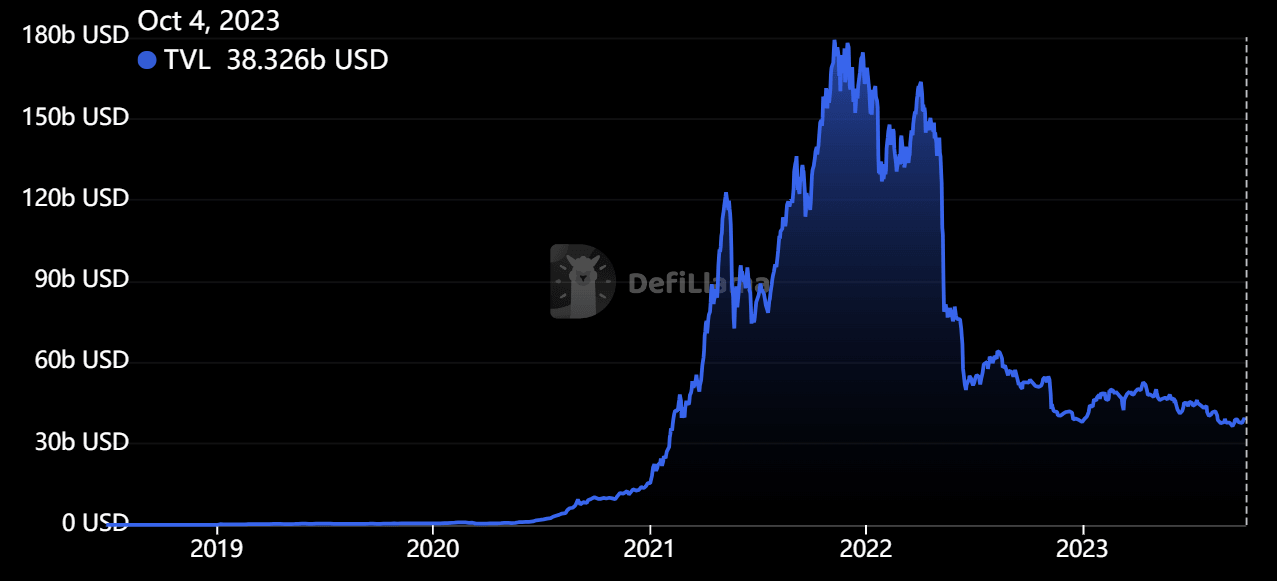
DeFi TVL drop
Also read: SEC to probe more exchanges and DeFi players after Coinbase and Binance
Author
Shraddha Sharma
FXStreet
With an educational background in Investment Banking and Finance, Shraddha has about four years of experience as a financial journalist, covering business, markets, and cryptocurrencies.