Will Russia use crypto to pay its foreign debt?
- Russia is no longer able to pay bondholders through US banks.
-
Speculation has it that Russia is about to default on its foreign debt.
-
The Russian government is considering allowing cryptocurrency to be used for international payments.

US Treasury Department officials announced that Russia would no longer be able to pay bondholders through US banks after May 25, 2022 due to sanctions imposed by the Biden administration for its invasion of Ukraine.
Under a special license from the US Treasury, the Russian Finance Ministry was able to pay bondholders through US and international banks despite the sanctions. In light of the cancellation of the waiver, all bondholders of the nation's foreign currency debt will no longer receive their payments in US dollars.
The move has caused speculation that Russia may default on its foreign debt since it will not only be unable to pay US creditors but also will have difficulty making payments to non-US bondholders due to the dominant role US financial institutions play in the global financial system. Russia defaulted on its debt last in 1918, when the Bolshevik Party refused to repay loans originated by Czar Nicholas II.
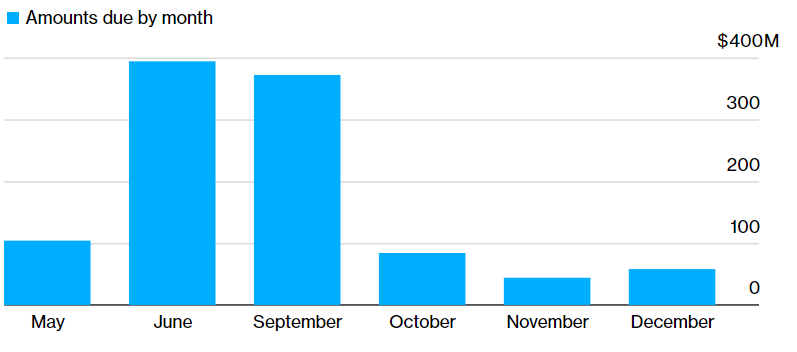
It is estimated that Russia owes almost $20 billion in debt that is not held in rubles, and it must pay interest payments totaling about $1 billion through the end of 2022, with about $500 million due next month.
Calendar of Russia's Coupon Payments in USD and EUR Converted to Dollars.
Source: Bloomberg News
Russia’s Ministry of Finance commented on the United States' refusal to renew the license, saying that payments on dollar-denominated bonds will be made in rubles (in the equivalent of a dollar at the time of payment) and then converted into dollars through the National Settlement Depository (NSD) as a paying agent.
“The decision of the US Department of Treasury to refuse to renew the license allowing investors to receive payments on the government debt of the Russian Federation primarily violates the rights of foreign investors who have invested in Russian debt instruments. It also undermines confidence in Western financial infrastructure,” a statement on Telegram from the Finance Ministry said.
Investors' accounts weren't credited with interest for debt maturing in 2026 or 26.5 million euros ($28.5 million) for bonds maturing in 2036 as of May 27, so the 30-day grace period has kicked off. However, according to the NSD, the funds had been deducted from its account in favor of depositors, which indicates, in Russia's eyes, that the obligations had been met.
The NSD is registered as the holder of the bonds for the purpose of making principal or interest payments. That could support Russia's claim that it avoided a default even if the funds aren't transferred to individual accounts.
In the event that Russia is unable to make the coupon payments, it still has the grace period to find a solution. However, after the US sanctions exemption was removed, options available to the Kremlin were significantly reduced.
Russia, meanwhile, claims it has cash and is willing to pay, declining to acknowledge the possibility of a default.
Russian Finance Minister Anton Siluanov said on Monday Moscow will continue servicing its external debt in rubles. He said Eurobond holders abroad must open ruble and forex accounts with Russian banks if they intend to receive payments in foreign currencies. The plan is similar to that of gas-for-rubles, but in the opposite direction.
Russia may allow international crypto payments
The Russian government is also considering allowing cryptocurrency to be used to make international payments, according to a government official.
"The idea of using digital currencies in transactions for international settlements is being actively discussed," Ivan Chebeskov, head of the financial policy department of the Ministry of Finance said.
At a press conference in March, Chairman of Russia's Duma committee on energy Pavel Zavalny said that Russia would be open to accepting bitcoins for its oil and gas exports. However, the option would only be available to "friendly" nations like China, and "unfriendly" nations would have to pay in rubles, as Vladimir Putin said in an earlier statement.
Commenting on amending the Ministry of Finance's draft bill on cryptocurrency regulation, Russia's tax officials proposed that crypto payments can be accepted for international trade contracts.
Nevertheless, the Ministry of Finance emphasized that the use of digital currencies as a payment method on the territory of the Russian Federation is prohibited. Under the proposed regulation, digital currencies are considered an investment vehicle.
Russia has been trying to break away from dollar-based trade for a long time. “I believe the US makes a huge mistake in using the dollar as a sanction instrument. We are forced. We have no other choice but to move to transactions in other currencies,” Putin said in an interview in October 2021.
Bottom line
The rising pressure on Russia due to sanctions, heated debates between lawmakers and regulators within the country, and the growing popularity of crypto in Russia lead me to believe a crypto regulation in the country is only a matter of time.
Regarding the mechanism for processing bond coupon payments, Russia has no options more immediate than to pay its bondholders in rubles. In the event that that option fails for whatever reason, then a crypto solution could be its Plan B.
Author
Mike Ermolaev
Independent Analyst
Mike Ermolaev is the founder of Outset PR. The agency helps tech companies, especially blockchain and Web3 projects, get the desired recognition thanks to its wealth of media connections.