What is a grid trading bot, and how do you use it?

Grid trading is a quantitative trading strategy that involves placing automated buy and sell orders in an attempt to profit from the volatility of cryptocurrencies. Grid trading is a style of algorithmic trading that automates order execution by utilizing grid trading bots.
To create a grid of orders that covers a range of potential market movements, this method entails placing numerous orders at incremental price levels above and below the present market price.
Generally, the trading bot places buy/sell orders between a predetermined price range, constructing an automated trading grid. This automation allows crypto traders to benefit and make profits on even small price fluctuations and avoid emotional decisions thereby increasing profitability potential in both bull and bear markets.
This article explains what grid trading is, how grid trading bots work and their benefits for traders.
What is grid trading?
The price of cryptocurrencies fluctuates; therefore, seasoned cryptocurrency traders rely on crypto market charts to make trading decisions. However, it can be difficult to keep up when cryptocurrency prices swing wildly, resulting in missed opportunities and sometimes market FOMO. For traders trading in multiple crypto assets and on multiple cryptocurrency exchanges, things get complicated, and constant monitoring becomes a difficult task.
This is where the grid trading strategy may be helpful as a quantitative crypto trading method. Grid trading helps in buying and selling cryptocurrencies in a range set by the trader. The strategy is based on the idea that the price of an asset will fluctuate within a certain range, and by placing orders at different points within that range, the trader can capture profits from both the upward and downward movements of the price. This essentially creates an area or a grid where the grid trading bot will work and calculate profitable buy-sell orders.
What are grid trading bots, and how do they work?
Grid trading bots are trading algorithms or codes that attempt to make profits from price changes within the predefined grid area. The trader sets up the parameters or limits for the grid trading bot to function within the predefined range and execute orders as per forethought rules. Thus, grid trading bot orders automate crypto trading.
Let’s take a hypothetical Bitcoin/Tether trade example to understand how a grid trading bot works and what parameters are taken into consideration. It is important to ensure sufficient funds are available in your wallet before setting up the grid.
Set upper and lower grid limits
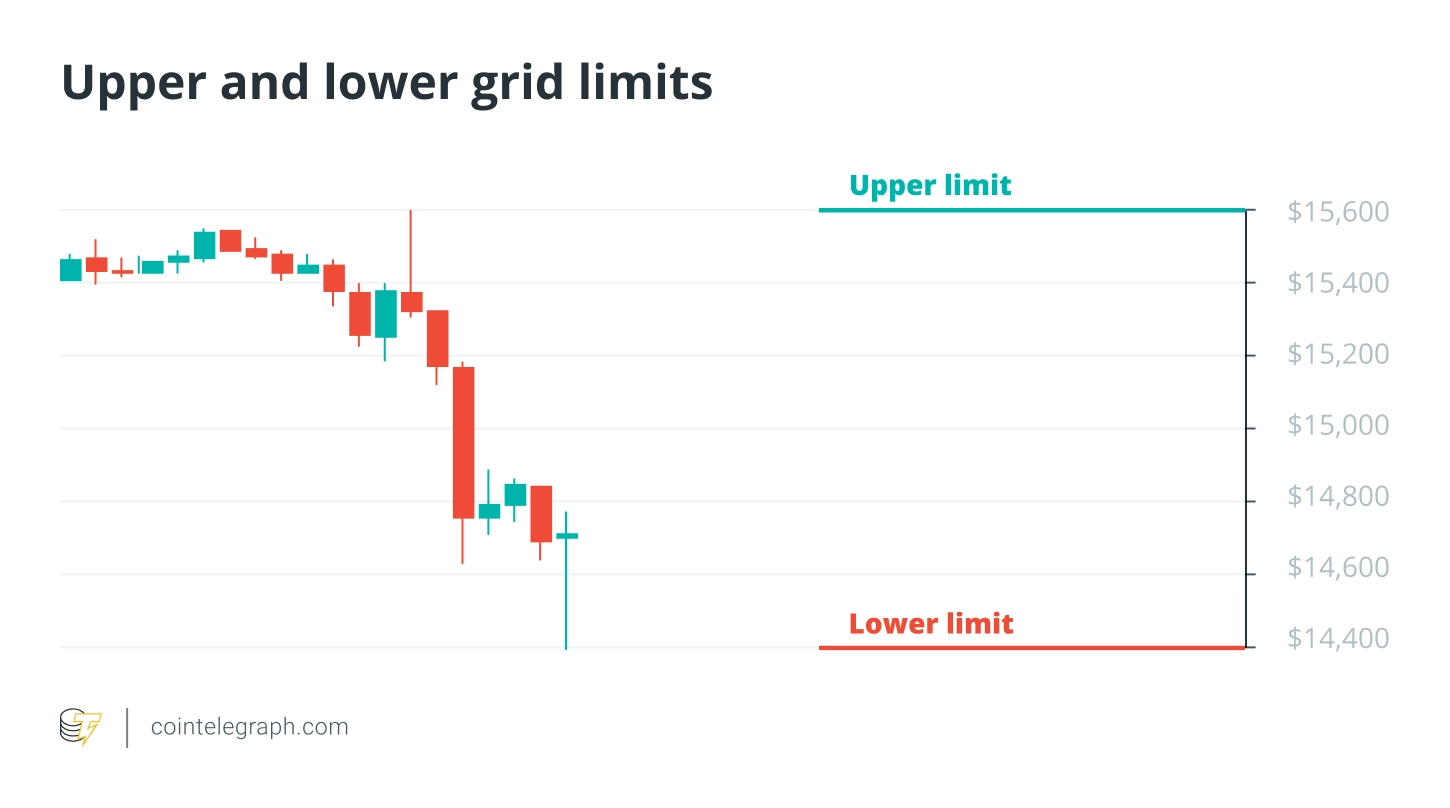
Let’s imagine that the price of Bitcoin (BTC $24,789) has neared $15,000 in the past two-week period. The trader has 5,000 Tether (USDT $1.00) and decides to trade $600 above and below the range. That makes $15,600 the upper limit price and $14,400 the lower limit.
Create multiple grid levels
The next step is to divide the interval upper limit price and interval lower limit price into grid levels. Each exchange has its rules; however, manual and automatic settings are available across all major exchanges, such as Binance, Crypto.com, ByBit, etc. In manual mode, the trader may select levels, and in the automatic mode, grid levels are determined automatically.
The selected grid number is a determinant of the amount of buy and sell orders in that grid. So in this example, it is set at 7 levels. One is free to select and create as many grid levels as required.
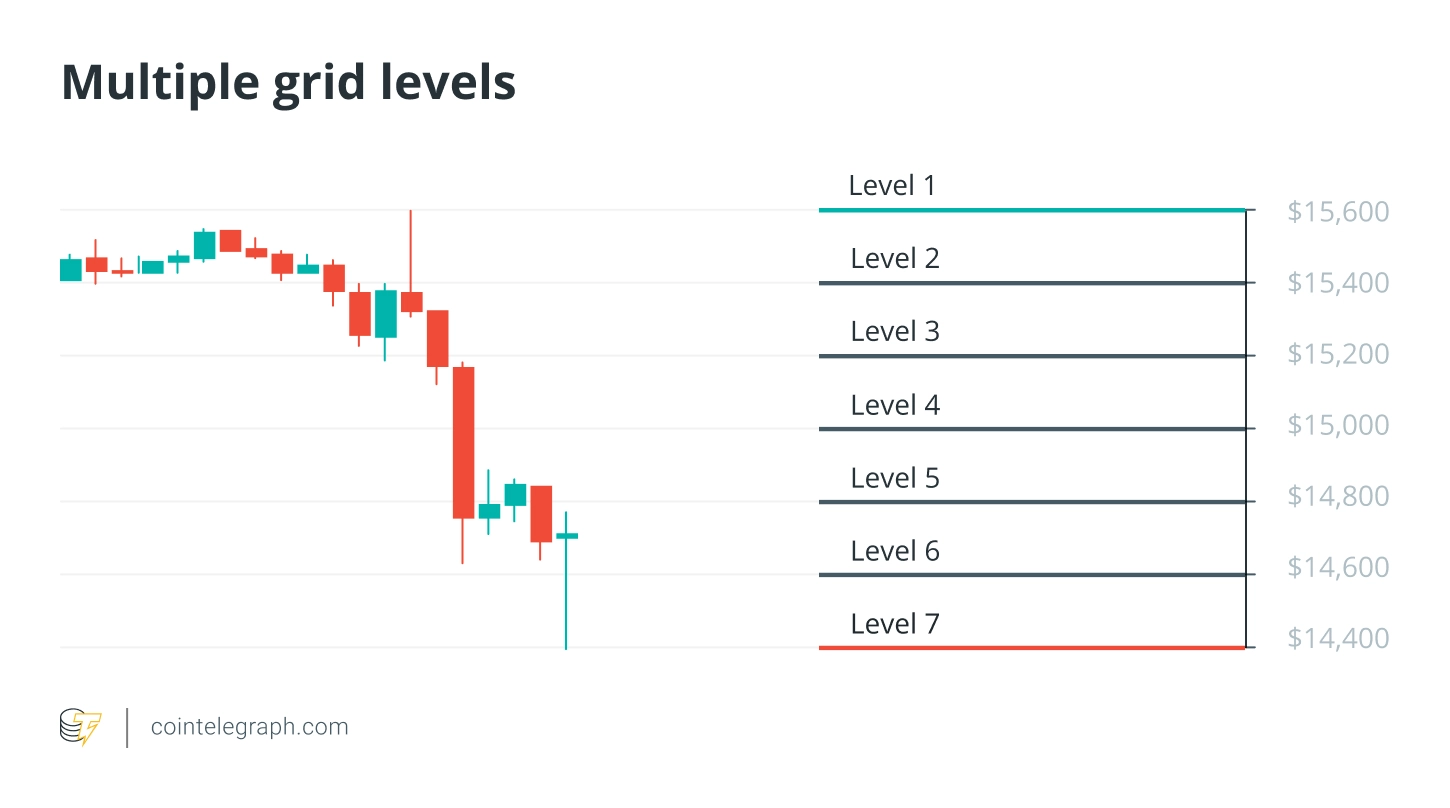
This will result in the following predefined limit within which the grid trading bot will now function.
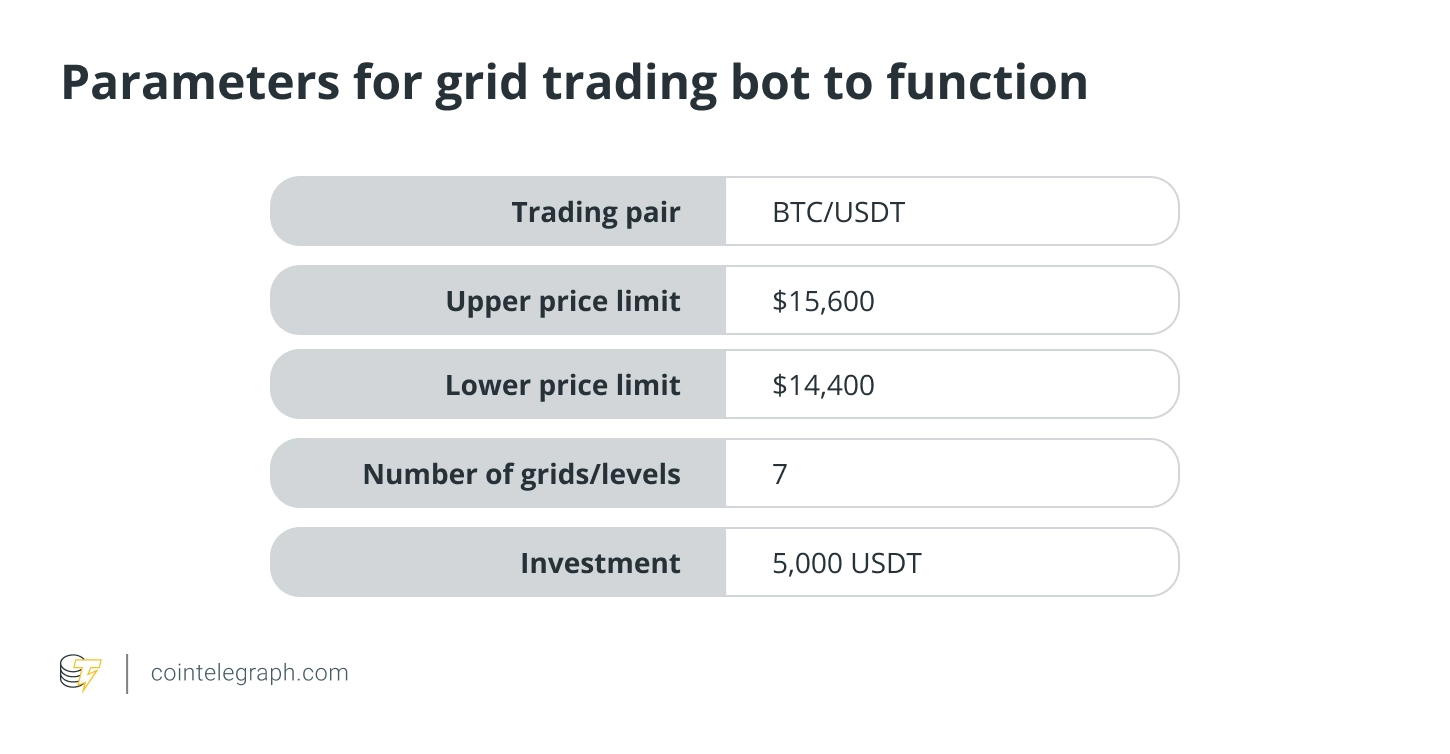
When the price rises and crosses the Sell grid, the bot sells BTC and makes a profit. Similarly, when the price dips in the Buy grid, the bot automatically buys BTC. Buying and selling continue with the aim of making a profit until the trader stops the bot or the timer runs out.
It is important to note that all the above parameter settings are for reference only. The parameters may change depending on one’s investment goals and risk-return trade-off. Moreover, crypto trading involves risks, and traders must acquaint themselves with all possibilities before setting up grid trading.
Benefits of using a grid trading bot
Trading cryptocurrencies can be time-intensive, and automation tools can help investors to make better, rational and profitable decisions. Crypto grid trading bots are beneficial for the following reasons:
Automated trade execution
Grid trading bots can automatically execute trades based on predetermined rules, which can save time and reduce emotional decision-making. Traders can also scale their trades by creating multiple grid trading bots for different coin pairs simultaneously.
Faster and rational decision-making
Bots can make decisions more quickly than traders. Additionally, because they are unaffected by emotions, FOMO, peer pressure or social media trends, they can maintain their trading rationale even during erratic and volatile market conditions.
Risk management
Grid trading bots can be programmed to automatically close trades if certain risk thresholds are reached, which can help to minimize potential losses. Additionally, diversifying trading among many coin pairs instead of trading in a single pair is a well-known risk management strategy: “Don’t put all your eggs in one basket.” Using grid trading bots makes it easier to trade simultaneously in multiple pairs.
Is grid trading strategy profitable?
Crypto grid trading strategies have the potential to generate profits if grid parameters are configured carefully.
While grid limits and grid levels are mandatory for setting up a grid trading bot, the following terms and settings are optional on most cryptocurrency exchanges. However, when used in conjunction with grid limits and grid level, these settings help to make more clinical trades.
Trigger price: This is the pre-set price at which the grid trading bot will initiate its operations. No buy/sell activity will happen until the market price hits the trigger price. Once the market price and trigger price are the same, the bot is triggered and the grid becomes active for trade.
Stop loss price: As the name suggests, this is the point where the trading grid bot will automatically close all positions to protect against a heavy loss. The stop loss point is below both the lowest price limit and the trigger price. Setting this up will help protect the trader because when the market price hits below the stop loss price, the trading grid will stop working.
Take profit price: This is higher than both the upper price limit and the trigger point. When the market price hits the take profit price, the bot will sell the base cryptocurrency, collect the profit, and terminate automatically.
Another important aspect to take into account when using a grid trading bot is the trading fees. If the trading fees on the exchange are high and the grid trading bot executes several transactions quickly in a short period, then the trading fees can add up and eat into the overall profits. One must make sure that overall, the trades generate more profit than incurred costs.
Grid trading takes place in both spot and futures crypto trading. Spot grid trading bots generate profits only on capital deployed since they use spot wallet funds and insufficient funds will automatically stop the trade. This makes spot trading relatively safer since the trade is solely with one’s own money. Futures grid trading bots use margin trades and can borrow funds beyond available capital. This allows traders to make larger crypto trades amid extra risk exposure.
Author
Cointelegraph Team
Cointelegraph
We are privileged enough to work with the best and brightest in Bitcoin.