Tokenization of illiquid assets to reach $16T by 2030 – Report

A large chunk of the world's wealth today is locked in illiquid assets, notes the report's authors.
The total size of tokenized illiquid assets, including real estate and natural resources could reach $16.1 trillion by 2030, according to the Boston Consulting Group (BCG).
In a newly released report from BCG and digital exchange for private markets ADDX, authors including BCG managing director Sumit Kumar and ADDX co-founder Darius Liu noted that “a large chunk of the world’s wealth today is locked in illiquid assets.”
According to the report, illiquid assets include pre-IPO stocks, real estate, private debt, revenues from small and medium businesses, physical art, exotic beverages, private funds, wholesale bonds, and many more.
Reasons for this asset illiquidity are attributed to factors such as limited affordability for mass investors, lack of wealth manager expertise, limited access — such as when assets are restricted to elite cliques (in the case of fine art and vintage cars), regulatory hurdles, and other scenarios in which users have difficulty acquiring or trading an asset.
On-chain asset tokenization could solve this problem, a market that surpassed $2.3 billion in 2021 and is expected to reach $5.6 billion by 2026, as per the report.
The authors added that in just the last two years, global digital asset daily trading volume has soared from 30 billion euros in 2020 to 150 billion euros in 2022, noting that it "is still minuscule in comparison to the total potential of illiquid tokenizable assets in the world.”
By 2030, the authors forecast the on-chain asset tokenization opportunity to reach $16.1 trillion — made up largely of financial assets (such as insurance policies, pensions, and alternative investments), home equity, and other tokenizable assets, such as infrastructure projects, car fleets, and patents.
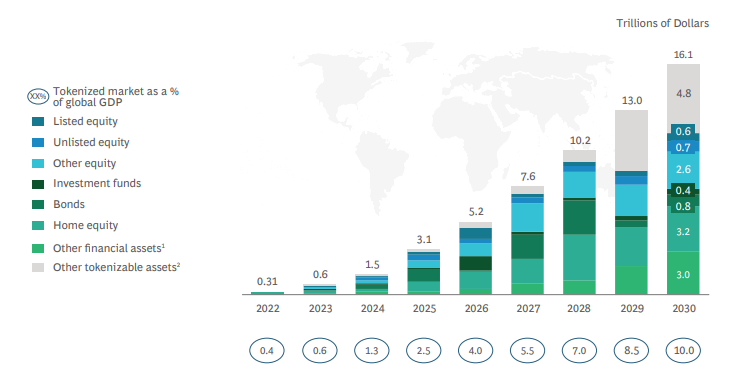
Tokenization of global illiquid assets by 2030. Source: Boston Consulting Group
The authors also noted that this was a “highly-conservative forecast” and that in a best-case scenario, the tokenization of global illiquid assets could reach $68 trillion.
However, the potential of tokenized assets will differ across countries due to various regulatory frameworks and asset class sizes.
In Singapore, the Monetary Authority recently launched the Project Guardian, a blockchain-based asset tokenization pilot that will explore decentralized finance (DeFi) applications in wholesale funding markets by establishing a liquidity pool of tokenized bonds and deposits to execute borrowing and lending processes on-chain.
In addition to Singapore, tokens issuance is regulated in Hong Kong, Japan, the European Union, the United Kingdom, the United States, the United Arab Emirates, Germany, Austria, and Switzerland.
Other authors in the report include BCG’s project leader Rajaram Suresh, associate director Bernhard Kronfellner, and consultant for BCG Aaditya Kaul, noting:
“On-chain asset tokenization presents an opportunity to obviate many of these barriers of asset illiquidity as well as the current modality of traditional fractionalization.”
Real estate may be among the illiquid assets that could benefit from tokenization, with investors looking for investments backed by real-world assets in DeFi.
Cointelegraph Research Terminal revealed that real estate assets account for upwards of 40% of the pipeline for certain technology providers, making it one of the primary sectors for security token offerings.
Earlier this month, the digital asset investment platform Zerocap announced that companies on the Australian Securities Exchange (ASX) could be able to trade tokenized bonds, equities, funds, or carbon credits after a successful proof-of-concept trial.
Author
Cointelegraph Team
Cointelegraph
We are privileged enough to work with the best and brightest in Bitcoin.