Time to pump? Data suggests traders intend to push Filecoin (FIL) above $100


Derivatives data and recent protocol developments signal that retail traders have turned bullish on FIL.
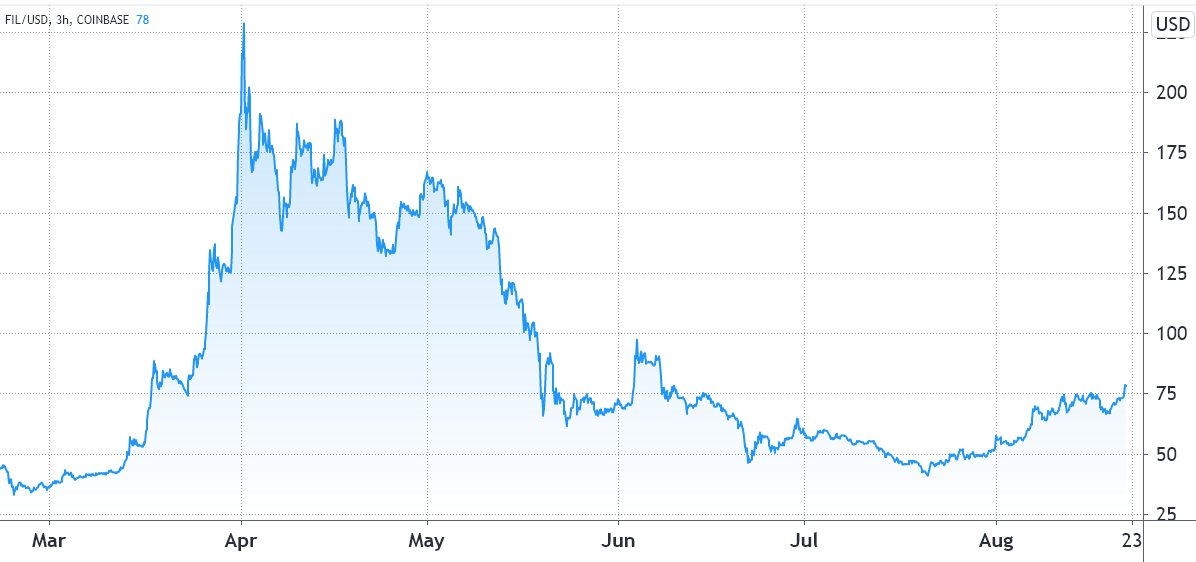
Filecoin (FIL) accumulated 65% gains over the past 30 days to reach its highest price since June 8. The recent strength was accelerated after an Aug.6 partnership with Chainlink's oracle protocol on Aug. 6 allowed the projects to join their grant initiatives to speed up the development of hybrid smart contracts to leverage code running on the blockchain while the managing data computation process off-chain.
Filecoin (FIL) price in USD at Coinbase. Source: TradingView
Numerous events triggered the $235 all-time-high on April 1, but that movement is clearly long gone because the cryptocurrency is 67% below that level. Let's take a moment to understand what triggered the rally and whether these drivers still exist.
China-based mining activity boosted investors' expectations
Filecoin is a decentralized cloud-based data storage network that allows its users to gain rewards for selling their excess storage on an open-source platform. The built-in economic incentives ensure files are reliably stored over time.
The network's storage capacity surpassed 2.5 exabytes in February, which lead to positive remarks from influencers like Cameron Winklevoss, the billionaire investor and co-founder of the Gemini exchange.
On March 17, Grayscale Investments, the digital currency asset manager behind the GBTC Trust, announced the launch of its Filecoin investment vehicle.
On March 25, a $23 million Filecoin Ecosystem Fund was announced, backed by large Chinese investment groups like Fenbushi Capital, SNZ Capital, and Neo's EcoFund.
New smart contract capabilities are expected and FIL's daily issuance was cut
On March 31, Qtum founder Patrick Dai said that the protocol was working to enable smart contracts for Filecoin through the Qtum network.
On April 10, Martin Gaspar, a research analyst at CrossTower exchange, told Cointelegraph that solid demand from Chinese miners emerged due to a shortage of proof-of-work rigs. Gaspar added that these miners "are required to pledge the FIL token as collateral, resulting in demand for the token."
Lastly, on April 15, Filecoin changed its supply economics, reducing its daily issuing from 648,000 FIL per day to 365,000. The drastic cut likely led to a perception of scarcity for the token. In turn, it may have caused retail investors and miners to accelerate their investments ahead of the event.
Data shows retail activity has been picking up
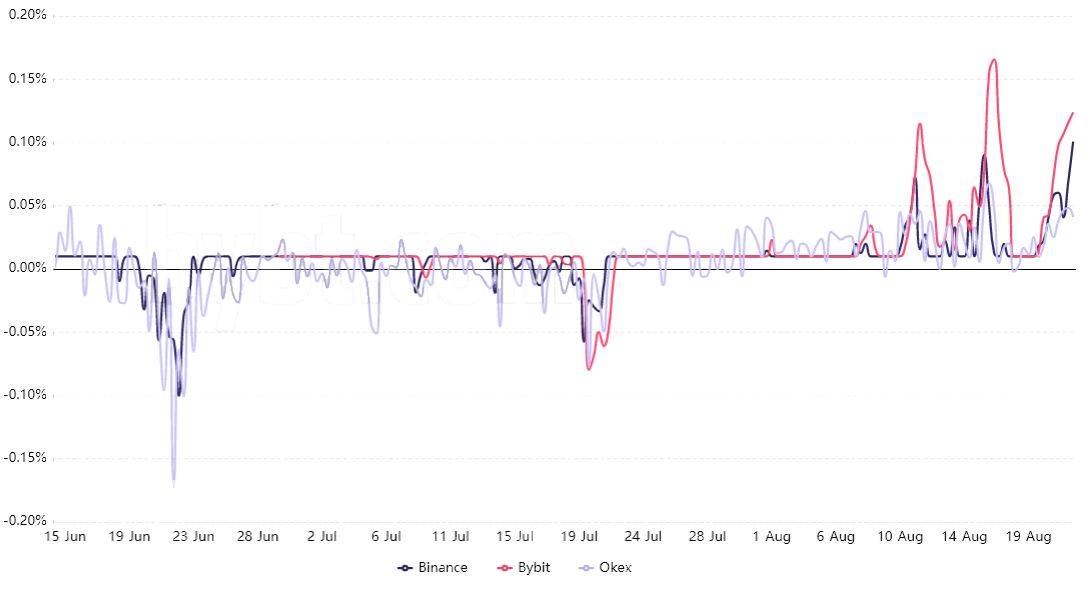
Perpetual futures contracts, also known as inverse swaps, have an embedded rate usually charged every eight hours to ensure no exchange risk imbalances.
Whales, arbitrage desks, and market makers avoid exposure to these instruments due to their variable funding rates. When longs (buyers) demand more leverage, they are the ones paying the fee. The opposite holds when shorts (sellers) use more leverage, thus causing a negative funding rate.
Filecoin (FIL) perpetual futures 8-hour funding rate. Source: Bybt.com
The above data clearly shows the funding rate surging between Aug. 10 and Aug. 17, and it reached a positive 0.08% average. This number translates to 1.7% per week, indicating increased leverage longs activity. After receding for a couple of days, the indicator initiated another hike to a 0.10% fee charged every 8-hour from longs.
The current 2.1% weekly equivalent fee indicates even stronger leverage from retail traders, which means optimism. Of course, there's no way to know if the recent move will be enough to spark a continuous price improvement, but traders seem to believe $100 is closer than ever.
Author
Cointelegraph Team
Cointelegraph
We are privileged enough to work with the best and brightest in Bitcoin.