These four key charts shed light on the FTX exchange's spectacular collapse


Nansen’s on-chain metrics suggest several reasons why FTX decided to sell itself to Binance.
Speculation surrounding Sam Bankman Fried’s crypto exchange FTX grew so intense that the firm agreed to sell itself to bigger rival Binance. Blockchain data offers a fresh perspective on FTX’s liquidity crunch, illustrating how the drama escalated so quickly.
Top 10 FTX withdrawers for all wallets
Comprehending why Binance agreed to buy FTX today means understanding FTX’s liquidity woes.
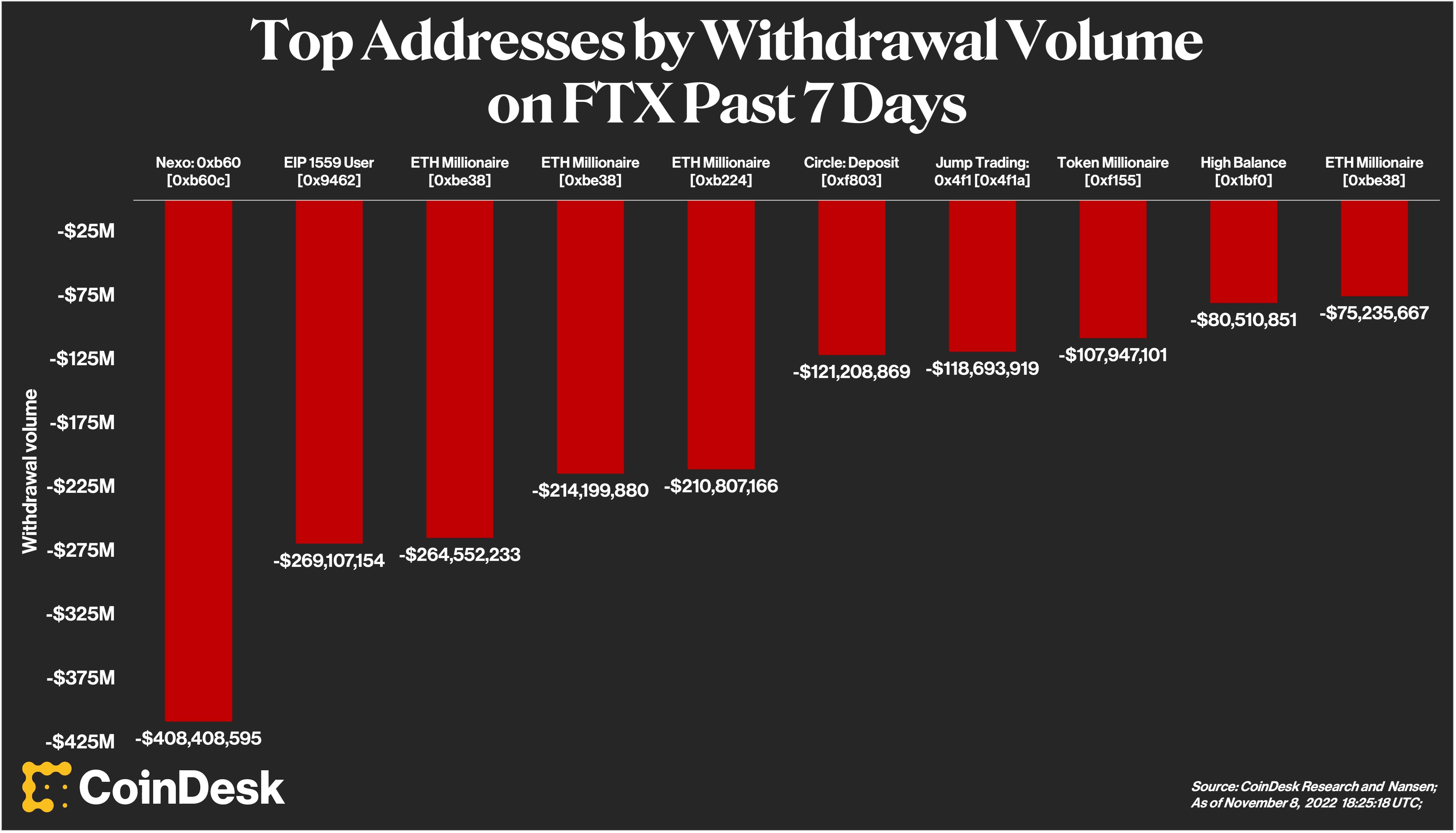
One of the earliest red flags came from the top 10 addresses by withdrawal volume on FTX. These addresses, which include Nexo, Circle and Jump Trading, have withdrawn a whopping $1.87B in the past seven days, Nansen data suggests.
Nexo, a crypto lending platform that has more than five million users worldwide, as stated on the company’s homepage, has withdrawn more than $408 million worth of ether (ETH) from FTX. The blockchain explorer website Etherscan confirms Nansen’s data, with Nexo transferring ETH in large volumes through several transactions. Here are several Nexo transactions out of FTX with values of at least 4,999 ETH: Tx1, Tx2, Tx3, Tx4, Tx5, Tx6, Tx7, Tx8 and Tx9.
Market participants also have withdrawn $121 million USDC from FTX to Circle’s deposit contract address, data from Nansen and Etherscan suggests. (Nansen shows that $1.15 billion USDC has left Coinbase in the past 24 hours, reflecting of users are taking tokens off exchanges.)
Data from Coinglass reveals that in the past 24 hours, the number of bitcoins on FTX dropped by 19,941.64 BTC to 36.14 as of press time.
Stablecoin outflow
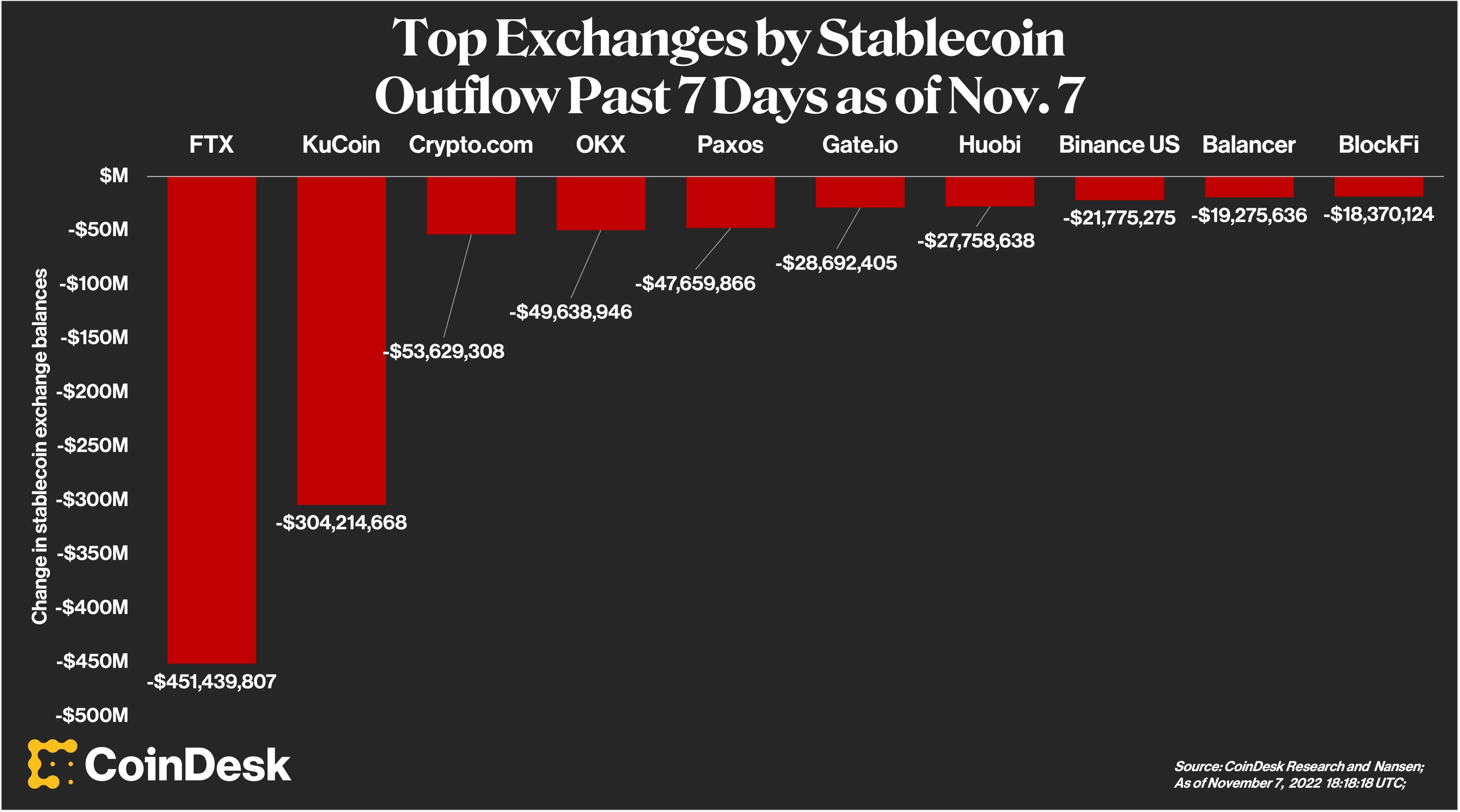
Understanding the volatility stemming from the FTX drama continues with stablecoin outflows. According to Nansen data, in the past seven days starting on Monday Nov. 7, FTX led all exchanges in stablecoin outflows. Some $451 million worth of stablecoins have left FTX, more than the combined outflows of KuCoin, Crypto.com and OKX.
Specifically, FTX’s holdings of USDC and USDT have nosedived dramatically. Between Friday, Nov. 4 and Tuesday, Nov. 8, Nansen data states that FTX’s USDC holdings dropped about $137 million, roughly 84%, while its USDT holdings dropped from $198 million to $68 million.
According to CryptoQuant, FTX’s stablecoin reserve stands at roughly $156 million currently, down more than 78% since Oct. 24.
FTX’s stablecoin reserve is at its lowest levels in a year. Some market participants have been concerned because one of the initial signs that foreshadowed the collapse of Terra Luna was when UST deposits on the Anchor lending protocol started dropping rapidly.
Top 10 “smart money” FTX withdrawers
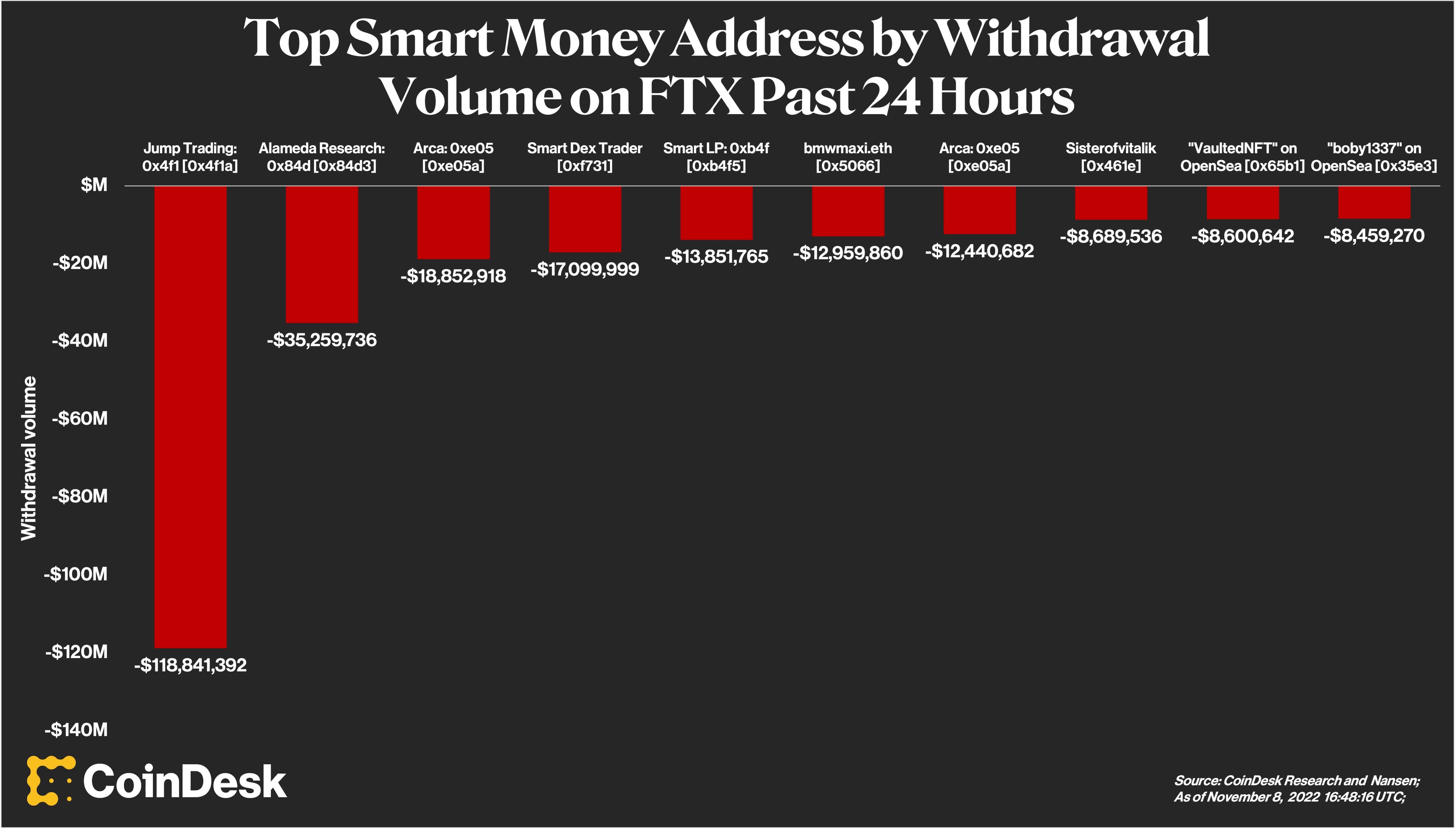
Additionally, prolific and active cryptocurrency traders have been transferring their wealth out of FTX, according to data from blockchain analytics firm Nansen. Over the last 24 hours, the top 10 withdrawal wallets categorized by Nansen as belonging to “smart money” have removed about $246.6 million worth of tokens.
Nansen considers a wallet to be “smart money” if it meets at least one of several test, including:
-
It is known to belong to an investment fund.
-
It has made at least $100,000 by providing liquidity to the decentralized finance (DeFi) protocols, SushiSwap and Uniswap, excluding so-called impermanent loss.
-
It is in the top 300 addresses ranked by realized profit, considering only on-chain trades that occurred on decentralized exchanges (DEXes).
Jump Trading, which focuses on ecosystem building, quant research and trading, has withdrawn $118 million, more than the next six addresses combined.
Other notable smart money withdrawals include asset management firm Arca and SBF’s trading firm Alameda Research. Alameda Research transferred 92 million BIT (roughly $35 million) out of FTX and into their own address.
FTT Price and Volume
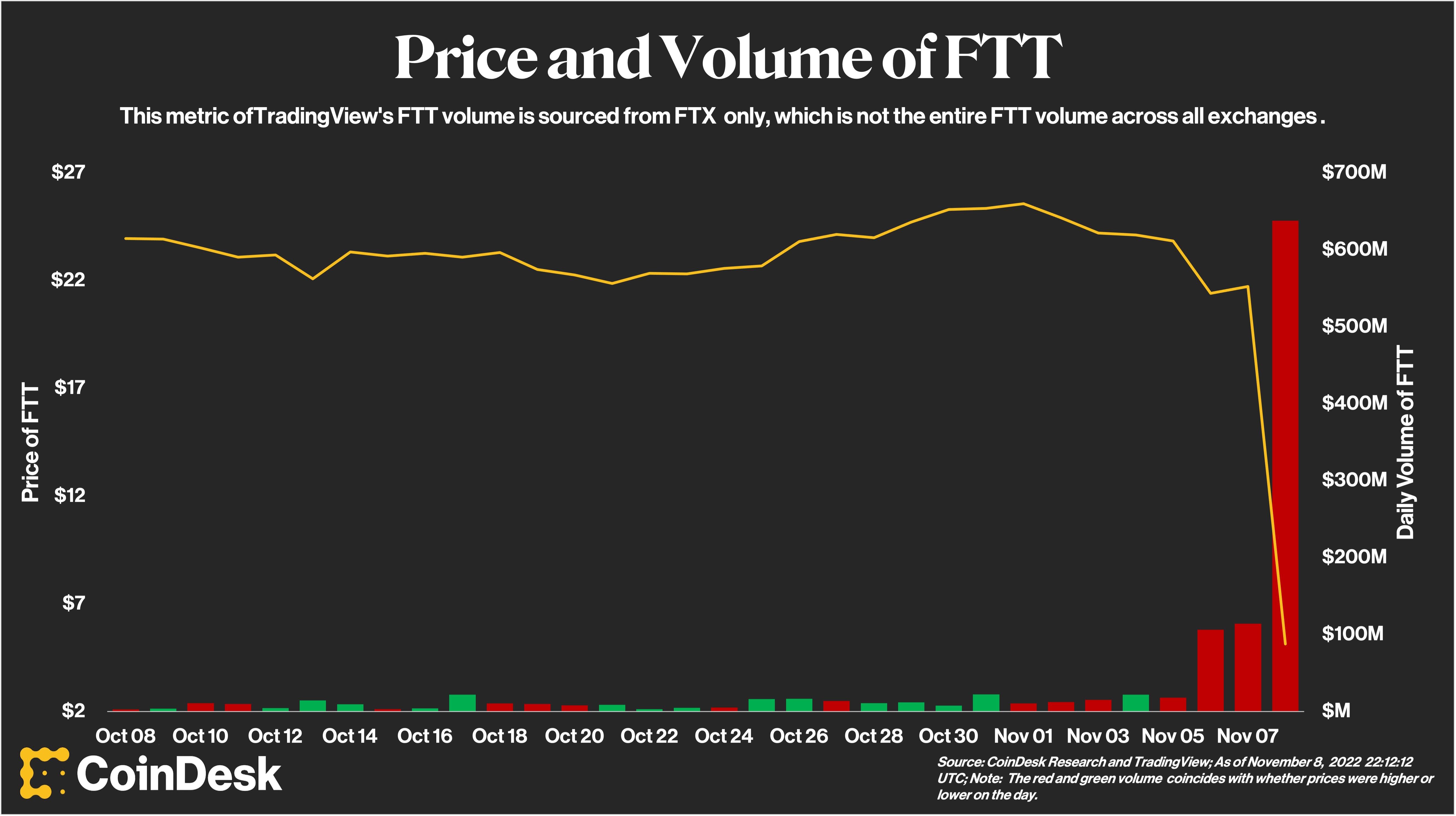
The chart above shows the daily price and volume of the FTX exchange’s FTT token, which grants holders a discount on trading fees on the FTX marketplace. Following CoinDesk’s disclosure on Nov. 2, FTT recently slid roughly 79%, with its volume jumping dramatically.
The data in the chart only covers volume on the FTX exchange, so it may not cover the entire FTT trading volume across all exchanges. The chart shows that the recent revelations triggered a flurry of interest in the token and that the drop in FTT was accompanied by significant price discovery.
Author
CoinDesk Analysis Team
CoinDesk
CoinDesk is the media platform for the next generation of investors exploring how cryptocurrencies and digital assets are contributing to the evolution of the global financial system.