LPT, BLZ short squeezes send the altcoins almost 150% north, with funding rates hitting 2000%
- Livepeer and Bluezelle prices recorded massive rallies, originating from weekly demand zones to hit record highs.
- The move is attributed to short squeezes for the altcoins, as bears cut their losses, exiting their positions after heavily shorting the tokens.
- As tokens record impressive unprecedented runs, investors must always stay aware of pump-and-dump projects.


Livepeer (LPT) and Bluezelle (BLZ) prices recorded stunning rallies to hit record highs last week, outperforming the entire cryptocurrency market with Bitcoin (BTC) and Ethereum (ETH) stuck in a bind and moving along an equilibrium line.
LPT, BLZ rally as shorts cuts losses
Last week saw two pronounced short squeezes for LPT and BLZ, the Livepeer and Bluezelle ecosystems tickers, respectively. A short squeeze is a scenario where the price of an asset unexpectedly surges, gaining momentum as short sellers decide to exit their positions and cut their losses.
It happens when an asset breaks out despite many traders taking short positions. As the traders who took short positions rush to exit by buying the asset, the ensuing buying pressure sends its price even higher. When the tokens skyrocketed, their funding rates went up as high as 2000%, suggesting ultra-high interest in long trades on leverage.
Open Interest, funding rate FAQs
How does Open Interest affect cryptocurrency prices?
Higher Open Interest is associated with higher liquidity and new capital inflow to the market. This is considered the equivalent of an increase in efficiency, and the ongoing trend continues. When Open Interest decreases, it is considered a sign of liquidation in the market, investors are leaving, and the overall demand for an asset is on a decline, fueling a bearish sentiment among investors.
How does the Funding rate affect cryptocurrency prices?
Funding fees bridge the difference between spot prices and prices of futures contracts of an asset by increasing liquidation risks faced by traders. A consistently high and positive funding rate implies there is a bullish sentiment among market participants, and there is an expectation of a price hike. A consistently negative funding rate for an asset implies a bearish sentiment, indicating that traders expect the cryptocurrency’s price to fall and a bearish trend reversal is likely to occur.
For LPT, its futures surged to an astonishing negative rate, with Binance, OKX, and Bybit exchanges, among others, having an annualized negative rate of more than 2,000%. This preceded the short squeeze, which commenced with a 48% surge in less than 24 hours before extending. Similarly, its perpetual contracts trading volume on the Binance exchange hit a staggering $1.992 billion US dollars in a day, outperforming BTC to secure the position at the helm. It has since dropped to $110.5 million at the time of writing.
For BLZ, its trading volume for perpetual futures surged to breach the $2.4 billion level in under 24 hours, with open interest exceeding $75 million. These scores were both record highs and saw the Bluezelle token’s annualized negative fee rate on Binance and Bitget hit 2,700%.
At the time of writing, the LPZ and BLZ funding rate has dropped to the negative zone, suggesting that perpetual futures contracts are lower than the marked price.
LPT, BLZ price forecast
After about a 150% aggregate rise in prices for LPT and BLZ tokens, they may be due for a correction. This speculation has raised concerns about a possible pump-and-dump scheme. It should be noted that the surges sprouted from weekly demand zones, an area populated by traders willing to buy aggressively.
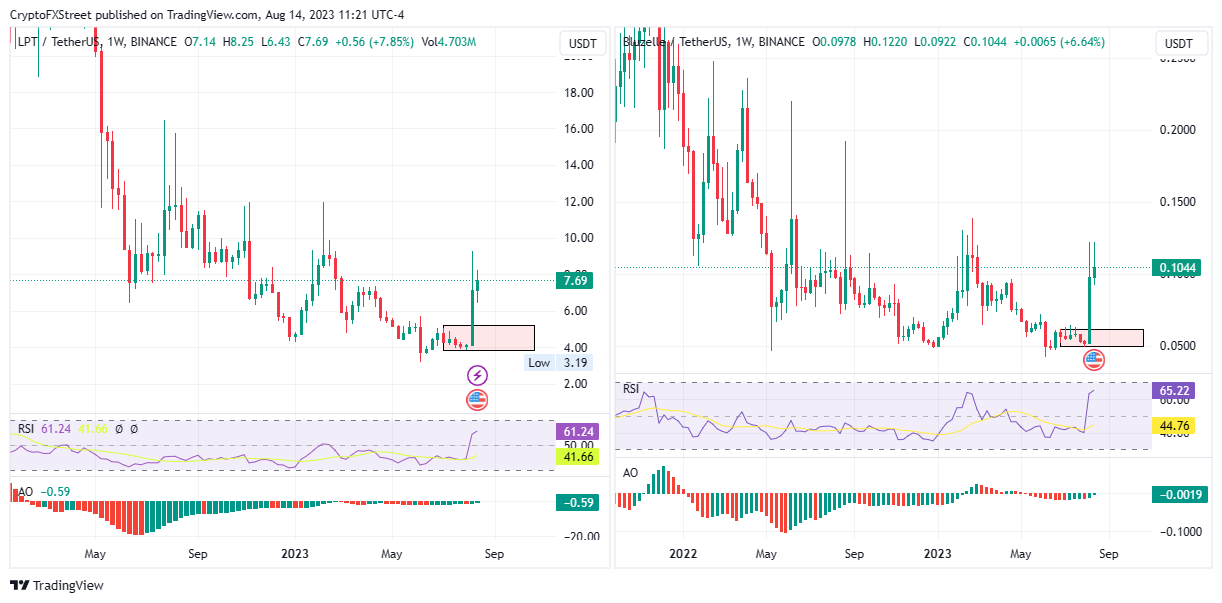
LPT/USDT 1-week chart BLZ/USDT 1-week chart
As tokens record striking rallies during the nascent stages of their deployment, traders must remain vigilant to avoid falling victim to pump-and-dump schemes. In the above cases, the altcoins’ prices could pull back to their respective weekly demand zones, where their prices would stand a chance for a correction.
On the flip side, if the demand zones fail to hold as support and LPT and BLZ prices slip through, the order blocks would be converted to bearish breakers, paving the way for further declines.
Author
Lockridge Okoth
FXStreet
Lockridge is a believer in the transformative power of crypto and the blockchain industry.