Sanctions couldn't 'pull the plug' on Tornado Cash: Chainalysis


Sanctions aimed at decentralized crypto mixer Tornado Cash weren’t able to completely cut off its usage, though it has hamstrung the service, a blockchain analytics firm has shared.
On Aug. 8, the Office of Foreign Assets Control (OFAC) announced sanctions against the crypto mixer for its role in the laundering of crime proceeds.
In a report published on Jan. 9, Chainalysis said the sanctions did have some effect, causing total inflows to the mixer to drop by 68% in the 30 days after the sanctions came into force.
However, the firm also emphasized that because Tornado Cash is a smart-contract-based decentralized platform, “no person or organization can ‘pull the plug’ as easily on Tornado Cash as they could with a centralized service.”
Chainalysis gave the example of darknet marketplace Hydra, which in contrast, saw its cryptocurrency inflows drop to zero after German police seized its servers as a result of sanctions.
Chainalysis explained that while sanctions applied to Tornado Cash saw its “front-end website taken down, its smart contracts can run indefinitely, meaning anyone can still technically use it at any time,” adding:
That suggests sanctions against decentralized services act more as a tool to disincentivize the service’s use rather than cutting off usage completely.
OFAC came down hard on Tornado Cash in Aug. 2022 due to concerns that individuals and groups had allegedly used the mixer to launder billions worth of crypto since 2019 including the $455 million stolen by the North Korea-affiliated Lazarus Group.
The agency then amended those sanctions in November as it cracked down on the platform even further for: “enabling malicious cyber activities, which ultimately support the DPRK’s [weapons of mass destruction] program.“
In its latest report, Chainalsis’ research indicated that illicit use of Tornado Cash was primarily related to crypto hacks and scams, with a rough average of 34% of all inflows being attributed to having originated from such.
While the sanctions could not stop the mixer entirely, it did effectively work to spook people away from using that platform, with total inflows dropping by 68% in the following month.
Specific figures are not given, however the chart shows that daily inflows were at times hitting nearly $25 million per day in the 30 days prior to the sanctions, and then subsequently dropped under $5 million per day in the aftermath.
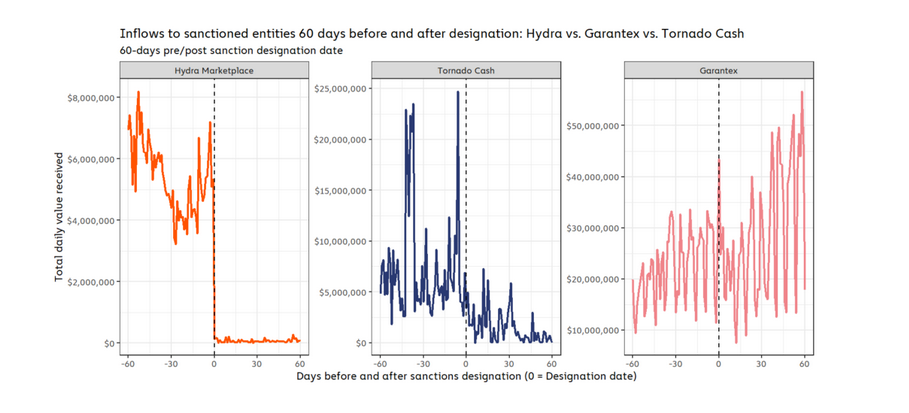
Before and after Inflows for sanctioned plaforms: Chainalysis
“Those incentives appear to have been powerful, as its inflows fell 68% in the 30 days following its designation. That’s especially important here given that Tornado Cash is a mixer, and mixers become less effective for money laundering the less funds they receive overall,” the report reads.
This week, a separate report from blockchain security firm SlowMist also gave some indications about the type of money that flowed through Tornado Cash in 2022. According to the firm’s research, 1,233,129 Ether (ETH $1,326) worth $1.62 billion was deposited into the platform last year, with 1,283,186 ETH pulled out ($1.7 billion).
Author
Cointelegraph Team
Cointelegraph
We are privileged enough to work with the best and brightest in Bitcoin.