New law grants US president power to block digital asset access


A new law grants the United States president sweeping powers to block access to digital assets, drawing significant concern from commentators on X.
Scott Johnsson, a prominent voice in the digital assets field, criticized the law for its broad scope on June 6, stating:
It’s hard to see how this isn’t intended to be a user-level ban power by the President on any protocol/smart contract that’s deemed by the Treasury Secretary to be “controlled, operated or [made] available” by a foreign sanctions violator. Breathtaking scope and implications to corral users to KYC/permissioned chains.
Senator Warner’s legislative maneuver
An X user posted Senator Mark Warner’s apparent strategic insertion of legislative elements on June 5, enabling the scrutinized new sweeping powers granted to the U.S. president over digital assets.
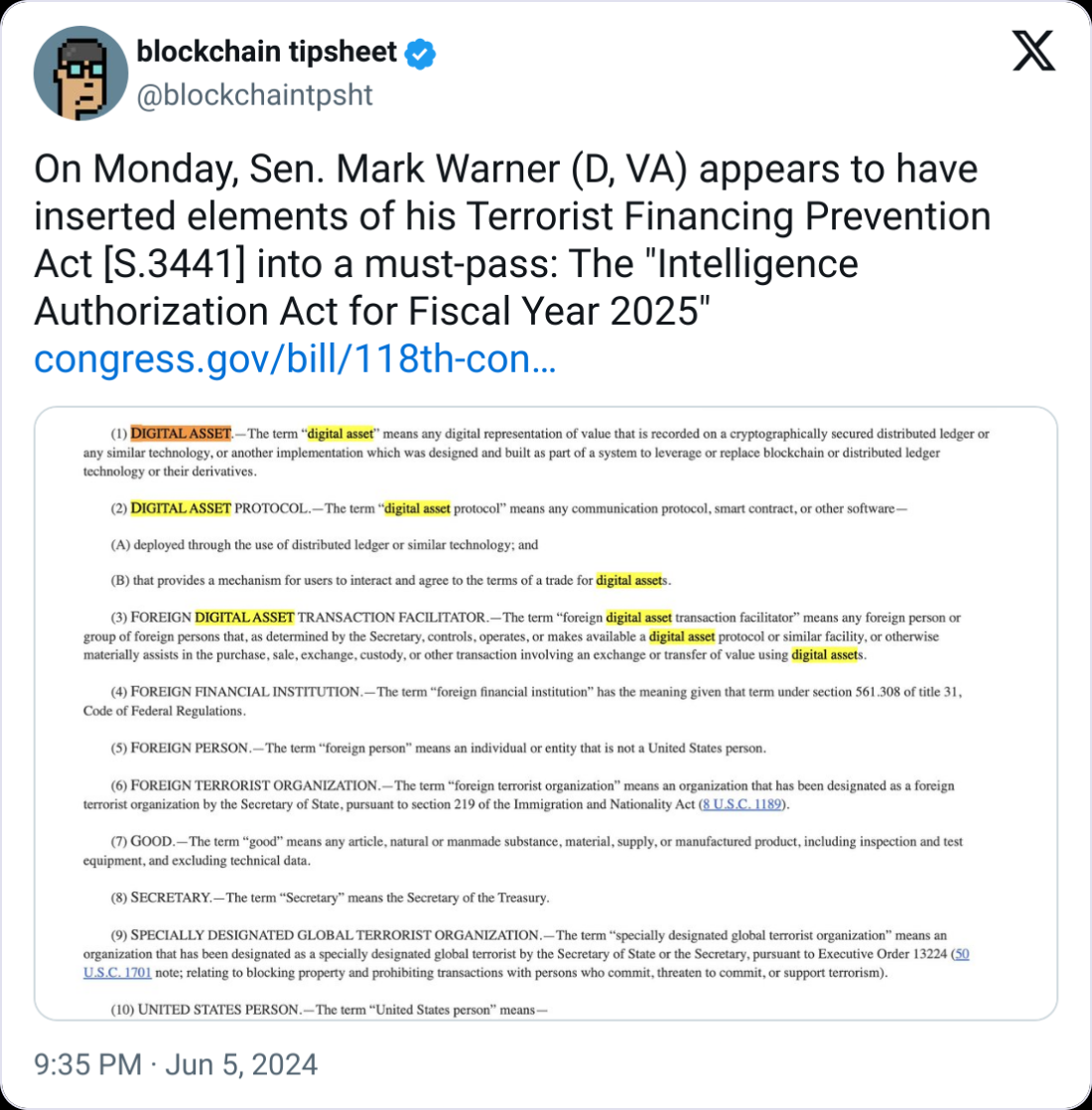
Source: Blockchain Tipsheet
The new law broadly defines “digital assets,” encompassing any digital representation of value recorded on cryptographically secured distributed ledgers.
[...] any communication protocol, smart contract, or other software [...] deployed through the use of distributed ledger or similar technology; and [...] that provides a mechanism for users to interact and agree to the terms of a trade for digital assets.
Just “Biden” time
Under the new law, the president can block transactions between U.S. persons and foreign entities identified as supporting terrorist organizations.
This includes imposing strict conditions on foreign financial institutions maintaining accounts in the U.S. if they are found facilitating such transactions.
[...] prohibit any transactions between any person subject to the jurisdiction of the United States and a foreign digital asset transaction facilitator identified under paragraph (1).
Implications for digital asset users
Johnsson’s analysis suggests that the law’s broad applicability could compel users to join Know Your Customer (KYC)-compliant and permissioned blockchain networks, ultimately limiting them to regulated blockchains.
He warns that the move could be seen as an effort to exert control over digital assets under the guise of combating terrorism.
The elements allegedly added by Warner enabling this presidential empowerment are borrowed from the Terrorism Financing Prevention Act.
The act was introduced in a December 2023 announcement, allowing the U.S. Treasury Department to go after “emerging threats involving digital assets.”
Author
Cointelegraph Team
Cointelegraph
We are privileged enough to work with the best and brightest in Bitcoin.