More than 50% of validators signal to increase ETH gas limit


Over 50% of Ethereum validators have signaled support for raising the network’s gas limit, increasing the maximum amount of gas that can be used for transactions in a single Ethereum block.
As of Feb. 4, Gaslimit.pics, which actively tracks the progress of validators’ support for a higher gas limit, shows 52% of validators are in favor, surpassing the threshold requiring at least half to agree to scale the layer 1 network.
Validators can adjust their node configurations to signal support for increasing the limit, enabling the network to scale without the need for a hard fork.
The Ethereum average gas limit has been around 30 million since August 2021, after it was increased from 15 million, according to Ycharts.
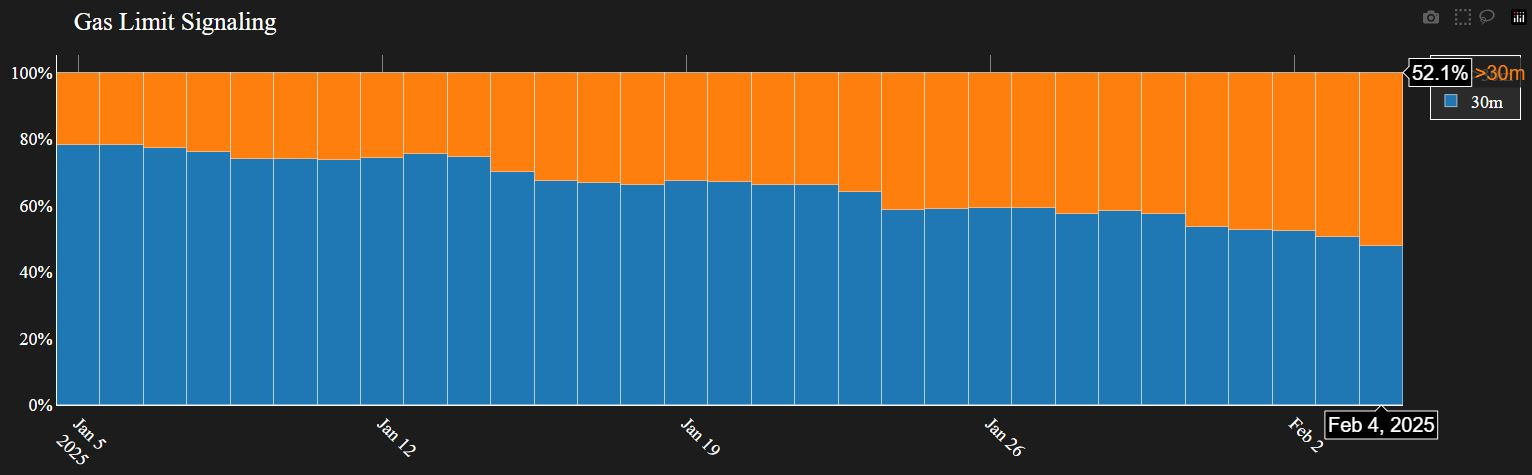
As of Feb. 4, 52% of validators are in favor of increasing the gas limit for transactions on the Ethereum blockchain. Source: Gaslimit. pics
Data on Blockscout, a multichain block explorer, shows the gas limit is already rising, with a transaction around 3 am UTC showing a gas limit of over 33 million.
Crypto commentator Evan Van Ness, the former director of operations for blockchain tech company Consensys, said in a Feb. 4 post on X that this would be the first increase under proof-of-stake after the Merge upgrade in September 2022.
“Because PoS is so much more decentralized than obsolete tech like PoW, it took longer to coordinate,” he said.
After the success of the vote, Ethereum co-founder Vitalik Buterin is calling for the Pectra fork, which is expected in March and will increase the blob target from three to six. Pectra will also be staker-voted, using the “same mechanism as the gas limit,” Buterin said.
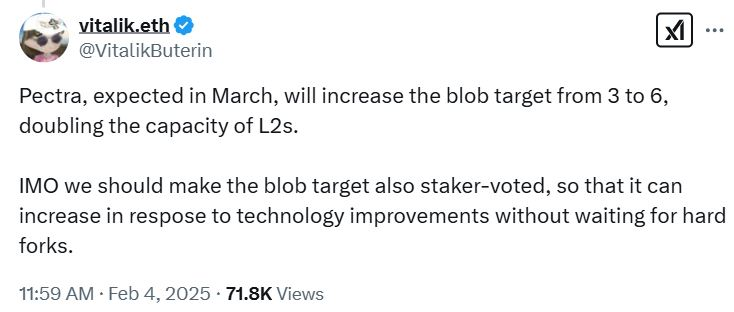
Source: Vitalik Buterin
Buterin said this will ensure the limit “can increase in response to technology improvements without waiting for hard forks.”
Prior to the successful vote, there was fierce debate in the Ethereum community.
Some advocates for the gas limit increase argued that increasing it to 36 million would enhance the L1 network’s capacity and reinvigorate innovation.
Ethereum researcher Justin Drake said last year in a Dec. 9 post on X that he would be configuring his validator for a 36 million gas limit to help safely grease the wheels.
In March, core Ethereum developer Eric Connor and former head of smart contracts at MakerDAO Mariano Conti launched a website called Pump The Gas that advocates for the gas limit to be raised to 40 million, which they said would reduce transaction fees.
However, others were concerned a raise too significant might pose risks to stability and security on the blockchain.
In a Dec. 9 post to the Ethereum Research page, the Ethereum Foundation’s Toni Wahrstätter said an increase to 60 million gas per block could result in propagation failures, missed validator slots and network destabilization.
The Pump The Gas site also acknowledged the risks, saying if raised too high, it could create a situation where the chain becomes too large for solo node operators to validate and download — but that it makes “sense to slowly increase it as time goes on.”
Author
Cointelegraph Team
Cointelegraph
We are privileged enough to work with the best and brightest in Bitcoin.