Maker, now Sky’s, new stablecoin lashed over ‘freeze function’


Decentralized finance project Maker, which has rebranded to Sky, has seen backlash over its recently upgraded stablecoin, with observers noting it will have a so-called “freeze function.”
Maker’s new stablecoin, USDS, will supposedly have a function allowing its issuer to freeze the token, some online observers noted, who added that it could bring into question the decentralization of the protocol.
“Doesn’t this completely defeat the purpose of the project? Am I missing something here?” Monad marketer “Tunez” asked his 155,000 X followers on Aug. 28.
In an Aug. 27 X post, protocol co-founder Rune Christensen clarified that there will be no freeze function at launch, just an upgrade ability, adding:
So later governance can decide how to implement something like a freeze function based on considering all data and find something that protects against as many risk factors as possible.
In a May forum post explaining new tokens that Maker is set to launch, he said that when activated, the freeze function is generally expected to “follow the rule of law from jurisdictions where Maker needs a high level of certainty that the legal system will enforce recourse against RWA [real-world asset] collateral.”
Cinneamhain Ventures partner Adam Cochran commented that this was necessary in order to back the new stablecoin by US Treasuries.
The reality is, if you want T-bill yield backing, even by secondary treasury deals, you’re going to have a freeze function and a VPN jurisdiction blocker.
Maker rebranded to Sky this week and along with it, rebranded its DAI stablecoin to USDS. The project’s website blocks access via VPNs which further fueled derision from the DeFi community.
Cochran added that the freeze function and VPN blocks were “a trade-off this industry needs to decide on.”
You can’t reap the benefits of the US TradFi system without its rule set.
Christensen said a post that claimed Phoenix Labs and Spark Protocol CEO Sam MacPherson said the new Dai would have the freeze function is misleading.
Dai will continue to function just as before, and can still be used,” he wrote. “Upgrading to USDS is optional, and it is only USDS that will have a freeze function. Dai is an immutable smart contract and cannot be altered.
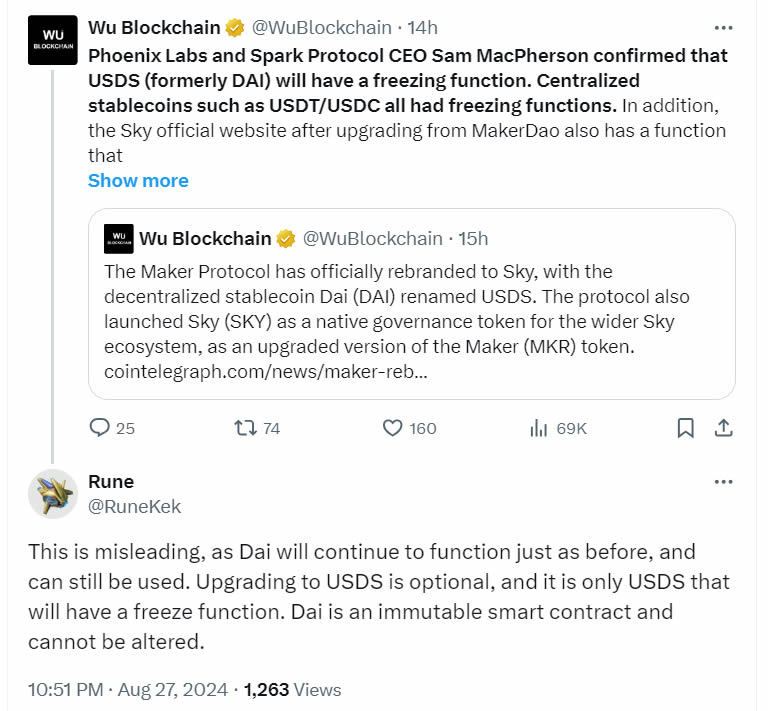
Source: Rune Christensen
Centralized stablecoins such as Tether (USDT $1.00) also have the ability to be frozen by the issuer, as demonstrated when the company locked $5.2 million worth of USDT linked to phishing scams in May.
It now appears that Maker has taken this route in order to fulfill its “Endgame” roadmap which involves backing the stablecoin with real-world assets and scaling up the supply to rival Tether.
Author
Cointelegraph Team
Cointelegraph
We are privileged enough to work with the best and brightest in Bitcoin.