Liquid staking replaces defi lending as second-largest crypto sector

Liquid staking, which allows users to earn rewards for locking cryptocurrency in a blockchain network while retaining the liquidity of the locked funds, is now bigger than decentralized lending and borrowing.
The total value of crypto assets deposited in liquid staking protocols was $14.1 billion as of European hours on Monday, making it the second-largest crypto market sector, according to data source DeFi Llama. The total value locked in the DeFi lending and borrowing protocols was $13.7 billion, the third largest, while decentralized exchanges, with deposits of $19.4 billion, held the top spot.
Ethereum's upcoming Shanghai upgrade, which will allow stakers to withdraw the ether (ETH) they have staked and the accumulated rewards for the first time, has galvanized investor interest in liquid staking. Liquid staking is the best-performing crypto sector this year, with growth in total value locked (TVL) approaching 60%.
Liquid staking, which allows users to earn rewards for locking cryptocurrency in a blockchain network while retaining the liquidity of the locked funds, is now bigger than decentralized lending and borrowing.
The total value of crypto assets deposited in liquid staking protocols was $14.1 billion as of European hours on Monday, making it the second-largest crypto market sector, according to data source DeFi Llama. The total value locked in the DeFi lending and borrowing protocols was $13.7 billion, the third largest, while decentralized exchanges, with deposits of $19.4 billion, held the top spot.
Ethereum's upcoming Shanghai upgrade, which will allow stakers to withdraw the ether (ETH) they have staked and the accumulated rewards for the first time, has galvanized investor interest in liquid staking. Liquid staking is the best-performing crypto sector this year, with growth in total value locked (TVL) approaching 60%.
"It [the upgrade] will innovate the current space by allowing for healthy competition between liquid staking solutions, will strengthen ETH's position by providing yield from staking/unstaking, and will give users the security of maintaining sovereignty over their assets," Messari CEO Ryan Selkis said in a newsletter published Friday.
By opening up to withdrawals, the upgrade is expected to improve overall liquidity. Since December 2020, more than 16.5 million ETH has been staked in Ethereum's Beacon Chain, of which 42% has been locked through liquid staking protocols, mainly Lido.
Users of liquid staking protocols like Lido receive derivative tokens such as staked ether (stETH) on a 1:1 basis. These derivative tokens represent user's stake and can be used to generate additional yield across Defi protocols. Lido's governance token LDO has rallied 220% this year, outperforming industry leaders bitcoin and ether by a huge margin. Governance tokens of Lido's rivals Rocket Pool and Frax have also surged, according to CoinDesk data.
Liquid staking's increased popularity relative to decentralized lending could also be attributed to the yield differential between the two sectors.
Lido, which controls over 75% of the liquid staking market, offers an annualized percentage return (APR) of 4.8% on staked ether, 6% on staked solana and 6.3% on Polygon's MATIC token. That's higher than the rates available for lending top stablecoins USDT, USDC and DAI on the DeFi giant Aave.
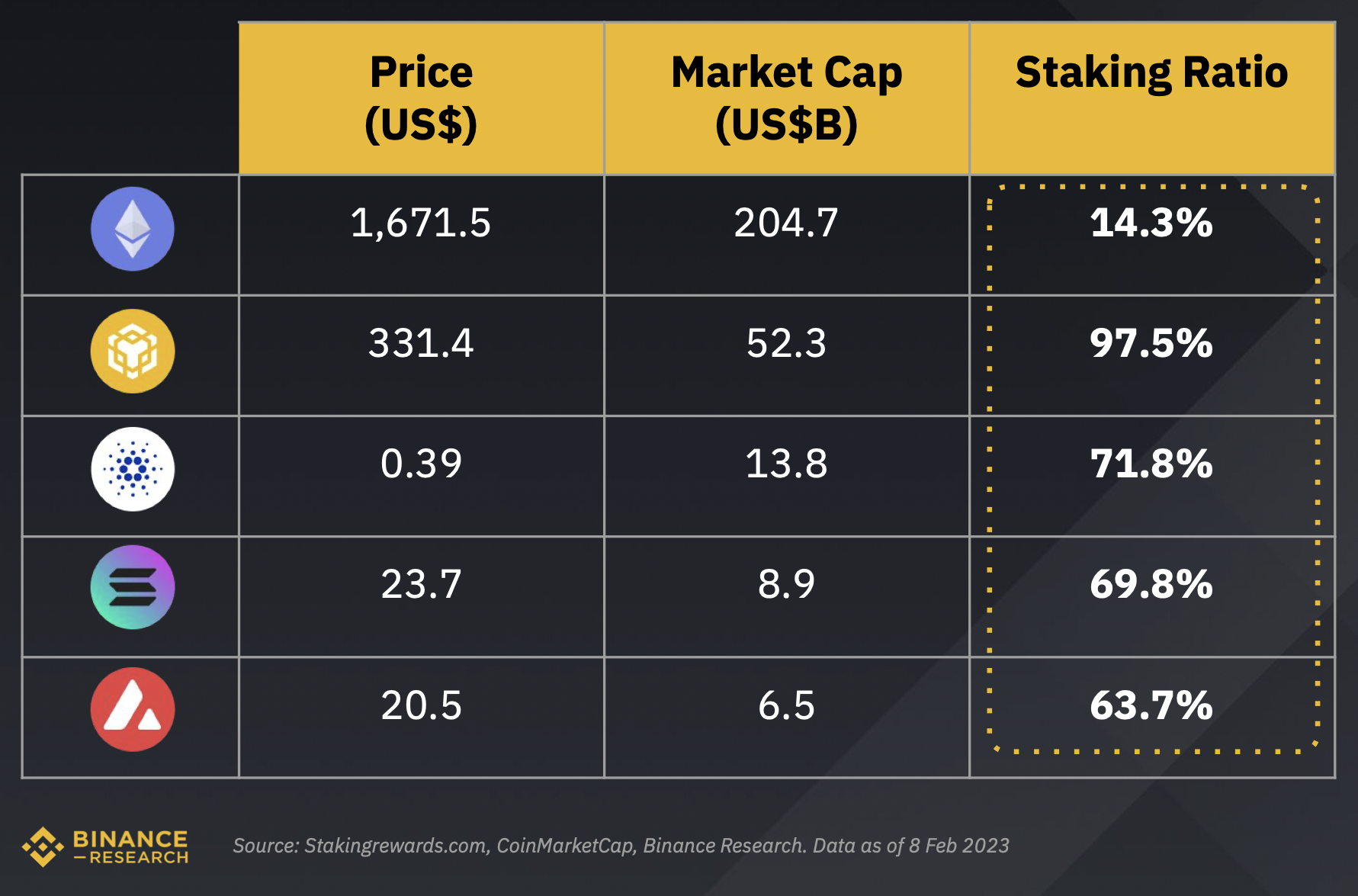
Ether staking ratio is materially lower than its. competitors. (Binance Research) (Binance Research)
Binance Research recently voiced a similar opinion, forecasting more inflow of money into staking protocols after the Shanghai upgrade.
"It could be argued that many groups of individuals had been waiting for Shanghai to stake their ETH, as withdrawals will remove the liquidity risk and uncertainty of an previously undefined lock-up period," Binance Research said in a report early this month.
Author
CoinDesk Analysis Team
CoinDesk
CoinDesk is the media platform for the next generation of investors exploring how cryptocurrencies and digital assets are contributing to the evolution of the global financial system.