First Mover Asia: China’s potential SWIFT competitor CIPS lacks reach; Bitcoin, Ether rise again

The Cross-Border Interbank Payment System has just 75 members and processes only a fraction of the transactions that SWIFT handles; most major cryptos jump even as the Russian invasion intensifies.
Good morning. Here’s what’s happening:
Markets: Cryptos continued their Monday momentum.
Insights: China's interbank payment system lacks the reach to replace SWIFT.
Technician's take: BTC buyers could remain active at lower support levels, particularly at $40K.
Prices
Bitcoin (BTC): $44,224 +2.5%
Ether (ETH): $2,959 +1.7%
Top Gainers
| Asset | Ticker | Returns | Sector |
|---|---|---|---|
| Bitcoin | BTC | +2.7% | Currency |
| Chainlink | LINK | +2.1% | Computing |
| Ethereum | ETH | +1.9% | Smart Contract Platform |
Top Losers
| Asset | Ticker | Returns | Sector |
|---|---|---|---|
| Internet Computer | ICP | −4.1% | Computing |
| Filecoin | FIL | −2.8% | Computing |
| Bitcoin Cash | BCH | −1.8% | Currency |
Bitcoin, ether and other major cryptocurrencies continued their momentum from Monday even as Russia escalated its efforts to take control of Ukraine.
On Tuesday, a 40-mile long Russian convoy of armored vehicles, tanks and towed artillery chugged relentlessly toward Kyiv. Ukraine's capital and Kharkiv, its second largest city, were rocked by rocket explosions as an estimated half-million people, including foreign nationals who study and work in Ukraine fled the country.
Cryto's performance veered markedly from equities, particularly risk-on stocks. Among the major indexes, the S&P 500 and tech-heavy Nasdaq fell 1.6% and 1.5%, respectively. A number of analysts say that the invasion has highlighted cryptos' potential usefulness for investors.
According to an estimate by Forklog, a Russian-language crypto news outlet, various organizations raising crypto for Ukraine have received over $58 million in donations over the past six days. And Arcane Research in a Tuesday report wrote that Ukrainians were "buying crypto as never before," fearful that the country's banking system "may collapse."
Meanwhile, Russian investors have been looking at crypto as a workaround to economic sanctions by the European Union and U.S. In its report, Arcane Research wrote of a "massive increase in the ruble pairs on Binance, particularly in USDT," and in bitcoin volume. The group speculated that Russians were seeking "stablecoins to get dollar exposure ahead of possible sanctions directed toward Russian crypto traders," or a result of "market makers seeking to eliminate their ruble exposure."
At the time of publication, bitcoin was trading at about $44,200, up about 3% over the past 24 hours. Ether, the second largest cryptocurrency by market cap, was changing hands at a little below $3,000, a more than 2% increase. Almost all other altcoins in the CoinDesk top 20 by market cap were trading higher with SHIB and SAND both up about 5%.
"Investors are speculating that crypto will become increasingly important as apolitical, trustless money in a time of escalating geopolitical uncertainty," Arcane Research wrote.
Markets
S&P 500: 4,306 -1.5%
DJIA: 33,294 -1.7%
Nasdaq: 13,532 -1.6%
Gold: $1,945 +1.9%
Insights
Wannabe SWIFT competitor CIPS doesn't have the reach to help Russia much
As the reality of sanctions sinks in for Russia – an energy superpower and a top-15, global economy – so do the warnings that this is a moment for China’s financial infrastructure to shine.
China’s Cross-Border Interbank Payment System (CIPS) can step up to the occasion to replace the SWIFT interbank messaging service, argued some observers, for Russian banks that are now disconnected from the world.
“When payment systems are politicized, then you have to be sure you're on the right side of the leviathan at all times,” is how one ex-VC put it in their Twitter thread.
(Unclear if the civilians in Ukraine that are being bombed think of their situation as being ‘politicized’ or have a stronger term for it.)
Despite numerous calls that these sanctions are the beginning of the twilight of dollar hegemony, China’s financial infrastructure just isn’t up to the task of replacing it.
It’s important to remember just how small CIPS really is.
Per data published on its website, the service pushed through 388 billion RMB, or $61 billion a day, for the month of February. Binance does this in turnover in less than 72 hours.
FTX will do it in 18 days.
Of course, this comparison is specious; CZ and SBF aren’t our new financial overlords. They just run exchanges. We aren’t going to pay for things in Binance’s BNB or BUSD tokens.
But the idea that CIPS could seriously compete with SWIFT is also specious when some crypto exchanges are already larger entities.
The system is still reliant on SWIFT for messaging (the bank-to-bank ledgers that show fund transfers). While CIPS can do transfers within China and Hong Kong, moving funds abroad requires SWIFT’s rails. And that’s going to make the whole operation redundant as sanctioned Russian banks can’t touch SWIFT.
So then how big is CIPS compared to SWIFT? Really, really small.
Per its own stats, SWIFT pushes through 50 million messages a day compared to CIPS 15,000. And it’s daily volume? SWIFT messages enable $5 trillion to move worldwide each day.
SWIFT counts 11,000 members as institutions. CIPS has 75 direct participants and 1205 indirect participants. There just isn’t a comparison in size and scale.
If there’s a ‘bull case’ for CIPS rocketing to the moon and taking on SWIFT there’s also a case – maybe even a stronger one – of Ripple’s RippleNet messaging service doing the same. Yes, that Ripple that’s being sued by the SEC. Its CEO recently reported on Twitter that the network is about to eclipse the $10 billion mark in volume and continues to grow.
The important thing is that the underlying currencies used on the RippleNet are liquid. China’s yuan is not. For CIPS to challenge the world, there needs to be a freely convertible currency behind it.
Technician's take
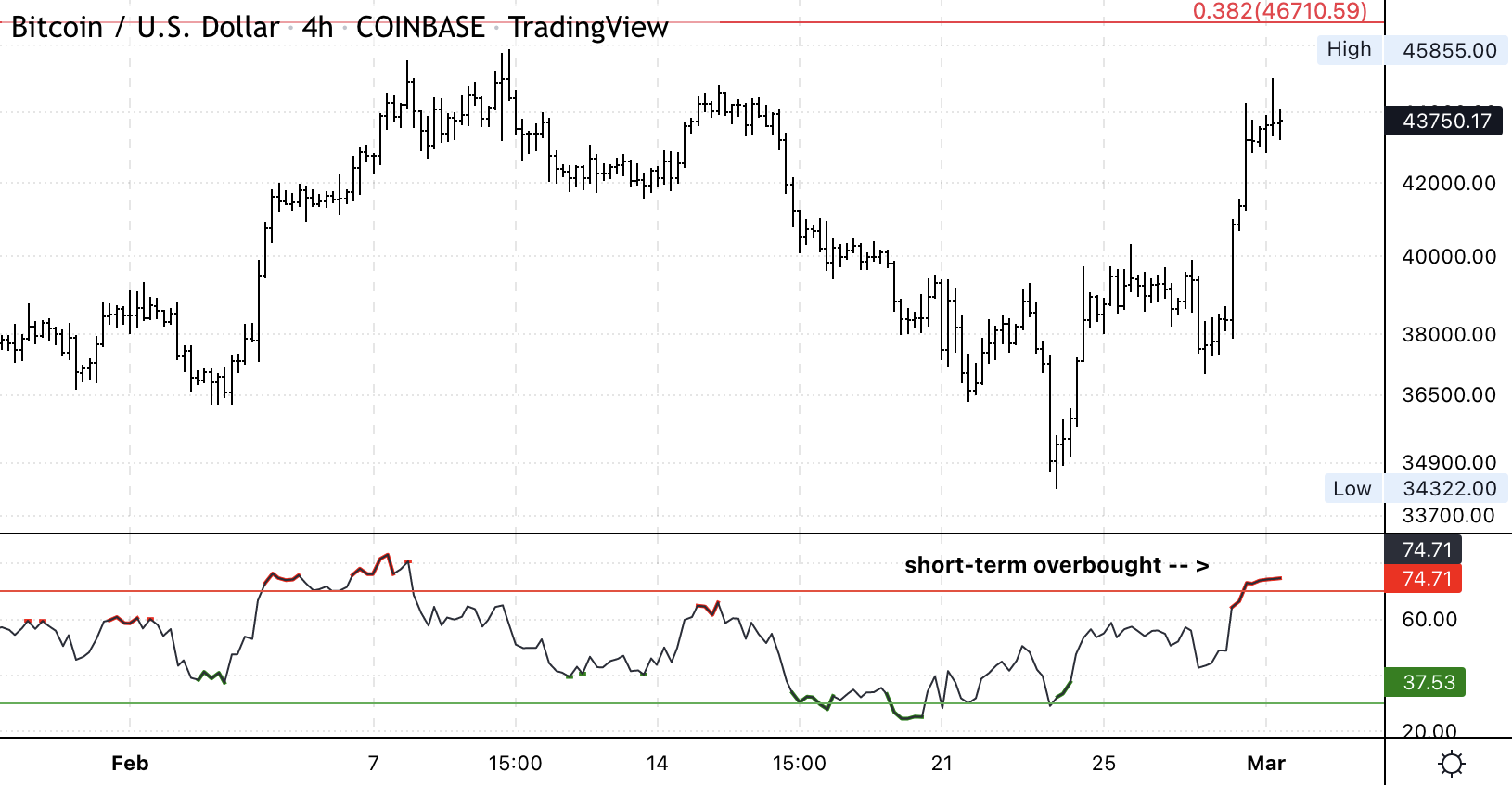
Bitcoin (BTC) rallied 13% over the past week as bearish sentiment waned. The cryptocurrency, however, faces immediate resistance at $44,000 to $46,000, which could stall the price recovery over the short term.
BTC was trading at around $43,800 at press time and is up 6% over the past 24 hours.
The relative strength index (RSI) on the four-hour chart is overbought, similar to what occurred in early February, which preceded a pullback in price. This time, however, there has been a significant loss of downside momentum, which means buyers could remain active at lower support.
For now, bitcoin is stuck in a range of between $37,000 and $46,000, pointing to a potential reversal of a three-month long downtrend. That means buying volume will need to increase on pullbacks in order to cause a shift in trends.
Important events
8:30 a.m. HKT/SGT (12:30 a.m. UTC): Australia gross domestic product (Q4/MoM/YoY)
3:45 p.m. HKT/SGT (7:45 a.m. UTC): France budget
5 p.m. HKT/SGT (9 a.m. UTC): U.S. Opec meeting
10:30 p.m. HKT/SGT (2:30 p.m. UTC): Speech by James Bullard, president of the Federal Reserve Bank of St. Louis.
Author
CoinDesk Analysis Team
CoinDesk
CoinDesk is the media platform for the next generation of investors exploring how cryptocurrencies and digital assets are contributing to the evolution of the global financial system.