Ethereum Layer 2s hit key milestone as ETH takes 4% slide
- Global Ethereum ETFs posted net outflows of $19 million.
- Ethereum Foundation sells 100 ETH for $226,868 worth of DAI following price decline.
- Ethereum Layer 2 network activity hits record highs.
- ETH could decline toward symmetry triangle support after seeing rejection around a key descending trendline.


Ethereum (ETH) is down 4% on Monday following another round of sales by the ETH Foundation, totaling 100 ETH. Meanwhile, Layer 2 networks are experiencing record highs in network activity despite the price decline.
Daily digest market movers: Ethereum ETFs outflows, ETH Foundation sells again
Spot Ethereum exchange-traded funds (ETF) globally continued their weekly outflow streak, posting $19 million in negative flows last week, per CoinShares report. US spot ETH ETFs, outweighed by Grayscale's ETHE outflow pressure, were responsible for over 67% of the flows.
Following CoinShares' report, the Ethereum Foundation sold 100 ETH for $226,868 DAI a few hours ago, per Spot On Chain. The move has taken the Foundation's total sales in the past few weeks to 650 ETH despite criticism from a few crypto community members.
Notably, ETH's price during most of the Foundation's sales have turned out to be weekly price tops. While most of its ETH sales are too small to cause a market decline, investors may be using the ETH Foundation activity as a proxy to time price tops, leading to a self-fulfilling prophecy.
Despite the Foundation's sales, crypto analyst HedgeX posted a chart on X showing that Ethereum validators reached an all-time high on Monday. Increasing validators implies growing decentralization, which is one of the key ethos of Web3.
ETH validators just hit new ATHs with even more incentives to solo stake on the way.
— Hedgex.eth (@hedge__x) September 16, 2024
ETH is the most decentralized blockchain in existence ⛓️ pic.twitter.com/xnoxTEh5tg
Meanwhile, Ethereum Layer 2s hit a record high of over $10 billion in total value locked (TVL), over 2x of Solana's TVL, per Leon Waidmann, Head of Research at Onchain Insights. Apart from TVL, the Layer 2 user base also grew more than 35x weekly to reach a high of over 10 million active addresses, per data from growthepie.
ETH Layer 2 Weekly Active Addresses
ETH technical analysis: Ethereum sees rejection around key trendline
Ethereum is trading around $2,280 on Monday, down 4% on the day. In the past 24 hours, ETH has seen nearly $61 million in liquidations, with long and short liquidations accounting for $54.76 million and $6.06 million, respectively, per Coinglass data.
Ethereum is trading within a symmetry triangle that dates back to November 2021. After seeing a rejection on Friday around a descending trendline extending from May 27, ETH is fast declining following the resumption of traditional markets on Monday.
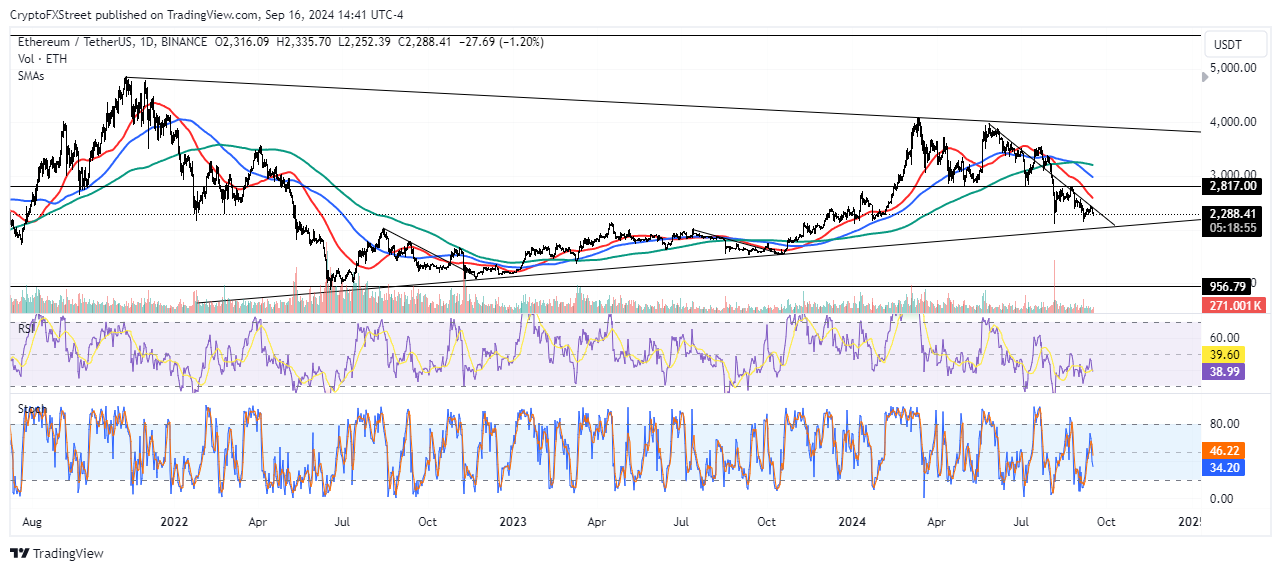
ETH/USDT Daily chart
The trendline within the symmetry triangle suggests ETH could decline toward the $2,100 to $2,200 range in the coming days. ETH posted similar declines from August to November 2022 and July to October 2023 before eventually staging a rally. ETH could see an extended rally around October or November if history repeats.
On the way up, ETH faces resistance around the 2,817 price level. A sustained move above this level could fuel bullish momentum for ETH, considering it was a critical support level for over four months before flipping into a resistance following the market crash on August 5. The 50-day, 100-day and 200-day Simple Moving Averages (SMA) also stand as potential resistance.
The Relative Strength Index (RSI) and Stochastic Oscillator (Stoch) momentum indicators are below their neutral levels, indicating prevailing bearish pressure.
A sustained move below the symmetry triangle will invalidate the thesis.
In the short term, ETH could decline to $2,261 to liquidate positions worth $24.73 million.
Cryptocurrency prices FAQs
Token launches like Arbitrum’s ARB airdrop and Optimism OP influence demand and adoption among market participants. Listings on crypto exchanges deepen the liquidity for an asset and add new participants to an asset’s network. This is typically bullish for a digital asset.
A hack is an event in which an attacker captures a large volume of the asset from a DeFi bridge or hot wallet of an exchange or any other crypto platform via exploits, bugs or other methods. The exploiter then transfers these tokens out of the exchange platforms to ultimately sell or swap the assets for other cryptocurrencies or stablecoins. Such events often involve an en masse panic triggering a sell-off in the affected assets.
Macroeconomic events like the US Federal Reserve’s decision on interest rates influence risk assets like Bitcoin, mainly through the direct impact they have on the US Dollar. An increase in interest rate typically negatively influences Bitcoin and altcoin prices, and vice versa. If the US Dollar index declines, risk assets and associated leverage for trading gets cheaper, in turn driving crypto prices higher.
Halvings are typically considered bullish events as they slash the block reward in half for miners, constricting the supply of the asset. At consistent demand if the supply reduces, the asset’s price climbs. This has been observed in Bitcoin and Litecoin.
Author
Michael Ebiekutan
FXStreet
With a deep passion for web3 technology, he's collaborated with industry-leading brands like Mara, ITAK, and FXStreet in delivering groundbreaking reports on web3's transformative potential across diverse sectors. In addi