Digital Pound could co-exist with private stablecoins – UK central bank


The United Kingdom is a step closer to launching a central bank digital currency (CBDC) after releasing a consultation paper explaining the proposed digital pound, which the public has nicknamed “Britcoin.”
The 116-page consultation paper was jointly released on Feb. 7 by the Bank of England (BoE) and the U.K. Treasury. A technology working paper was also released delving into the technical and economic design considerations.
Despite the rise of privately-issued stablecoins in recent years, the paper said that CBDCs such as the digital pound can co-exist in what they expect to be a “mixed payments economy.”
“In much the same way that cash exists alongside private money, the digital pound does not need to be a dominant form of money in order to meet its public policy objectives. The digital pound could exist alongside other forms of money, including stablecoins.”
While the BoE and the Treasury hope to have a digital pound launched by 2025 “at the earliest,” at this stage, they’re still not 100% certain that it will be launched at all.
“The Bank and HM Treasury consider a digital pound is likely to be needed in the UK though no decision to introduce one can be taken at this stage,” the paper stated.
The paper explained the primary motivator behind launching the digital pound is to ensure U.K. central bank money remains “an anchor for confidence and safety” in the country’s monetary system and to “promote innovation, choice, and efficiency in domestic payments.”
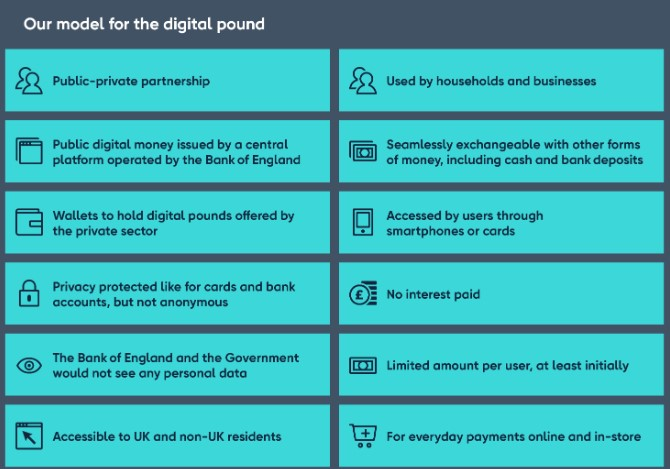
The model for the digital pound as outlined in the consultation paper. Source: Bank of England.
To achieve this feat, the e-GBP would need to be largely adopted in the retail ecosystem through a series of “public-private partnerships.”
For the digital pound to play the role that cash plays in anchoring the monetary system, it needs to be usable and sufficiently adopted by households and businesses.
Users will be able to access e-GBP by connecting to private sector-run API that in turn connects to the core ledger.
Other programmability features including smart contracts and atomic swaps — which enables assets to move across networks — will be enabled.
While the paper states the private sector would help build such infrastructure, it also considers imposing individual limits between 10,000 to 20,000 British pounds ($12,000 to $24,000) to essentially prevent its use as a savings account:
A limit on individual holdings would be intended to manage those risks by constraining the degree to which deposits could flow out of the banking system. That is important during the introductory period as we learn about the impact of the digital pound on the economy.
Privacy concerns that many in the crypto community have voiced were also acknowledged. Without going into detail, the paper stated an e-GBP would be subject to “rigorous standards” of privacy and data protection.
It further explained that users will “have at least some level of privacy” because transactions will be recorded anonymously on the core ledger.
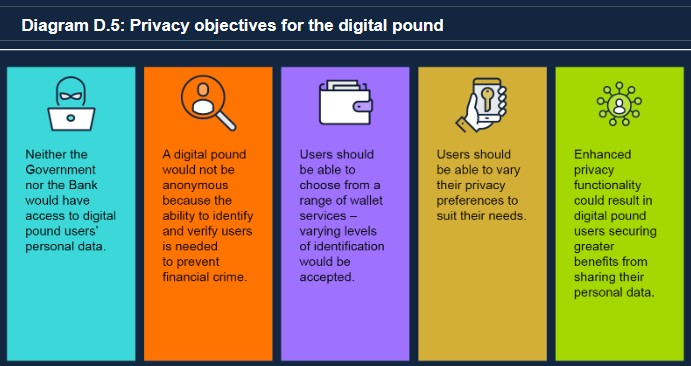
The paper said a “digital pound will not be anonymous” as user verification is needed “to prevent financial crime” but added neither the government nor the BoE would have access to personal data. Source: The Bank of England
The paper outlined, however, that an e-GBP may impact the business models of commercialized banks through what is known as “bank disintermediation” — where fewer deposits are made into commercial banks.
“The digital pound would not fundamentally alter the traditional channels of money creation, but it might affect monetary stability. [...] Bank disintermediation might affect the transmission of monetary policy to the real economy,” the consultation paper stated.
The central bank also believes the digital pound could bring about more financial inclusivity among the U.K. population.
Author
Cointelegraph Team
Cointelegraph
We are privileged enough to work with the best and brightest in Bitcoin.