Decoding the $7B decline in Bitcoin's notional open interest
-
While notional open interest has dropped, OI in BTC terms has held steady alongside positive funding rates.
-
That's a sign of renewed demand for longs amid the price dip, according to observers.

Notional open interest in Bitcoin (BTC) futures and perpetual futures, a crucial market sentiment gauge, has declined roughly 18% from $37 billion to $30.2 billion in one month, alongside a 14% slide decline in the cryptocurrency's spot market price, according to data source Coinglass.
At first glance, the data indicates that longs or bullish leveraged bets anticipating a price rise have been squared off over the past four weeks. In other words, BTC's price drop is bolstered by the unwinding of bullish bets.
That interpretation could be partially correct at best and masks the bullish undercurrents in the market.
Open interest refers to the number of active or open contracts at a given time, and notional open interest is calculated by multiplying the number of units in one contract by its current spot market price. Therefore, changes in the asset price impact notional open interest even as the total number of contracts remains steady, thereby painting a misleading picture of market activity.
That seems to be the case in the BTC market.
Per Coinglass, open interest has remained steady above the 500,000 BTC mark over four weeks. Meanwhile, perpetual funding rates charged by exchanges every eight hours have consistently held positive, indicating a bias for bullish bets.
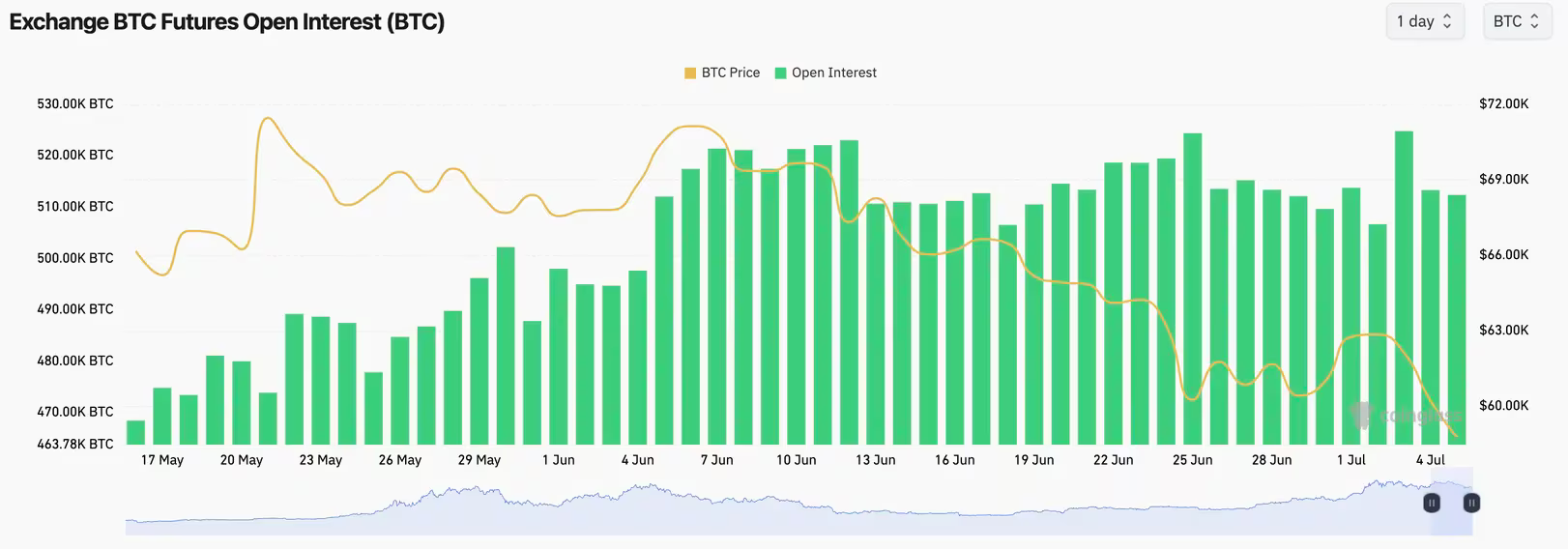
BTC futures open interest in BTC terms. (Coinglass) (Coinglass)
The combination of steady open interest in BTC terms and positive funding rates, coupled with the decline in notional open interest, suggests that some traders have been setting fresh long positions, offsetting other market participants' supposed unwinding of bullish bets.
That's a sign traders are not yet hesitating to put longs, according to Laurent Kssis, crypto ETF specialist at CEC Capital.
"This assumption is indeed correct. Also, more protection strategies are being implemented as the market remains very uncertain. Don't forget the lat liquidity washouts were decent enough to push the market down below the $60K mark. Hesitation to position long orders is still not dominating, but hedging is a rather large part of the trading."
Perhaps traders are hopeful that once the selling pressure from Mt. Gox reimbursements and miners is exhausted, bitcoin could resume the upward trend, keeping pace with the Nasdaq.
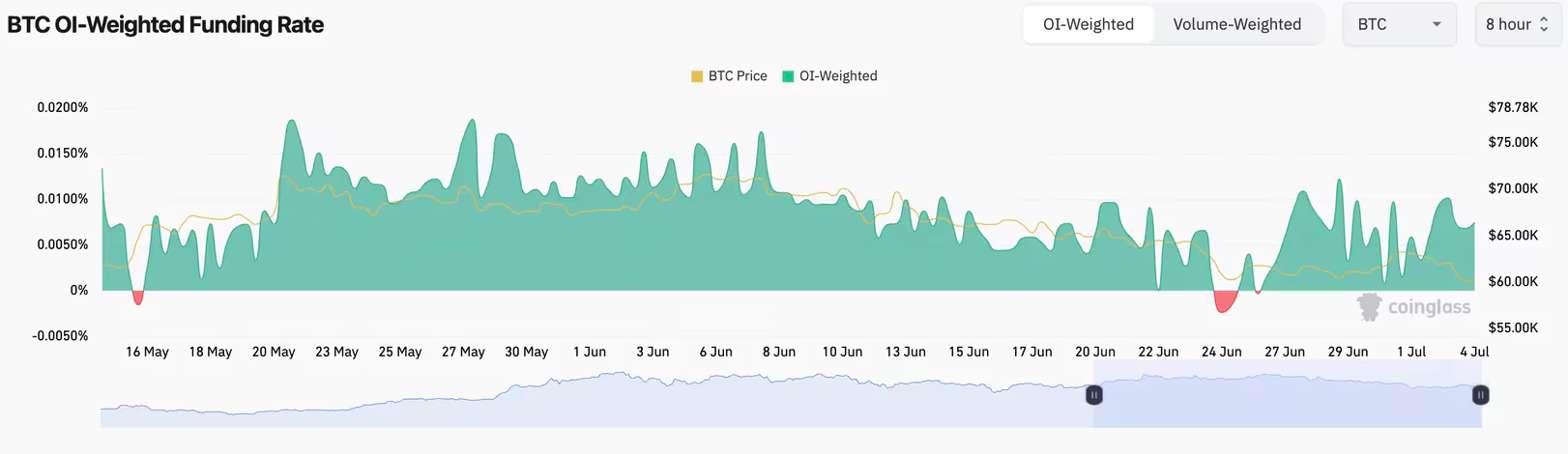
BTC OI-weighted funding rate. (Coinglass) (Coinglass)
A similar conclusion can be drawn from the consistent positive spread between futures and spot prices, widely referred to as basis.
"The basis has dipped slightly but is still attractive, so there is still demand for long positions as part of the basis trade, and expectations of a breakout are building as macro tailwinds accumulate and as the selling pressure is likely to dissipate soon, so investors could be accumulating strategic longs while funding rates are low," Noelle Acheson, author of the Crypto Is Macro Now newsletter told CoinDesk.
Activity in the spot and options market also suggests upside bias.
According to Griffin Ardern, head of options trading and research at crypto financial platform BloFin, crypto exchange Bitfinex has been the source of bullish pressure during the price dip.
"Bitfinex whales have been buying the dips [in the spot] since late June, but I haven't observed similar signals in the other derivatives market," Ardern told CoinDesk.
The margin longs on Bitfinex, which involve using borrowed funds to buy an asset in the spot market, have steadily increased since June.
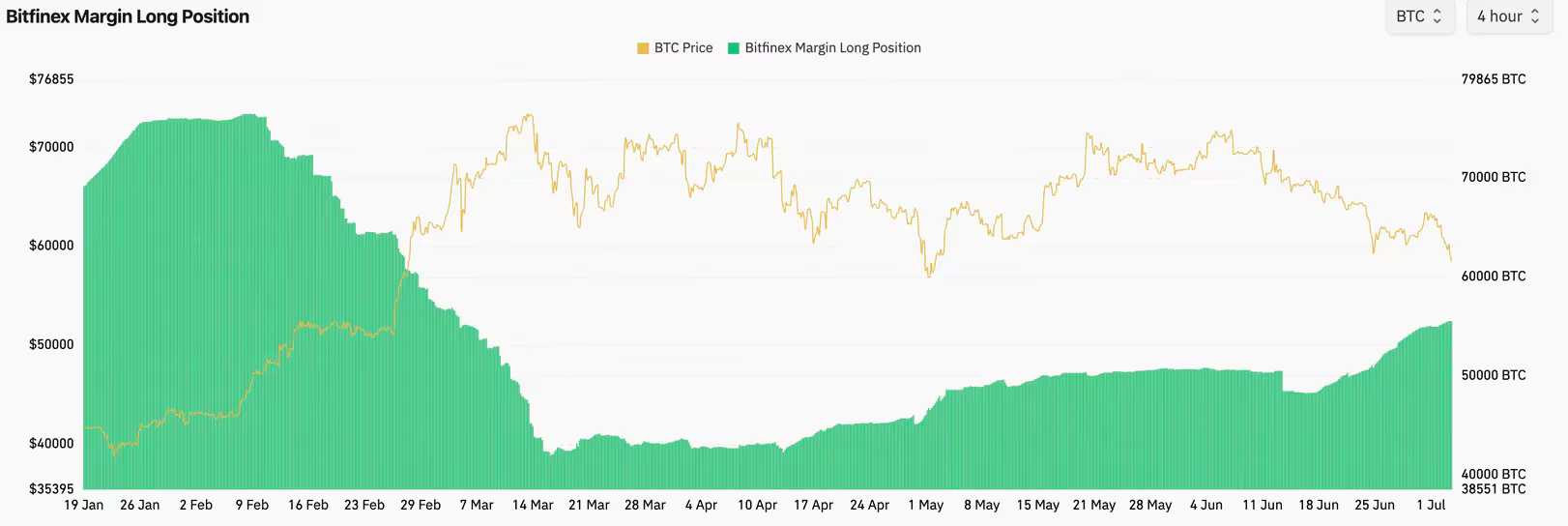
BTC's margin long positions. (Coinglass) (Coinglass)
Meanwhile, according to QCP Capital, traders have been buying topside bets in the options market.
"Despite the sell-off, the options market is still heavily skewed in favor of the topside, suggesting that the market is still anticipating a year-end rally. This aligns with the desk's observation of significant buying interest in the longer-term options at the $100K/$120 strike [calls]," QCP said in a market update on Wednesday.
Author
CoinDesk Analysis Team
CoinDesk
CoinDesk is the media platform for the next generation of investors exploring how cryptocurrencies and digital assets are contributing to the evolution of the global financial system.