Crypto sentiment index dips back to March ‘fear’ levels amid Binance lawsuit


The Crypto Fear and Greed Index — a tool that measures broader market sentiment towards Bitcoin and the broader crypto market — has dipped to a level of “fear” not witnessed since March 11 this year, when Circle’s USD coin (USDC $1.00) briefly lost its dollar-peg.
The stumble in market sentiment comes in the wake of the United States Securities and Exchange Commission (SEC) filing a lawsuit against Binance, its U.S. arm of operations and its CEO Changpeng Zhao.
The SEC pressed a total of 13 charges against the exchange and its affiliates for failing to register as a securities exchange and operating illegally in the United States.
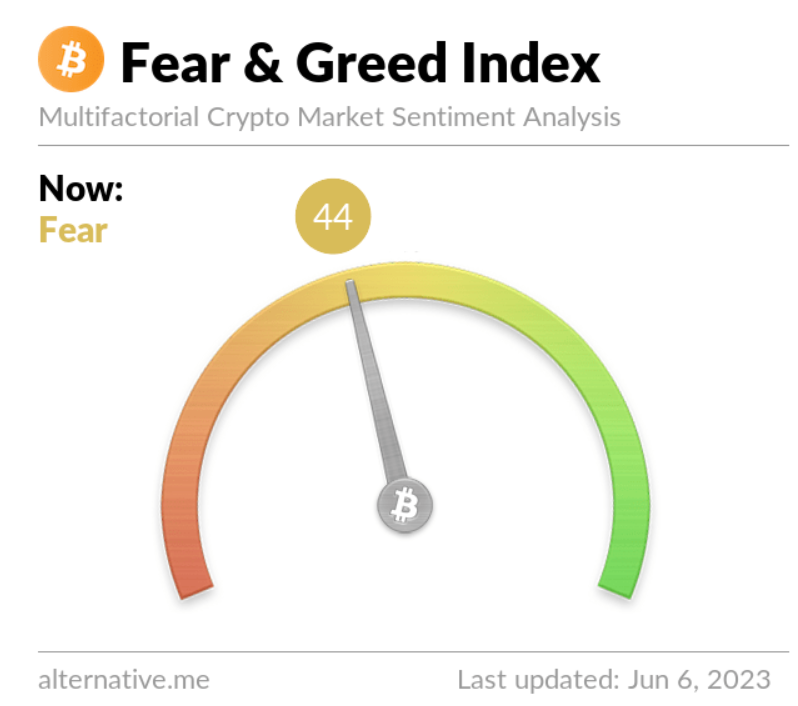
The Bitcoin Fear and Greed Index. Source: Alternative.me.
The index works by aggregating a mixture of indicators to gauge market sentiment. It combines metrics including price volatility, momentum, trading volume with data from social media and Google trends to form an overall picture of investor’s emotions towards Bitcoin and the wider crypto market.
Much of the negative sentiment owes to the immediate plunge in the value of cryptocurrencies following the SEC’s latest move against Binance. Blue-chip crypto assets such as Bitcoin and Ethereum (ETH $1,817) are down 4.1% and 3.1% respectively in the last 24 hours according to data from Cointelegraph Price Index.
The larger altcoins also took a beating. At the time of publication, Cardano (ADA $0.351) is down 6.4% in the last 24 hours while Solana (SOL $20) has fallen 7.4%.
Traders with open positions on crypto derivatives markets also suffered consequences, with more than $280 million worth of liquidations occurring since the announcement of the lawsuit.
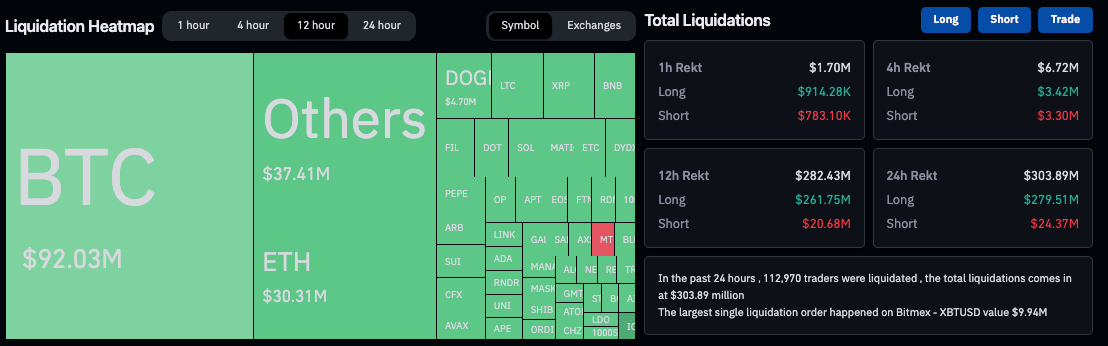
Total liquidations in the past 12 hours. Source: Coinglass.
Unsurprisingly, traders with open “long” positions — a leveraged bet on the price of crypto assets increasing — were the hardest hit, accounting for $261.75 million (92%) of the overall liquidations. Meanwhile, short traders experienced $20.7 million in liquidations. The top two digital assets were responsible for around 43% of these losses.
Author
Cointelegraph Team
Cointelegraph
We are privileged enough to work with the best and brightest in Bitcoin.