|

Chainlink price rebounding, but not a convincing commitment from traders

  • Chainlink price collapse on March 22 broke significant support.
  • Lack of buying intensity undermines credibility of the 20% rebound.
  • Pivotal resistance above will determine price direction for the next 2-3 weeks. 

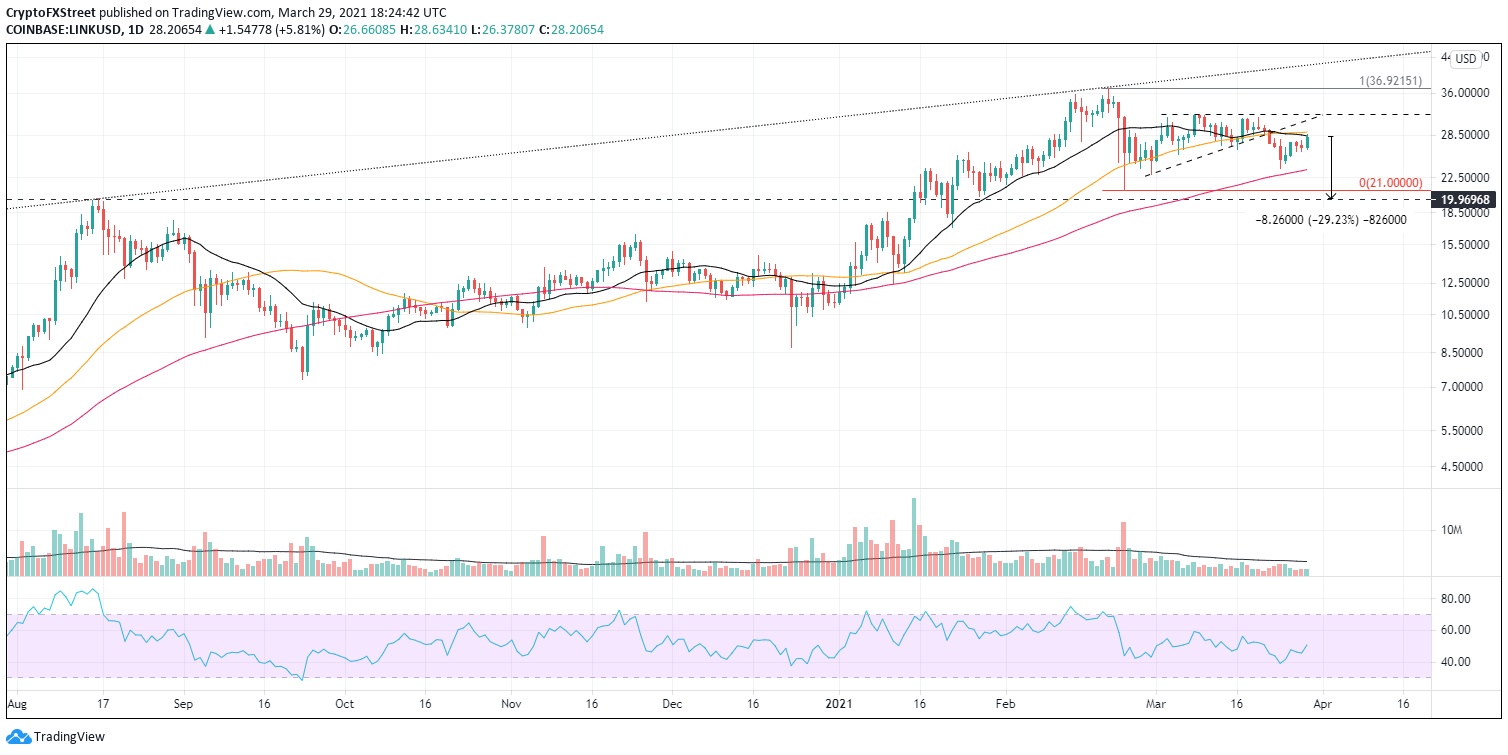
Chainlink price rebound is compromised by the down-trending 21-day simple moving average (SMA) at $28.41 and the flattening 50-day SMA at $29.03. A breakout above the confluence of moving averages requires a more outstanding commitment than daily volume running at less than half the average. For now, the 20% rebound over the last five days has to be viewed as a corrective process of the extreme oversold condition shown on the 4-hour chart on March 24.

Chainlink price follows the broader strength in the cryptocurrency complex

The tag-along advance is consistent with weaker cryptocurrencies. Still, with ample resistance just above the current price level, traders should be preparing for a reassertion of the selling to carry LINK to the 100-day SMA at $23.55, a trend-spotting indicator that has not been tested in the first days of 2021.

The February 23 crash low at $21.00 is compelling price support and will ignite a bounce, but a bearish outlook needs to entertain the August 2020 high at $20.00 as the final resting place for LINK, yielding a loss of 29% from today’s price.
LINK/USD daily chart

LINK/USD daily chart

If LINK can overcome the key moving averages’ resistance, it will empower the altcoin to test the March 9 high at $32.00. A breach will put the February 20 high at $36.92 in the crosshairs of the bulls.

Author

Sheldon McIntyre, CMT

Sheldon McIntyre, CMT

Independent Analyst

Sheldon has 24 years of investment experience holding various positions in companies based in the United States and Chile. His core competencies include BRIC and G-10 equity markets, swing and position trading and technical analysis.


More from Sheldon McIntyre, CMT
Share:

Editor's Picks

Bitcoin, Ethereum and Ripple consolidate after massive sell-off

Bitcoin, Ethereum, and Ripple prices consolidated on Monday after correcting by nearly 9%, 8%, and 10% in the previous week, respectively. BTC is hovering around $70,000, while ETH and XRP are facing rejection at key levels. Traders should be cautious: despite recent stabilization, upside recovery for these top three cryptocurrencies is capped as the broader trend remains bearish.

Ethereum: Trend Research capitulates, BitMine's Thomas Lee sees a V-shaped recovery

Ethereum had one of its sharpest historic declines over the past 10 days, shedding 40% of its value and briefly sliding below $2,000. The dip also saw ETH move below its realized price, or the average cost basis of investors — an occurrence that has historically accelerated selling pressure as investors cut losses.

Why Bitcoin and top cryptos are falling: Bitwise

The crypto market crash since October isn't down to a single factor but a combination of several, according to Bitwise CIO Matt Hougan. In a note to investors on Friday, Hougan outlined six key factors that potentially contributed to the crash that pushed down nearly every top crypto by more than 50% from prices seen over four months ago.

XRP recovery gains momentum despite retail market decline

Ripple is accelerating its recovery, trading above $1.36 at the time of writing on Friday, as investors adjust their positions following a turbulent week in the broader crypto market. The remittance token is up over 21% from its intraday low of $1.12.

Bitcoin Price Annual Forecast: BTC holds long-term bullish structure heading into 2026

Bitcoin (BTC) is wrapping up 2025 as one of its most eventful years, defined by unprecedented institutional participation, major regulatory developments, and extreme price volatility.

Bitcoin: The worst may be behind us

Bitcoin (BTC) price recovers slightly, trading at $65,000 at the time of writing on Friday, after reaching a low of $60,000 during the early Asian trading session. The Crypto King remained under pressure so far this week, posting three consecutive weeks of losses exceeding 30%.