Bitcoin's implied volatility gauge tops Ether for record 20 straight days

Bitcoin (BTC) remains the world's biggest and most liquid digital asset. Still, crypto traders are increasingly pricing higher volatility in bitcoin relative to ether (ETH), the second-largest cryptocurrency by market value.
The spread between dominant crypto options exchange Deribit's forward-looking 30-day implied volatility index for ether (ETH DVOL) and bitcoin (BTC DVOL) has been consistently negative since Sept. 7, the longest such stretch since Deribit started the DVOL indices in early 2021.
In other words, bitcoin's implied volatility (IV) has topped ether for 20 straight days. Implied volatility is an estimate of the price turbulence over a specific period based on options prices.
The spread briefly turned negative in March for the first time in nearly two years, reflecting the relative richness of BTC IV. Since then, it has become a norm in a sign of traders not looking beyond macroeconomic issues right now and being less interested in trading alternative cryptocurrencies.
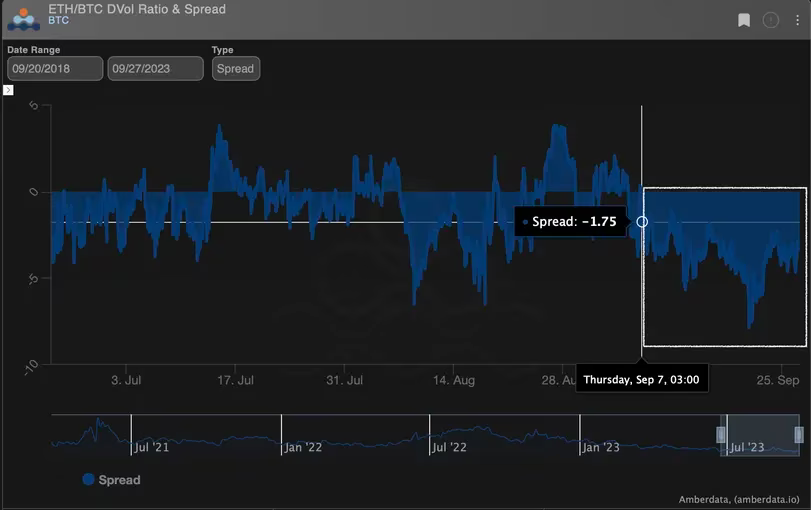
The negative spread shows traders imply a higher volatility in bitcoin relative to ether. (Amberdata)
Bitcoin has evolved as a macro asset since the coronavirus-induced crash of March 2020, consistently taking cues from the Fed policy, the U.S. fiscal and banking sector developments, and sentiment in traditional markets.
Of late, macro risks have piled up in the form of rising U.S. Treasury yields, stagflation risks, a strengthening dollar index, the lingering threat of a U.S. government shutdown and increased prospects of a deflationary crash in China, all denting the appeal of investing in risk assets, like bitcoin.
Besides, expectations for a U.S.-based spot bitcoin exchange-traded fund keep traders squarely focused on the leading cryptocurrency. Ether, meanwhile, has fallen out of favor, thanks to Ethereum's dwindling revenue and renewed inflationary tokenomics.
That said, ether may see renewed investor interest later this year when the Ethereum Improvement Proposal (EIP)-4844 goes live. The upgrade will introduce "proto-danksharding," to the Ethereum blockchain in a bid to reduce gas fees and increase transactions.
Author
CoinDesk Analysis Team
CoinDesk
CoinDesk is the media platform for the next generation of investors exploring how cryptocurrencies and digital assets are contributing to the evolution of the global financial system.