Bitcoin: Should you hold or have a trading system?

The term “HODL,” also known as “Diamond Hands” or “buy-and-hold (BNH),” first appeared in an online cryptocurrency forum in 2013 as a misspelling of the word “hold” — a typo that readers quickly adopted. HODL, or “Hold On for Dear Life,” refers to the strategy of not selling one’s digital assets, even during extreme price fluctuations. And given Bitcoin's (BTCUSD) latest bout of volatility, HODL remains relevant more than a decade later in 2025.
However, blind faith in any financial product may seem like a poor quality for an investor, especially given that Bitcoin has undergone three bear markets, with declines of 78-86% since 2011. See Figure 1 below. However, according to financial planners and analysts, it’s a rational response to a market with significant fluctuations.
Figure 1. Bitcoin’s price action since 2012 with a 4-year cycle, Elliott wave count, and our long-term system’s buy (green boxes) and sell (red boxes) signals.
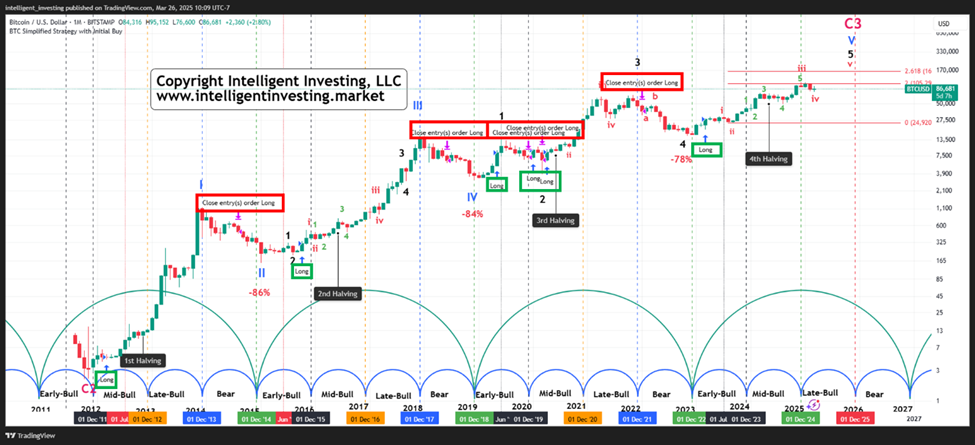
If you'd bought BTC in 2013 and held on to it, despite these three bear markets, you’d now be sitting on a substantial 7,335 to 665,590% gain, depending on when you purchased it, as the low price in 2013 was $13 and the high was $1163. Thus, when you buy is critically essential and showcases that HODL/BNH has no strategy because there is no entry or exit plan.
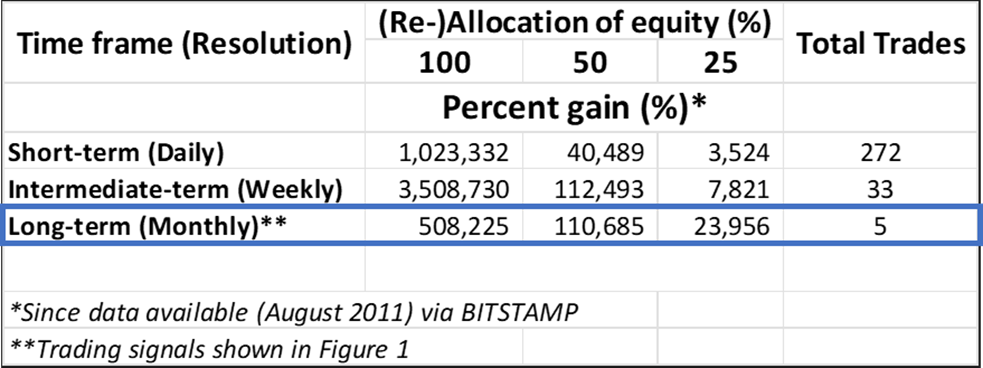
As such, let’s compare it to active position management. In this case, we will compare it to our trading systems that are featured in our Crypto Trade Alert Service. They provide our members with daily, weekly, and monthly alerts on when to buy and when to sell, ranging from short-term (Daily resolution) to long-term (monthly resolution). See Table 1 below.
Table 1. Trading system returns for different reinvestment strategies using BITSTAMP’s historical price data.
The long-term trading system’s signals are shown in Figure 1. Green boxes are when the system signaled to buy BTC, and red boxes are when it signaled to sell BTC. In total, five trades have been executed since 2012, with a sixth underway since February 28, 2023. It is currently up ~200%. Two trades were losses (-16.1% and -31.2%); three were winners (+9,480%, +1,960%, +346%). Thus, our trading systems kept losers small and allowed winners to run as any sound system should.
Additionally, the trading systems successfully navigated all three bear markets, enabling clients to weather these storms with complete confidence and maintain their cash holdings. HODLers were probably having sleepless nights, biting their nails, and yelling at their pets as their cortisol levels skyrocketed. A few months after the storms had passed, our long-term trading system resumed operation.
Moreover, Table 1 shows that
- Reinvesting profits, also known as compounding, is a crucial factor in achieving success. Our long-term system has generated returns ranging from 24 to 508 thousand percent, depending on the re-allocation level. Meanwhile, the average HODLer since 2013 has achieved ~15,000%, with the best result being a 665,590% gain and the worst result being +7,335%.
- Time in the market is essential. The longer one trades or sticks with it while compounding profits, the bigger one’s returns can be, up to a staggering 3.5 million percent since August 2011, using our weekly trading system. Yes, you read that right: 3.5 million percent.
In conclusion, Albert Einstein once said, “Compound interest is the eighth wonder of the world. He who understands it earns it; he who doesn't pays it.” Our compounding trading systems show how this simple principle works. Combined with patience, discipline, and a system with well-defined entry and exit signals, it is hard to go wrong. Jumping in and out or giving up after a few losing trades is detrimental to one’s performance. HODL, also known as Diamond Hands, and BNH appear promising on paper, with currently some tremendous potential returns. Still, without a strategy, i.e., without an exit plan and relying solely on hope, it will most likely not yield the anticipated profits that adhering to a time-tested trading system will.
Author
Dr. Arnout Ter Schure
Intelligent Investing, LLC
After having worked for over ten years within the field of energy and the environment, Dr.