Best period to invest in altcoins is 6-10 months prior to the Bitcoin halving, that's now; analyst says
- Michaël van de Poppe says it is crucial for altcoins to start moving in this period.
- According to the value-based investing and trading expert, the current jump in altcoins is attributed to VCs pumping.
- He holds that getting the funding going on altcoins has nothing to do with any change in the market environment.


CEO and founder of MN trading and value-based investing and trading expert, Michaël van de Poppe, says the bull market may be near, considering how altcoins have started to move. He bases his argument on the fact that altcoins tend to start moving when the worst period of a cycle sets in.
Best period to invest in altcoins is now
According to Michaël van de Poppe, the best period to invest in altcoins is now, as we are in the worst period of the cycle. In his opinion, altcoins have started recording massive moves.
The #Altcoins are breaking out left and right. The bull market is here.
— Michaël van de Poppe (@CryptoMichNL) September 15, 2023
It's crucial for altcoins to start moving in this period, as we're in the worst period of the cycle.
That means, the best period to invest. But why is that? Altcoins are moving massively.
Let's see. … pic.twitter.com/Zu1GL5nt61
The analyst attributes the moves by altcoins to venture capitalists (VCs), who are pumping to get the funding going on those assets. With this, Michaël van de Poppe separates any assumption that market changes may be driving altcoins.
You might want to wonder why some altcoins are making giant moves. The most obvious answer would be: 'VC's are pumping this to get the funding going on those assets and this has nothing to do with any change in market environment.
He says that this is when “the big coins start to move,” actualizing the change in the environment.
Bitcoin halving as a timer
The analyst uses the Bitcoin halving set for early 2024 (around April) as timer for investing in altcoins.
The best period to invest in altcoins is 6-10 months prior to the Bitcoin halving. That's now.
In his opinion, the last six to ten months to the Bitcoin halving is known to be the “worst period of the cycle,” with traders and investors beginning to lose their faith in the markets. In turn, the market shows ultra-bearishness with little to no return on investment (ROI).
Michaël van de Poppe uses Chainlink (LINK) to support his argument, showing how rallies are sold off after investors hodl for multiple years. Chainlink price action shows a “massive consolidation period,” characterized by minimal movement. During this time, investors think every time the price confronts resistance will translate to a “break out of a massive sideways construction.” They also anticipate the price dropping to new lows every time a new range low is triggered. On this note, he challenges that:
On both pairs, we see deviation beneath the lows, followed by a breakout upwards with the current retest holding as support.
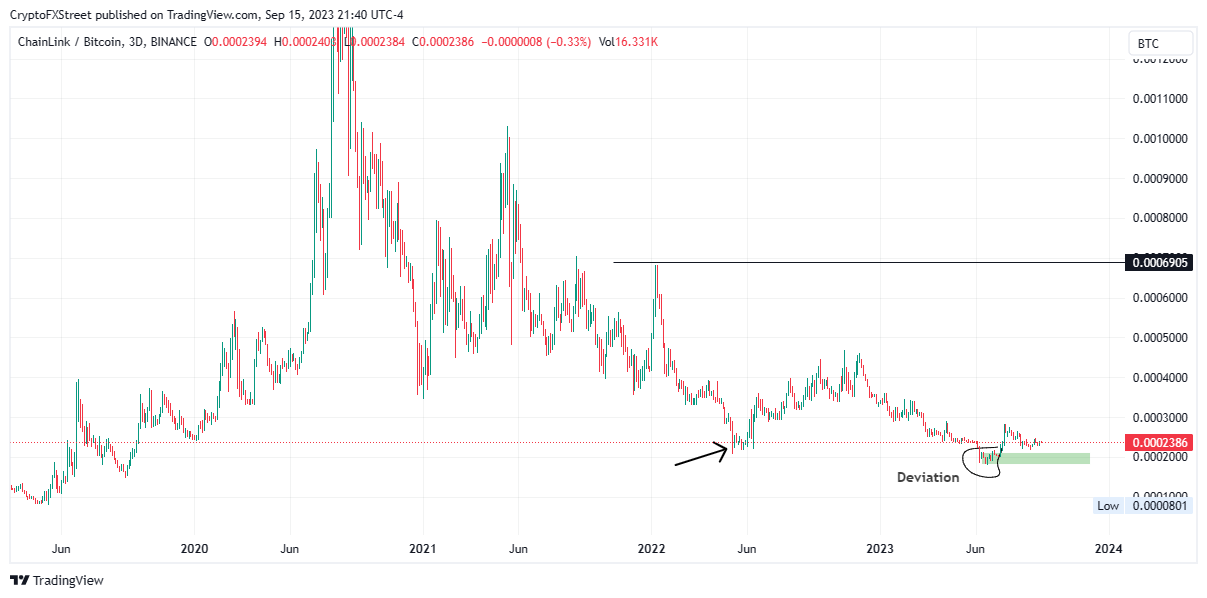
LINK/BTC 3-day chart
This, to Poppe, is a bullish indicator for continuation.
Meanwhile, some hold that during times when the market is bearish, investing on altcoins with utility is advisable as they offer actual value. Conversely, during bull markets, any coin is a plausible option to invest in as everything explodes. Still, the ones with value skyrocket.
Nevertheless, it is important to conduct one’s own research, with Poppe’s outlook leaving a lot unsaid considering altcoins are not breaking out with Bitcoin dominance still on the rise while altcoins steadily edge south.
Also Read: Alt season likely in Q3 with declining Bitcoin dominance, July emerges as altcoin month
Cryptocurrency metrics FAQs
What is circulating supply?
The developer or creator of each cryptocurrency decides on the total number of tokens that can be minted or issued. Only a certain number of these assets can be minted by mining, staking or other mechanisms. This is defined by the algorithm of the underlying blockchain technology. Since its inception, a total of 19,445,656 BTCs have been mined, which is the circulating supply of Bitcoin. On the other hand, circulating supply can also be decreased via actions such as burning tokens, or mistakenly sending assets to addresses of other incompatible blockchains.
What is market capitalization?
Market capitalization is the result of multiplying the circulating supply of a certain asset by the asset’s current market value. For Bitcoin, the market capitalization at the beginning of August 2023 is above $570 billion, which is the result of the more than 19 million BTC in circulation multiplied by the Bitcoin price around $29,600.
What is trading volume?
Trading volume refers to the total number of tokens for a specific asset that has been transacted or exchanged between buyers and sellers within set trading hours, for example, 24 hours. It is used to gauge market sentiment, this metric combines all volumes on centralized exchanges and decentralized exchanges. Increasing trading volume often denotes the demand for a certain asset as more people are buying and selling the cryptocurrency.
What is funding rate?
Funding rates are a concept designed to encourage traders to take positions and ensure perpetual contract prices match spot markets. It defines a mechanism by exchanges to ensure that future prices and index prices periodic payments regularly converge. When the funding rate is positive, the price of the perpetual contract is higher than the mark price. This means traders who are bullish and have opened long positions pay traders who are in short positions. On the other hand, a negative funding rate means perpetual prices are below the mark price, and hence traders with short positions pay traders who have opened long positions.
Author
Lockridge Okoth
FXStreet
Lockridge is a believer in the transformative power of crypto and the blockchain industry.